ICTLab, University of Science and Technology of Hanoi, Vietnam Academy of Science and Technology, 18 Hoang Quoc Viet, Cau Giay, Hanoi, Vietnam.
Sorbonne Université, IRD, UMMISCO, Unité de Modélisation Mathématiques et Informatique des Systèmes Complexes, F-93143 Bondy, France.
J Healthc Eng. 2019 Feb 4;2019:5156416. doi: 10.1155/2019/5156416. eCollection 2019.
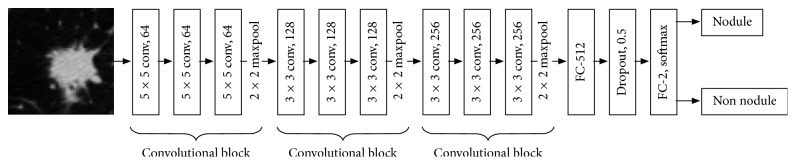
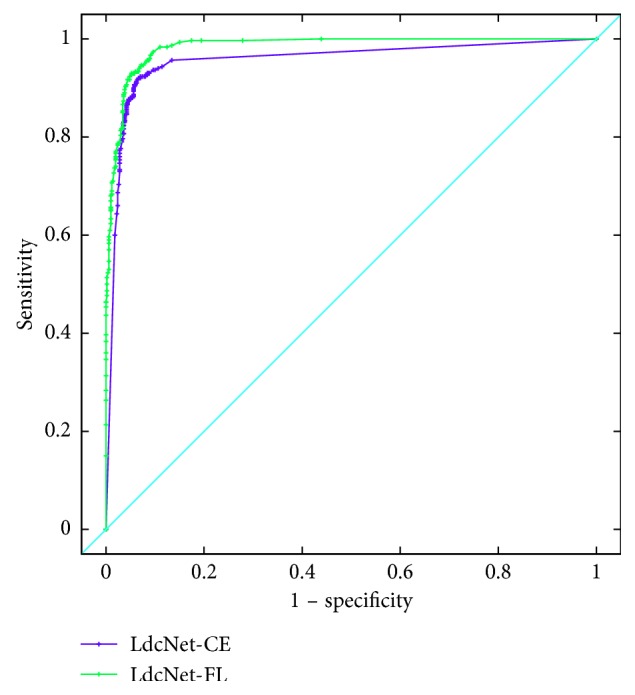
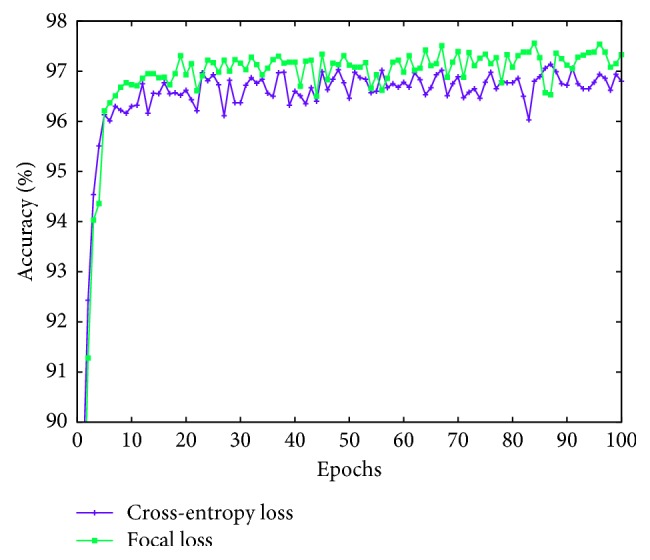
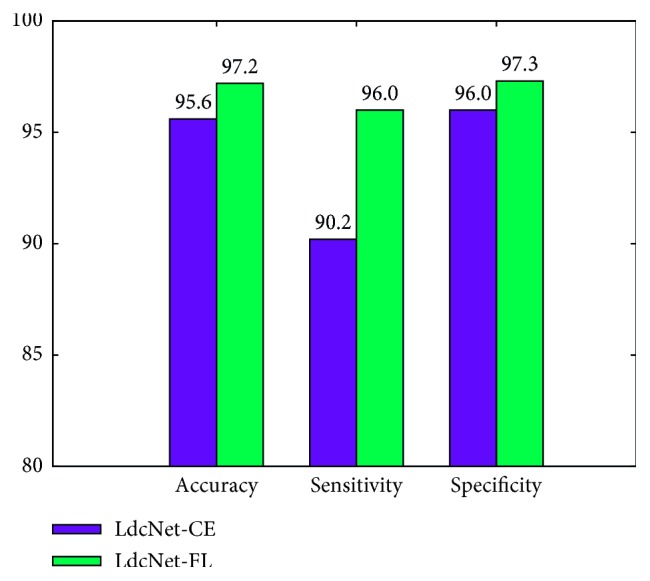
Early detection and classification of pulmonary nodules using computer-aided diagnosis (CAD) systems is useful in reducing mortality rates of lung cancer. In this paper, we propose a new deep learning method to improve classification accuracy of pulmonary nodules in computed tomography (CT) scans. Our method uses a novel 15-layer 2D deep convolutional neural network architecture for automatic feature extraction and classification of pulmonary candidates as nodule or nonnodule. Focal loss function is then applied to the training process to boost classification accuracy of the model. We evaluated our method on the LIDC/IDRI dataset extracted by the LUNA16 challenge. The experiments showed that our deep learning method with focal loss is a high-quality classifier with an accuracy of 97.2%, sensitivity of 96.0%, and specificity of 97.3%.
利用计算机辅助诊断(CAD)系统早期发现和分类肺结节有助于降低肺癌死亡率。在本文中,我们提出了一种新的深度学习方法,以提高计算机断层扫描(CT)扫描中肺结节的分类准确性。我们的方法使用了一种新颖的 15 层 2D 深度卷积神经网络架构,用于自动提取和分类作为结节或非结节的肺候选者。然后,在训练过程中应用焦点损失函数来提高模型的分类准确性。我们在 LUNA16 挑战赛提取的 LIDC/IDRI 数据集上评估了我们的方法。实验表明,我们的具有焦点损失的深度学习方法是一种高质量的分类器,准确率为 97.2%,灵敏度为 96.0%,特异性为 97.3%。