Allergy Immunology and Cell Biology Unit, Department of Immunology and Molecular Medicine, University of Sri Jayewardenepura, Nugegoda, Sri Lanka.
Colombo Municipal Council, Colombo, Sri Lanka.
PLoS One. 2021 Nov 8;16(11):e0257548. doi: 10.1371/journal.pone.0257548. eCollection 2021.
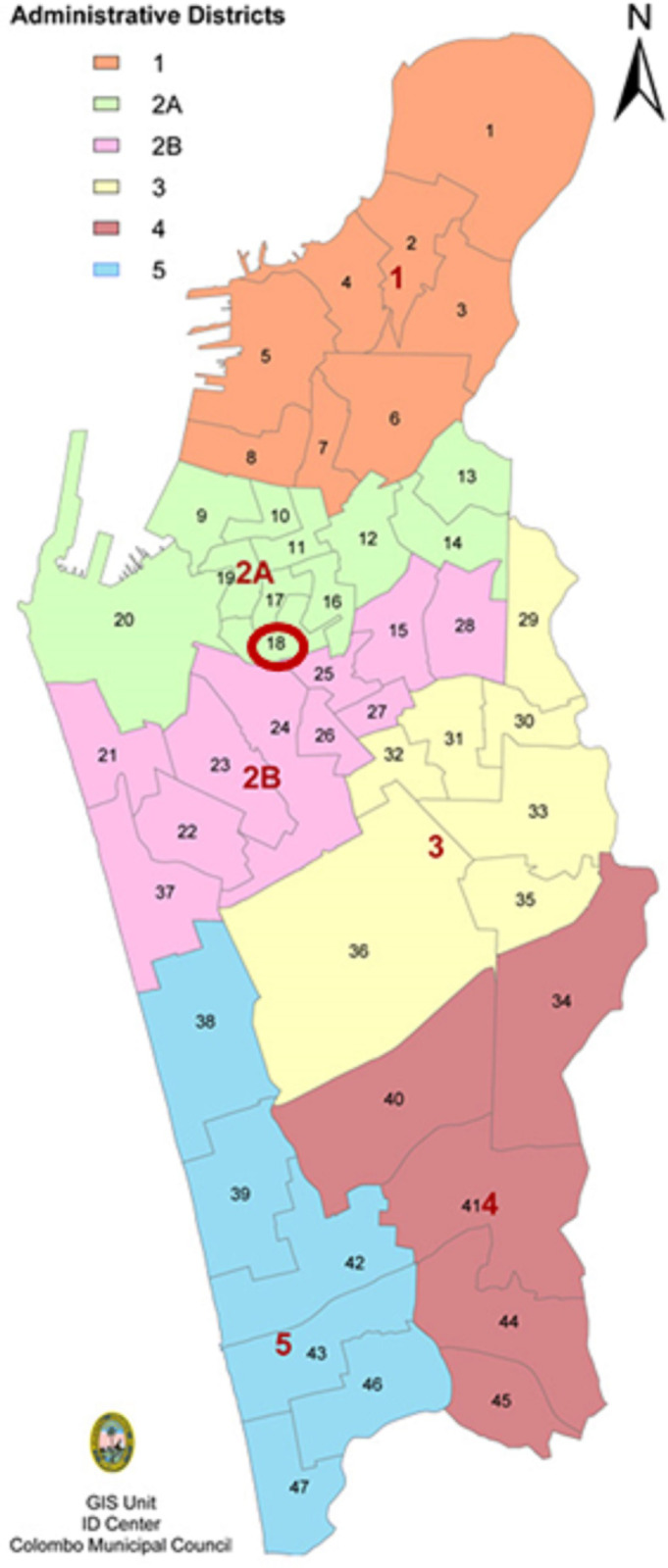
The transmission dynamics of SARS-CoV-2 varies depending on social distancing measures, circulating SARS-CoV-2 variants, host factors and other environmental factors. We sought to investigate the clinical and epidemiological characteristics of a SARS-CoV-2 outbreak that occurred in a highly dense population area in Colombo, Sri Lanka from April to May 2020.
METHODOLOGY/PRINCIPAL FINDINGS: We carried out RT-qPCR for SARS-CoV2, assessed the SARS-CoV-2 specific total and neutralizing antibodies (Nabs) in a densely packed, underserved settlement (n = 2722) after identification of the index case on 15th April 2020. 89/2722 individuals were detected as infected by RT-qPCR with a secondary attack rate among close contacts being 0.077 (95% CI 0.063-0.095). Another 30 asymptomatic individuals were found to have had COVID-19 based on the presence of SARS-CoV-2 specific antibodies. However, only 61.5% of those who were initially seropositive for SARS-CoV-2 had detectable total antibodies at 120 to 160 days, while only 40.6% had detectable Nabs. 74/89 (83.1%) of RT-qPCR positive individuals were completely asymptomatic and all 15 (16.9%) who experienced symptoms were classified as having a mild illness. 18 (20.2%) were between the ages of 61 to 80. 11/89 (12.4%) had diabetes, 8/89 (9%) had cardiovascular disease and 4 (4.5%) had asthma. Of the two viruses that were sequenced and were of the B.1 and B.4 lineages with one carrying the D614G mutation.
DISCUSSION/CONCLUSION: Almost all infected individuals developed mild or asymptomatic illness despite the presence of comorbid illnesses. Since the majority of those who were in this underserved settlement were not infected despite circulation of the D614G variant, it would be important to further study environmental and host factors that lead to disease severity and transmission.
SARS-CoV-2 的传播动力学因社交距离措施、循环中的 SARS-CoV-2 变体、宿主因素和其他环境因素而有所不同。我们试图调查 2020 年 4 月至 5 月在斯里兰卡科伦坡人口稠密地区发生的 SARS-CoV-2 暴发的临床和流行病学特征。
方法/主要发现:我们对 SARS-CoV2 进行了 RT-qPCR 检测,并在 2020 年 4 月 15 日发现首例病例后,对一个人口稠密、服务不足的定居点(n = 2722)中的 SARS-CoV-2 特异性总抗体和中和抗体(Nabs)进行了评估。有 89/2722 人通过 RT-qPCR 检测出感染,密切接触者的二次攻击率为 0.077(95%CI 0.063-0.095)。另有 30 名无症状个体根据存在 SARS-CoV-2 特异性抗体被诊断为 COVID-19。然而,在 120 至 160 天内,只有 61.5%最初 SARS-CoV-2 血清阳性者的总抗体可检测到,而只有 40.6%的人可检测到 Nabs。89 名 RT-qPCR 阳性者中有 74 名(83.1%)完全无症状,所有 15 名(16.9%)出现症状者均被归类为轻症。18 名(20.2%)年龄在 61 至 80 岁之间。11/89(12.4%)患有糖尿病,8/89(9%)患有心血管疾病,4 名(4.5%)患有哮喘。测序的两种病毒属于 B.1 和 B.4 谱系,其中一种携带 D614G 突变。
讨论/结论:尽管存在合并症,但几乎所有感染个体均出现轻度或无症状疾病。由于该服务不足的定居点中的大多数人尽管存在 D614G 变体的传播,但并未感染,因此进一步研究导致疾病严重程度和传播的环境和宿主因素非常重要。