Warren Alpert Medical School of Brown University, Providence, RI, USA.
Department of Imaging & Imaging Sciences, Johns Hopkins University School of Medicine, Baltimore, MD, USA.
Nat Rev Endocrinol. 2022 Feb;18(2):81-95. doi: 10.1038/s41574-021-00543-9. Epub 2021 Nov 9.
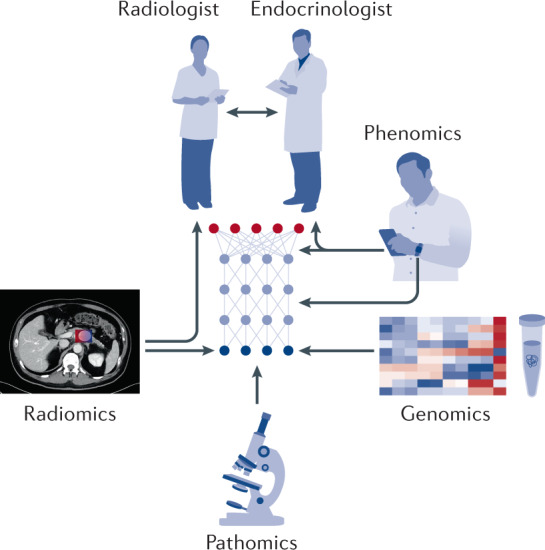
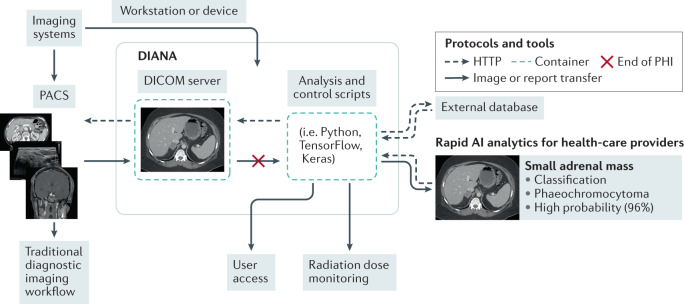
Artificial intelligence (AI) has illuminated a clear path towards an evolving health-care system replete with enhanced precision and computing capabilities. Medical imaging analysis can be strengthened by machine learning as the multidimensional data generated by imaging naturally lends itself to hierarchical classification. In this Review, we describe the role of machine intelligence in image-based endocrine cancer diagnostics. We first provide a brief overview of AI and consider its intuitive incorporation into the clinical workflow. We then discuss how AI can be applied for the characterization of adrenal, pancreatic, pituitary and thyroid masses in order to support clinicians in their diagnostic interpretations. This Review also puts forth a number of key evaluation criteria for machine learning in medicine that physicians can use in their appraisals of these algorithms. We identify mitigation strategies to address ongoing challenges around data availability and model interpretability in the context of endocrine cancer diagnosis. Finally, we delve into frontiers in systems integration for AI, discussing automated pipelines and evolving computing platforms that leverage distributed, decentralized and quantum techniques.
人工智能(AI)为不断发展的医疗保健系统指明了清晰的道路,该系统具有增强的精度和计算能力。通过机器学习可以增强医学成像分析,因为成像产生的多维数据自然适合分层分类。在这篇综述中,我们描述了机器智能在基于图像的内分泌癌诊断中的作用。我们首先简要概述了人工智能,并考虑了其直观地纳入临床工作流程的方式。然后,我们讨论了如何应用人工智能来描述肾上腺、胰腺、垂体和甲状腺肿块,以帮助临床医生进行诊断解读。这篇综述还提出了一些机器学习在医学中的关键评估标准,医生可以在评估这些算法时使用这些标准。我们确定了缓解策略,以解决内分泌癌诊断中数据可用性和模型可解释性方面的持续挑战。最后,我们深入探讨了 AI 系统集成的前沿领域,讨论了利用分布式、去中心化和量子技术的自动化管道和不断发展的计算平台。