Kim Ho-Yeon, Choi Juho, Lim Hyun-Mook, Park Chamjin, Hong Yun-Chul
Department of Preventive Medicine, Seoul National University, College of Medicine, Seoul, Korea.
Institute of Environmental Medicine, Seoul National University Medical Research Center, Seoul, Korea.
Ann Occup Environ Med. 2021 Mar 29;33:e9. doi: 10.35371/aoem.2021.33.e9. eCollection 2021.
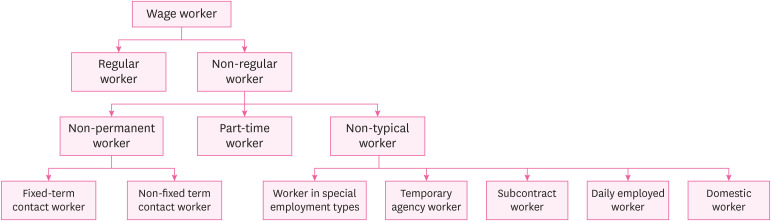
Non-regular workers are steadily increasing on account of improving corporate productivity. They are classified as non-permanent, part-time, or non-typical workers. Non-regular work has a negative impact on workers' physical and mental health. This study analyzed the relationship between non-permanent, part-time and non-typical work and insomnia among Korean wage workers, and investigated the differences and interactions between different work patterns.
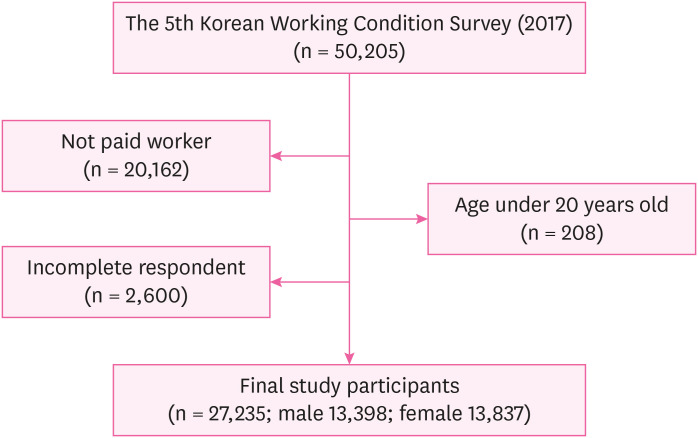
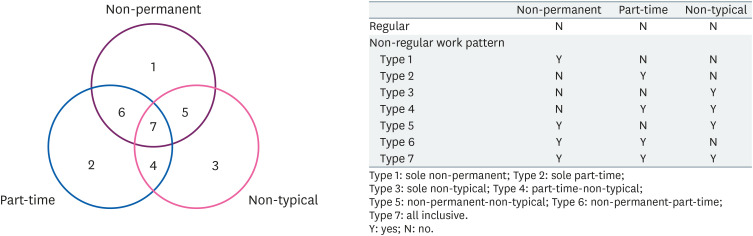
The Fifth Korean Working Conditions Survey was used in this study. Non-regular work patterns were classified into 7 types: type 1, sole non-permanent; type 2, sole part-time; type 3, sole non-typical; type 4, part-time-non-typical; type 5, non-permanent-non-typical; type 6, non-permanent-part-time; type 7, all inclusive. Insomnia was measured on a scale from "normal sleep" to "insomnia" based on the 3-item Minimal Insomnia Symptom Scale. Multiple logistic regression was used to analyze the association between non-regular work patterns and insomnia among wage workers.
After multivariate adjustment, a significantly increased odds ratio (OR) for insomnia was found in types 1, 2, 3, 4, 5, 6, and 7 of non-regular work patterns compared to regular work patterns. After stratification for shift and night work, the OR of the group with shift and night work was higher than that of the group without shift and night work.
Insomnia was significantly associated with non-regular work patterns. This association was prominent in workers with shifts and night work. This finding suggests that proper work patterns may be needed to reduce the risk of insomnia among Korean wage workers and workers who initially had insomnia should consider these results before placement.
由于企业生产率提高,非正规工人数量在稳步增加。他们被归类为非长期工、临时工或非典型工人。非正规工作对工人的身心健康有负面影响。本研究分析了韩国工薪阶层中,非长期工、临时工和非典型工作与失眠之间的关系,并调查了不同工作模式之间的差异和相互作用。
本研究使用了第五次韩国工作条件调查。非正规工作模式分为7种类型:类型1,单纯非长期工;类型2,单纯临时工;类型3,单纯非典型工;类型4,临时工-非典型工;类型5,非长期工-非典型工;类型6,非长期工-临时工;类型7,全部包含。根据3项简易失眠症状量表,从“正常睡眠”到“失眠”对失眠进行测量。采用多元逻辑回归分析工薪阶层中非正规工作模式与失眠之间的关联。
多变量调整后,与正规工作模式相比,在非正规工作模式的类型1、2、3、4、5、6和7中,发现失眠的优势比(OR)显著增加。在对轮班和夜班工作进行分层后,轮班和夜班工作组的OR高于无轮班和夜班工作组。
失眠与非正规工作模式显著相关。这种关联在轮班和夜班工作的工人中尤为突出。这一发现表明,可能需要适当的工作模式来降低韩国工薪阶层失眠的风险,并且最初患有失眠的工人在就业前应考虑这些结果。