Unnikrishnan Kavitha, Thomas Lynda Velutheril, Ram Kumar Ram Mohan
Department of Cancer Research, Rajiv Gandhi Center for Biotechnology, Thiruvananthapuram, India.
Division of Tissue Engineering & Regenerative Technology, Sree Chitra Thirunal Institute of Medical Sciences and Technology, Thiruvananthapuram, India.
Front Oncol. 2021 Oct 25;11:733652. doi: 10.3389/fonc.2021.733652. eCollection 2021.
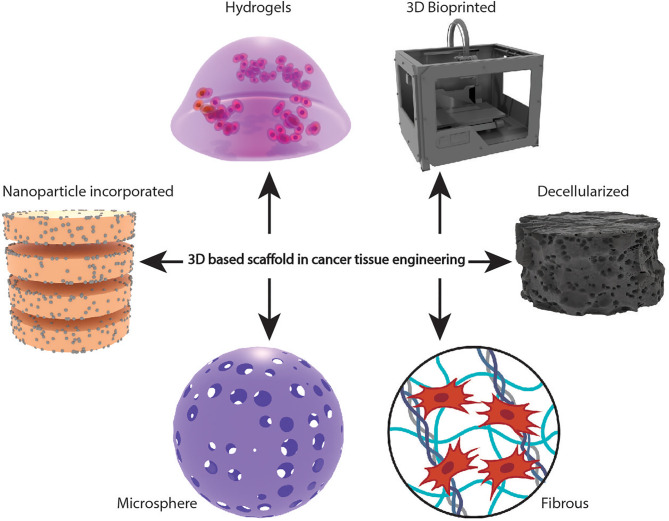
The lack of traditional cancer treatments has resulted in an increased need for new clinical techniques. Standard two-dimensional (2D) models used to validate drug efficacy and screening have a low - translation potential. Recreating the tumor microenvironment at the three-dimensional (3D) level is essential to resolve these limitations in the 2D culture and improve therapy results. The physical and mechanical environments of 3D culture allow cancer cells to expand in a heterogeneous manner, adopt different phenotypes, gene and protein profiles, and develop metastatic potential and drug resistance similar to human tumors. The current application of 3D scaffold culture systems based on synthetic polymers or selected extracellular matrix components promotes signalling, survival, and cancer cell proliferation. This review will focus on the recent advancement of numerous 3D-based scaffold models for cancer tissue engineering, which will increase the predictive ability of preclinical studies and significantly improve clinical translation.
传统癌症治疗方法的匮乏导致对新临床技术的需求不断增加。用于验证药物疗效和筛选的标准二维(2D)模型的转化潜力较低。在三维(3D)水平上重建肿瘤微环境对于解决二维培养中的这些局限性并改善治疗效果至关重要。3D培养的物理和机械环境使癌细胞能够以异质性方式生长,呈现不同的表型、基因和蛋白质谱,并产生与人类肿瘤相似的转移潜能和耐药性。目前基于合成聚合物或选定细胞外基质成分的3D支架培养系统的应用促进了信号传导、细胞存活和癌细胞增殖。本综述将聚焦于众多基于3D的癌症组织工程支架模型的最新进展,这将提高临床前研究的预测能力并显著改善临床转化。