Singh Jashan P, Young Jennifer L
Mechanobiology Institute, National University of Singapore, 117411 Singapore, Singapore.
Department of Biomedical Engineering, National University of Singapore, 117575 Singapore, Singapore.
Biophys Rev. 2021 Aug 31;13(5):625-636. doi: 10.1007/s12551-021-00834-5. eCollection 2021 Oct.
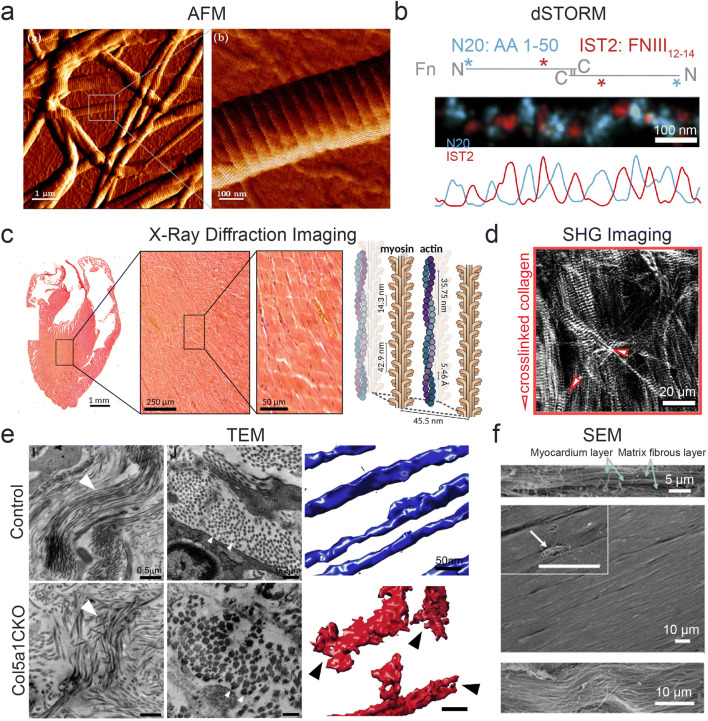
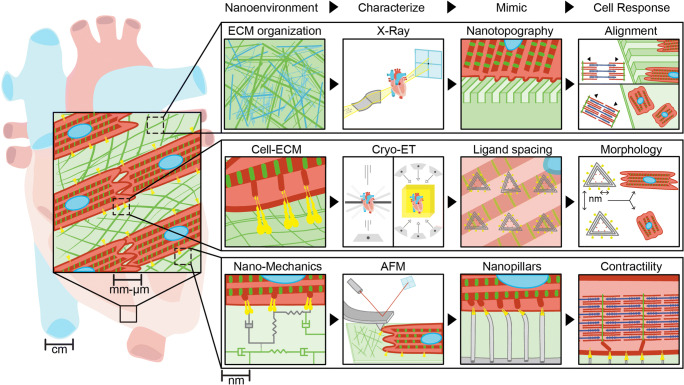
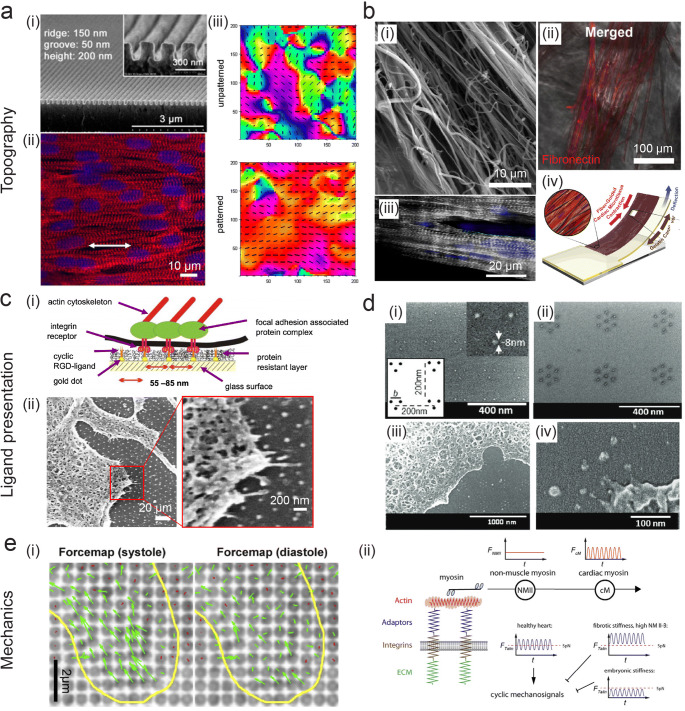
Mechanical forces in the cardiovascular system occur over a wide range of length scales. At the whole organ level, large scale forces drive the beating heart as a synergistic unit. On the microscale, individual cells and their surrounding extracellular matrix (ECM) exhibit dynamic reciprocity, with mechanical feedback moving bidirectionally. Finally, in the nanometer regime, molecular features of cells and the ECM show remarkable sensitivity to mechanical cues. While small, these nanoscale properties are in many cases directly responsible for the mechanosensitive signaling processes that elicit cellular outcomes. Given the inherent challenges in observing, quantifying, and reconstituting this nanoscale environment, it is not surprising that this landscape has been understudied compared to larger length scales. Here, we aim to shine light upon the cardiac nanoenvironment, which plays a crucial role in maintaining physiological homeostasis while also underlying pathological processes. Thus, we will highlight strategies aimed at (1) elucidating the nanoscale components of the cardiac matrix, and (2) designing new materials and biosystems capable of mimicking these features in vitro.
心血管系统中的机械力作用于广泛的长度尺度范围。在整个器官层面,大规模的力驱动着作为协同单元的跳动心脏。在微观层面,单个细胞及其周围的细胞外基质(ECM)呈现出动态的相互作用,机械反馈双向移动。最后,在纳米尺度范围内,细胞和细胞外基质的分子特征对机械信号表现出显著的敏感性。虽然这些纳米尺度的特性很小,但在许多情况下,它们直接负责引发细胞结果的机械敏感信号传导过程。鉴于在观察、量化和重构这种纳米尺度环境方面存在固有的挑战,与较大长度尺度相比,这个领域的研究较少也就不足为奇了。在这里,我们旨在阐明心脏纳米环境,它在维持生理稳态以及病理过程中都起着至关重要的作用。因此,我们将重点介绍旨在(1)阐明心脏基质的纳米尺度成分,以及(2)设计能够在体外模拟这些特征的新材料和生物系统的策略。