Kofod Linette Marie, Westerdahl Elisabeth, Kristensen Morten Tange, Brocki Barbara Cristina, Ringbæk Thomas, Hansen Ejvind Frausing
PMR-C, Department of Physio- and Occupational Therapy, Copenhagen University Hospital, 2650 Hvidovre, Denmark.
School of Medical Sciences, Faculty of Medicine and Health, Örebro University, 702 81 Örebro, Sweden.
J Clin Med. 2021 Oct 20;10(21):4820. doi: 10.3390/jcm10214820.
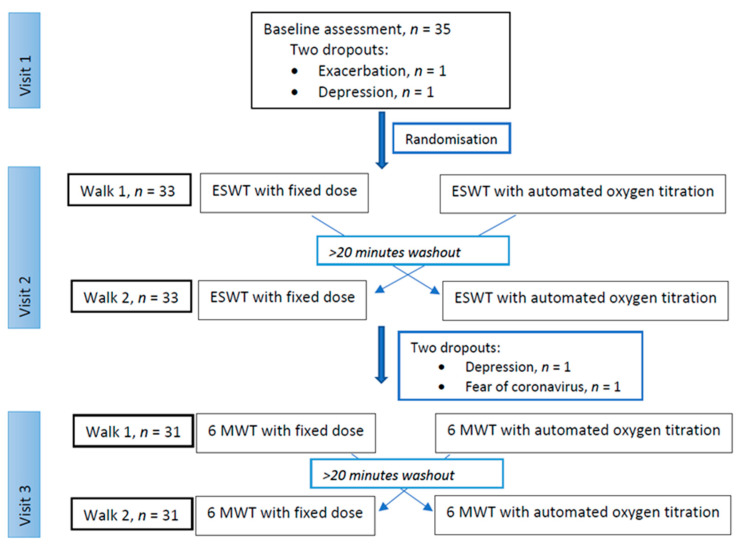
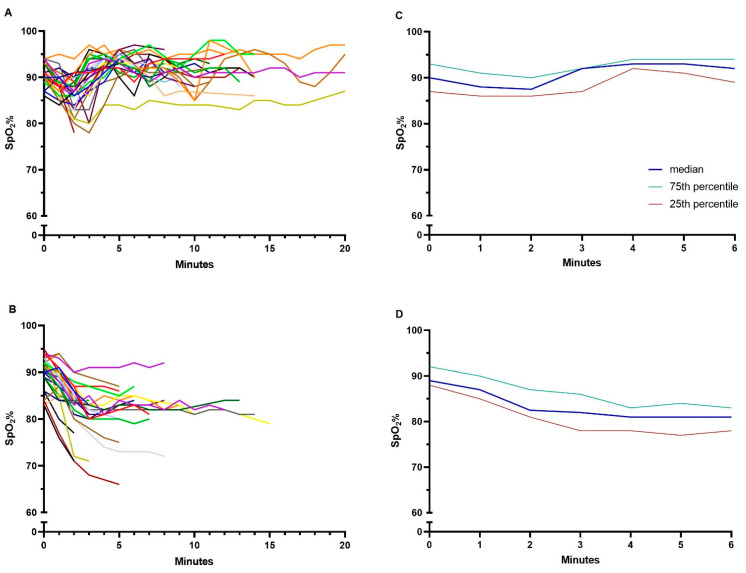
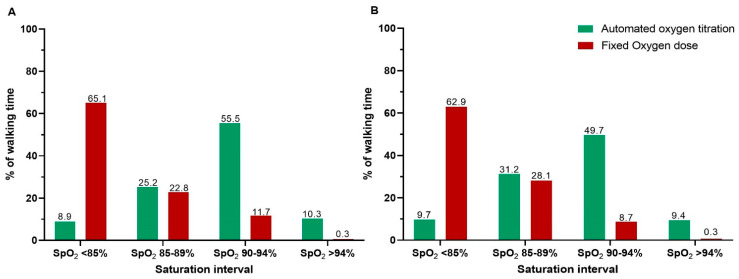
The need for oxygen increases with activity in patients with COPD and on long-term oxygen treatment (LTOT), leading to periods of hypoxemia, which may influence the patient's performance. This study aimed to evaluate the effect of automated oxygen titration compared to usual fixed-dose oxygen treatment during walking on dyspnea and endurance in patients with COPD and on LTOT. In a double-blinded randomised crossover trial, 33 patients were assigned to use either automated oxygen titration or the usual fixed-dose in a random order in two walking tests. A closed-loop device, O2matic delivered a variable oxygen dose set with a target saturation of 90-94%. The patients had a home oxygen flow of (mean ± SD) 1.6 ± 0.9 L/min. At the last corresponding isotime in the endurance shuttle walk test, the patients reported dyspnea equal to median (IQR) 4 (3-6) when using automated oxygen titration and 8 (5-9) when using fixed doses, < 0.001. The patients walked 10.9 (6.5-14.9) min with automated oxygen compared to 5.5 (3.3-7.9) min with fixed-dose, < 0.001. Walking with automated oxygen titration had a statistically significant and clinically important effect on dyspnea. Furthermore, the patients walked for a 98% longer time when hypoxemia was reduced with a more well-matched, personalised oxygen treatment.
慢性阻塞性肺疾病(COPD)患者及接受长期氧疗(LTOT)的患者,其氧气需求会随活动增加,从而导致低氧血症发作,这可能会影响患者的表现。本研究旨在评估与常规固定剂量氧疗相比,自动氧滴定在COPD患者及LTOT患者步行过程中对呼吸困难和耐力的影响。在一项双盲随机交叉试验中,33名患者在两次步行测试中被随机分配,以随机顺序使用自动氧滴定或常规固定剂量。一种闭环装置O2matic可提供设定目标饱和度为90 - 94%的可变氧气剂量。患者家庭用氧流量为(均值±标准差)1.6±0.9升/分钟。在耐力穿梭步行测试的最后一个相应等时时刻,患者报告使用自动氧滴定法时呼吸困难程度等于中位数(四分位间距)4(3 - 6),而使用固定剂量时为8(5 - 9),P<0.001。使用自动氧滴定法时患者步行了10.9(6.5 - 14.9)分钟,而使用固定剂量时为5.5(3.3 - 7.9)分钟,P<0.001。自动氧滴定步行对呼吸困难有统计学上显著且临床上重要的影响。此外,通过更匹配、个性化的氧疗减少低氧血症时,患者步行时间延长了98%。