Sangkyungwon Integrate Medical Caner Hospital, Yeoju 12616, Gyeonggido, Korea.
Comprehensive Gynecological Cancer Center, CHA Bundang Medical Center, Seongnam 13497, Gyeonggido, Korea.
Int J Mol Sci. 2021 Oct 31;22(21):11844. doi: 10.3390/ijms222111844.
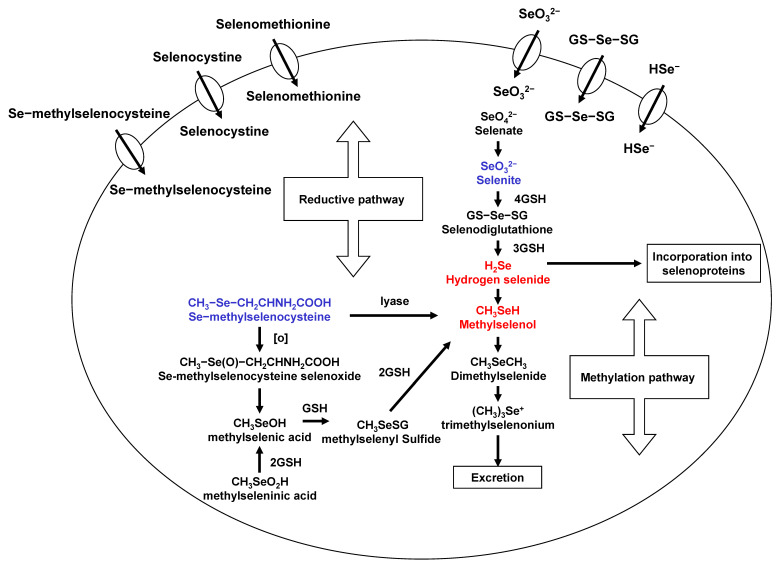
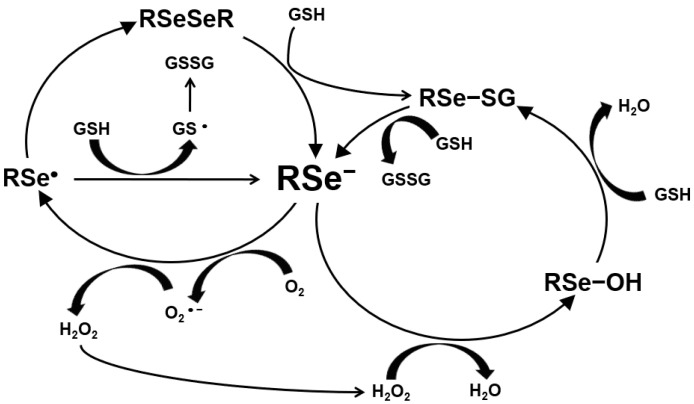
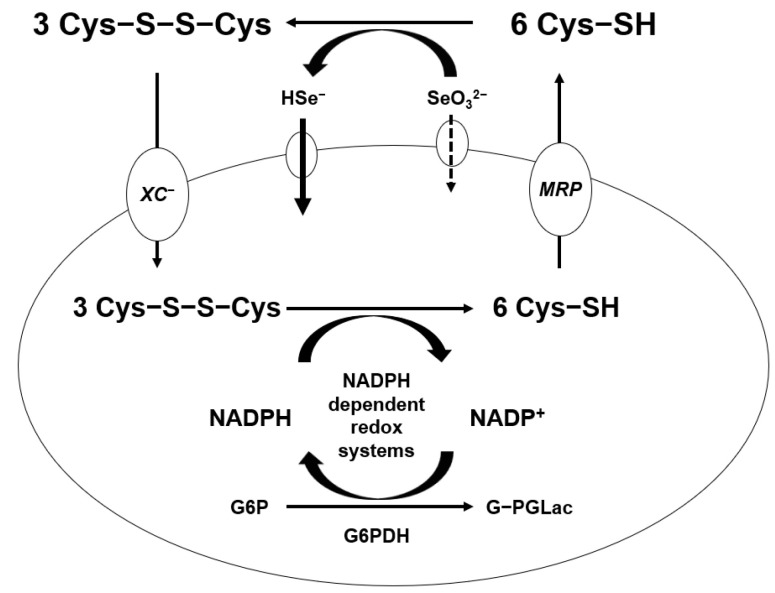
Functions of selenium are diverse as antioxidant, anti-inflammation, increased immunity, reduced cancer incidence, blocking tumor invasion and metastasis, and further clinical application as treatment with radiation and chemotherapy. These functions of selenium are mostly related to oxidation and reduction mechanisms of selenium metabolites. Hydrogen selenide from selenite, and methylselenol (MSeH) from Se-methylselenocyteine (MSeC) and methylseleninicacid (MSeA) are the most reactive metabolites produced reactive oxygen species (ROS); furthermore, these metabolites may involve in oxidizing sulfhydryl groups, including glutathione. Selenite also reacted with glutathione and produces hydrogen selenide via selenodiglutathione (SeDG), which induces cytotoxicity as cell apoptosis, ROS production, DNA damage, and adenosine-methionine methylation in the cellular nucleus. However, a more pronounced effect was shown in the subsequent treatment of sodium selenite with chemotherapy and radiation therapy. High doses of sodium selenite were effective to increase radiation therapy and chemotherapy, and further to reduce radiation side effects and drug resistance. In our study, advanced cancer patients can tolerate until 5000 μg of sodium selenite in combination with radiation and chemotherapy since the half-life of sodium selenite may be relatively short, and, further, selenium may accumulates more in cancer cells than that of normal cells, which may be toxic to the cancer cells. Further clinical studies of high amount sodium selenite are required to treat advanced cancer patients.
硒的功能多种多样,具有抗氧化、抗炎、增强免疫力、降低癌症发病率、阻断肿瘤侵袭和转移等作用,并可进一步临床应用于放化疗治疗。硒的这些功能大多与硒代谢物的氧化还原机制有关。亚硒酸盐中的氢硒化物,以及硒代半胱氨酸(MSeC)和硒代甲基酸(MSeA)中的甲基硒醇(MSeH),是产生活性氧(ROS)的最具反应性的代谢物;此外,这些代谢物可能涉及氧化巯基,包括谷胱甘肽。亚硒酸盐也与谷胱甘肽反应,通过硒代二谷胱甘肽(SeDG)产生氢硒化物,导致细胞凋亡、ROS 产生、DNA 损伤和细胞内核腺苷-甲硫氨酸甲基化,从而产生细胞毒性。然而,在随后的化疗和放疗中,亚硒酸钠的治疗效果更为显著。高剂量的亚硒酸钠对增加放疗和化疗效果显著,进一步降低放疗副作用和耐药性。在我们的研究中,晚期癌症患者可以耐受 5000μg 亚硒酸钠联合放化疗,因为亚硒酸钠的半衰期可能相对较短,而且硒在癌细胞中的积累可能比正常细胞更多,这可能对癌细胞有毒性。需要进一步的临床研究来治疗晚期癌症患者的高剂量亚硒酸钠。