School of Life Science and Resources Environment, Yichun University, Yichun 336000, China.
School of Ecology and Environment, Inner Mongolia University, Huhhot 010021, China.
Int J Environ Res Public Health. 2021 Oct 26;18(21):11245. doi: 10.3390/ijerph182111245.
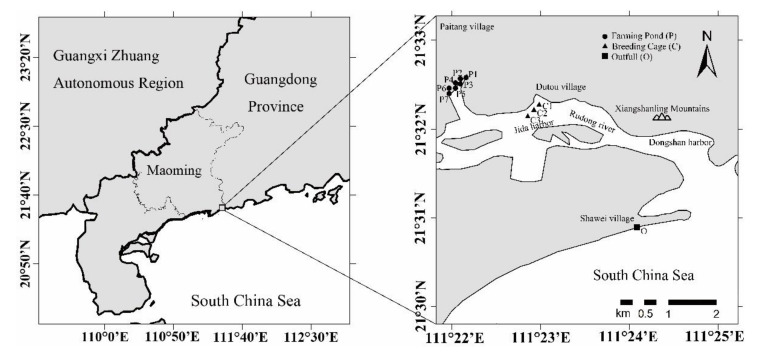
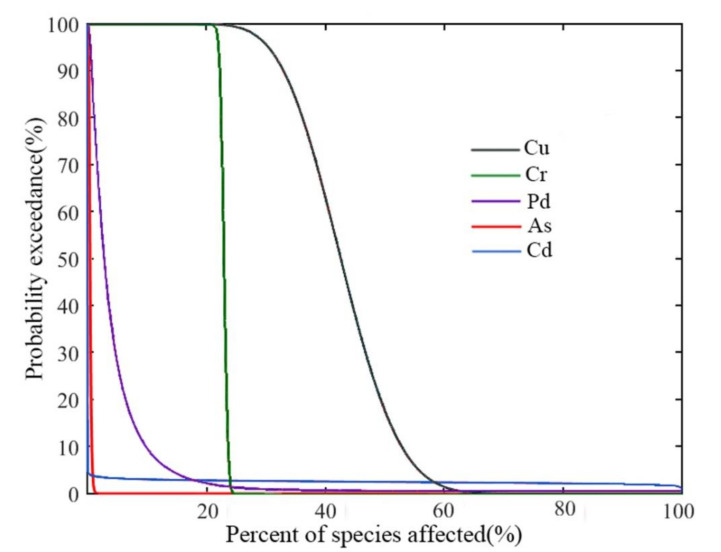
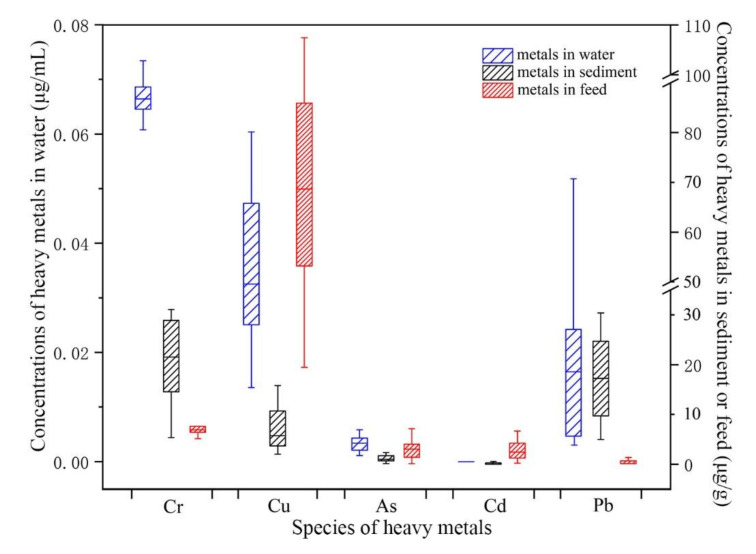
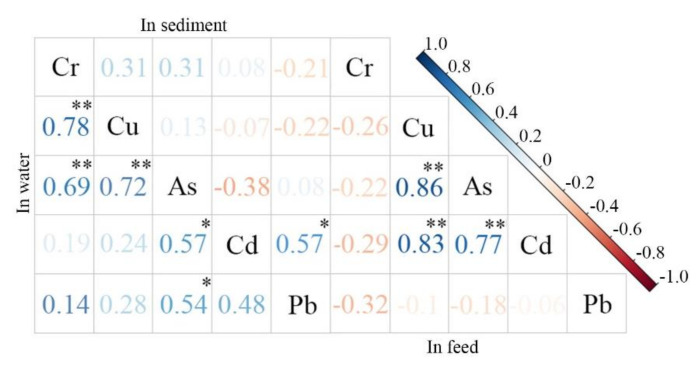
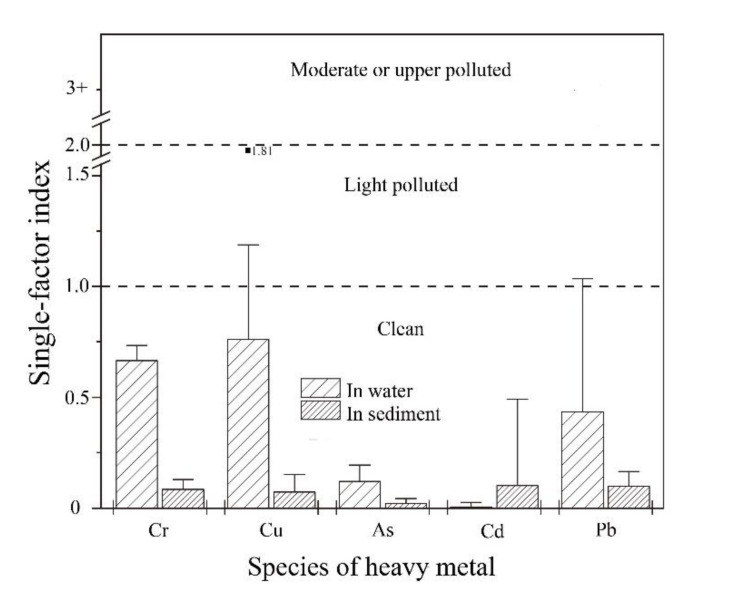
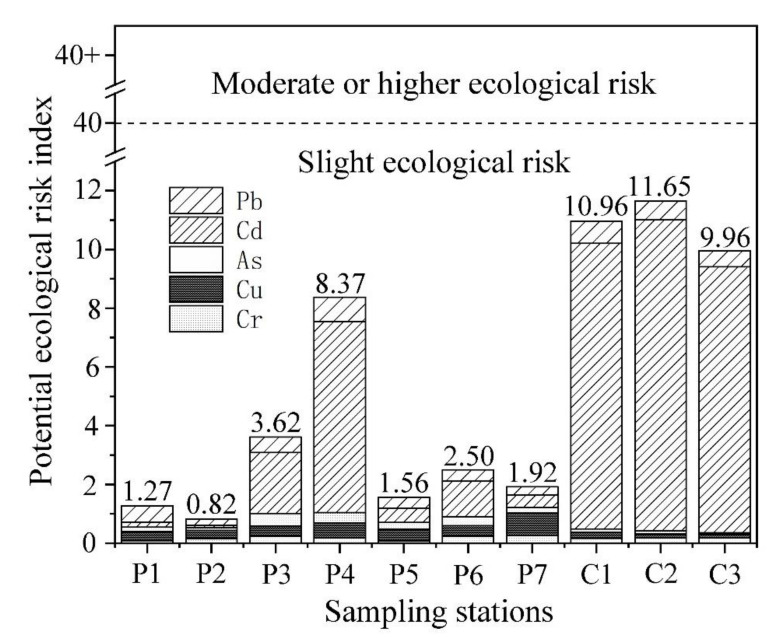
The distribution characteristics, environmental contamination states, and potential ecological risks of chromium (Cr), copper (Cu), arsenic (As), lead (Pb), and cadmium (Cd) in seawater, sediment and breeding feed were studied in a typical mariculture area in western Guangdong of China. Pearson correlation analysis was used to determine metal homology, and the single-factor index, potential ecological risk index, hazard quotient (HQ), and joint probability curve (JPC) were used to evaluate pollution states and ecological risk of metals. Four main statements can be concluded from the results: (1) Pb and Cu showed a similar distribution pattern in the seawater and sediment and their contents in the breeding wastewater exceeded the standard limits in several stations. (2) Cr, Cu, and As have similar sources in the feeds, which may be an important source of metals in water. (3) The risk assessment revealed that the sediment from the studied areas was at a low ecological risk of heavy metal, whereas, water in the pond and outfall was slightly polluted by Pb, and water in the cages and outfall were slightly polluted by Cu. (4) Both the hazard quotient (HQ) and joint probability curve showed the overall risk probabilities (ORPs) in the waters ranked as Cu > Cr > Pb > Cd > As. Although Pb and Cd had HQ values greater than 1, their ORPs were acceptable. This study highlights that multiple evaluation models are more reliable than the single ecological risk assessment for evaluating heavy metal pollution risks in the mariculture area.
在中国粤西的一个典型海水养殖区,研究了海水中、沉积物中和养殖饲料中的铬(Cr)、铜(Cu)、砷(As)、铅(Pb)和镉(Cd)的分布特征、环境污染状况和潜在生态风险。利用 Pearson 相关分析确定金属同源性,利用单因子指数、潜在生态风险指数、危害商数(HQ)和联合概率曲线(JPC)评估金属的污染状况和生态风险。从结果中可以得出四个主要结论:(1)Pb 和 Cu 在海水中和沉积物中的分布模式相似,并且在几个站点的养殖废水中其含量超过了标准限值。(2)饲料中 Cr、Cu 和 As 具有相似的来源,这可能是水中金属的重要来源。(3)风险评估表明,研究区域的沉积物处于重金属的低生态风险水平,而池塘和出水口的水受到 Pb 的轻微污染,以及笼子和出水口的水受到 Cu 的轻微污染。(4)无论是危害商数(HQ)还是联合概率曲线,均显示水中的总体风险概率(ORP)排序为 Cu > Cr > Pb > Cd > As。尽管 Pb 和 Cd 的 HQ 值大于 1,但它们的 ORP 是可以接受的。本研究表明,与单一生态风险评估相比,多个评估模型更可靠,可用于评估海水养殖区的重金属污染风险。