Department of Technological Innovations, National Institute for Insurance against Accidents at Work (INAIL), 00187 Rome, Italy.
Department of Public Health and Infectious Diseases, Sapienza University of Rome, 00185 Rome, Italy.
Int J Environ Res Public Health. 2021 Nov 4;18(21):11606. doi: 10.3390/ijerph182111606.
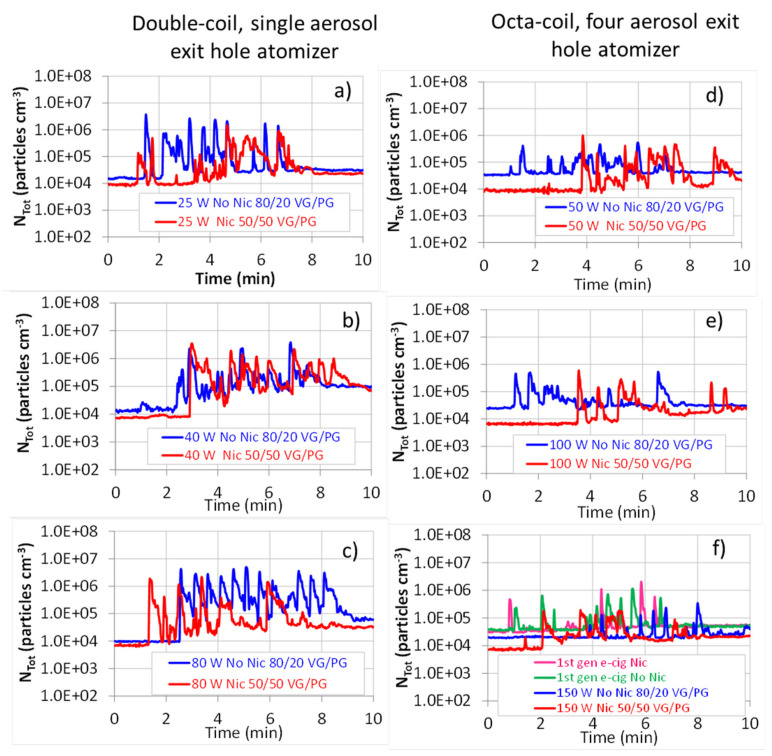
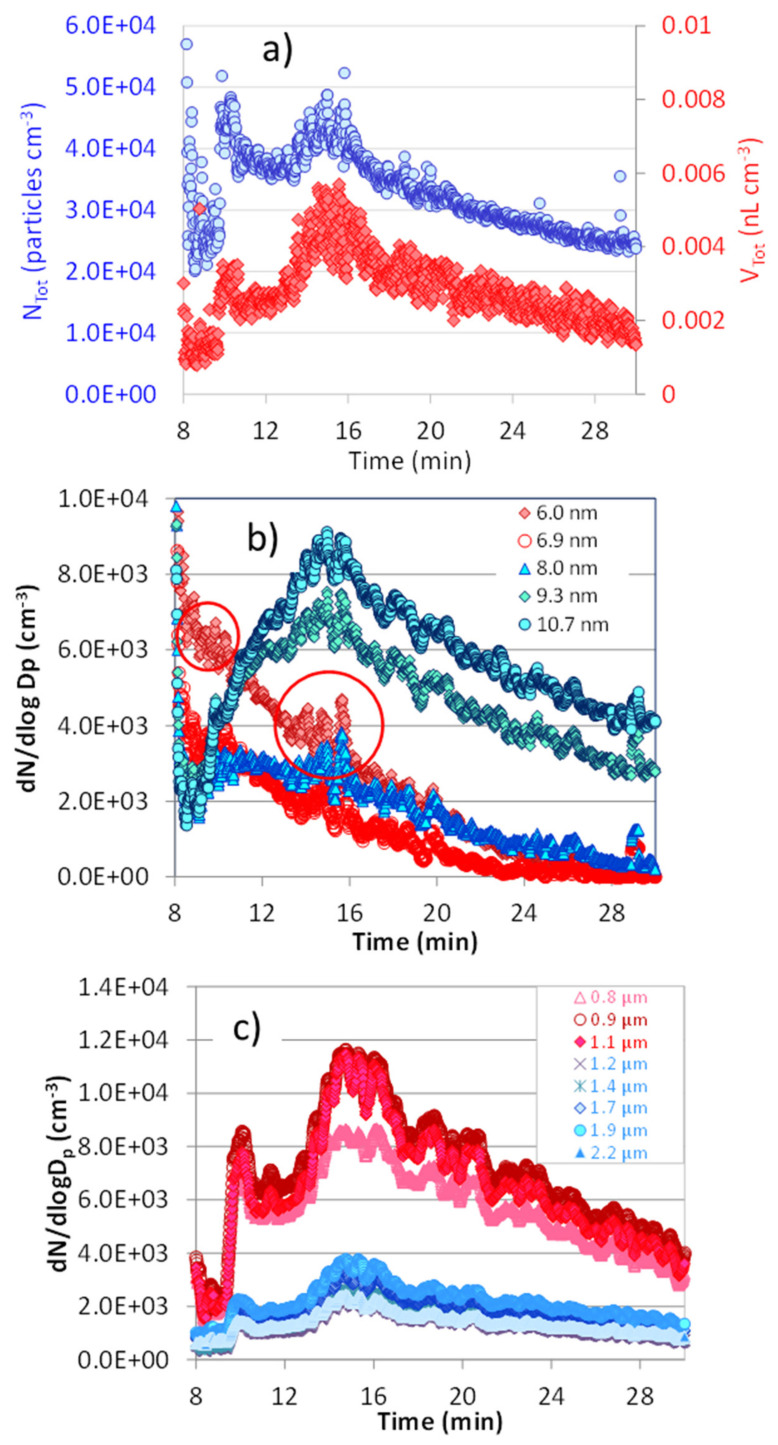
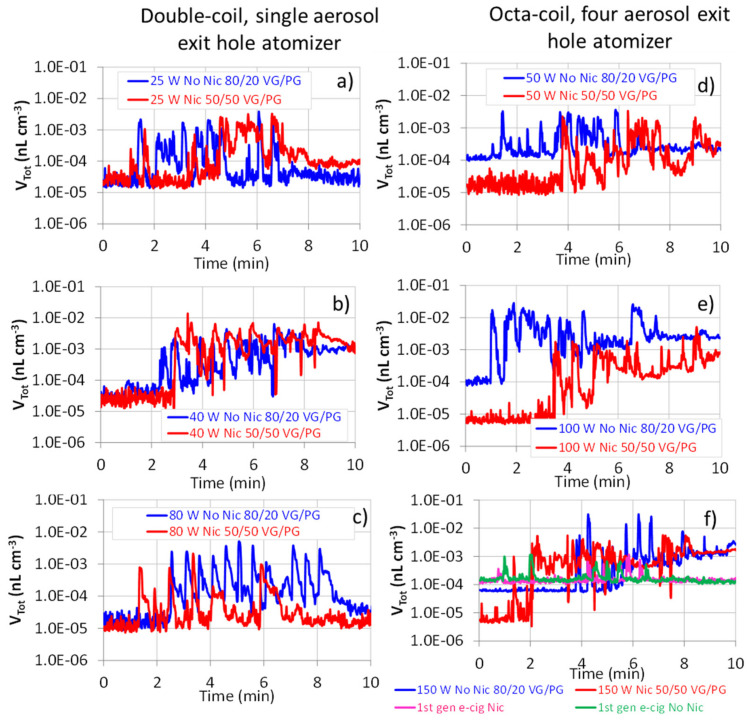
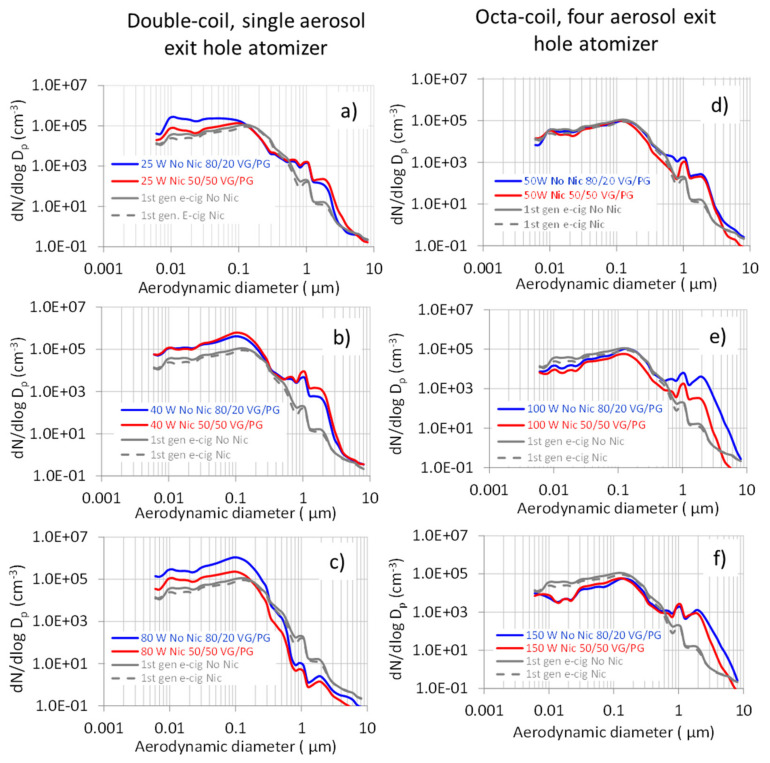
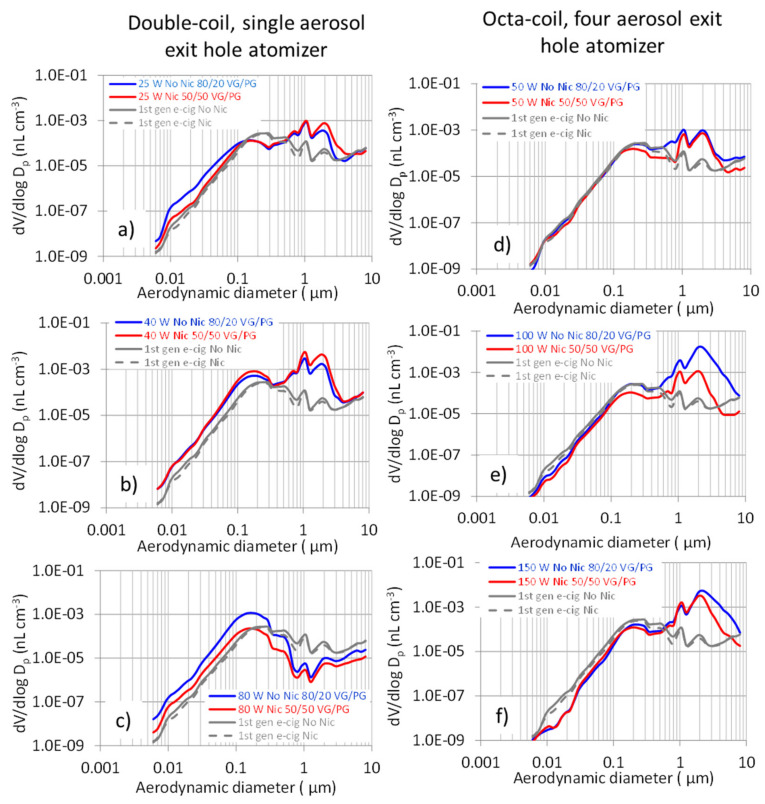
To investigate passive vaping due to sub-ohm electronic cigarettes (e-cigs), aerosol number size distribution measurements (6 nm-10 µm) were performed during volunteer-vaping sessions. E-liquids, with vegetable glycerin (VG) and propylene glycol (PG), with a VG/PG ratio of 50/50 (with nicotine) and 80/20 (without nicotine), were vaped with a double-coil, single aerosol exit hole at 25-80 W electric power, corresponding to 130-365 kW m heat fluxes and with an octa-coil, four aerosol exit holes atomizers, at 50-150 W electric power, corresponding to 133-398 kW m heat fluxes. At the lowest heat flux, lower particle number concentrations (N) were observed for the nicotine-liquid than for the nicotine-free liquid, also due to its higher content of PG, more volatile than VG. For the octa-coil atomizer, at 265 and 398 kW m, N decreased below the first-generation e-cig, whereas volume concentrations greatly increased, due to the formation of super micron droplets. Higher volume concentrations were observed for the 80/20 VG/PG liquid, because of VG vaporization and of its decomposition products, greater than for PG. For the double coil atomizer, increasing the electric power from 40 W (208 kW m) to 80 W (365 kW m) possibly led to a critical heat flow condition, causing a reduction of the number concentrations for the VG/PG 50/50 liquid, an increase for the 80/20 VG/PG liquid and a decrease of the volume concentrations for both of them. Coherently, the main mode was at about 0.1 µm on both metrics for both liquids. For the other tests, two main modes (1 and 2 µm) were observed in the volume size distributions, the latter becoming wider at 100 and 150 W (265 and 398 kW m), suggesting the increased emission of light condensable decomposition products. The lower aerosol emissions observed at 150 W than at 100 W suggest the formation of gas-phase decomposition products. The observation of low-count high-volume aerosols addresses the relevance of the volume metric upon measuring the second-hand concentration of the aerosols released by sub-ohm e-cigarettes.
为了研究亚欧姆电子香烟(e-cig)导致的被动吸烟,在志愿者吸烟过程中进行了气溶胶数尺寸分布测量(6nm-10μm)。电子烟液中含有蔬菜甘油(VG)和丙二醇(PG),VG/PG 比例为 50/50(含尼古丁)和 80/20(不含尼古丁),使用双线圈、单出口孔,在 25-80W 电功率下,对应 130-365kW m 的热通量,以及八线圈、四出口孔雾化器,在 50-150W 电功率下,对应 133-398kW m 的热通量。在最低热通量下,含尼古丁的电子烟液比不含尼古丁的电子烟液的粒子数浓度(N)更低,这也是由于其 PG 含量较高,比 VG 更易挥发。对于八线圈雾化器,在 265 和 398kW m 下,由于形成了超微米液滴,N 值下降到第一代 e-cig 以下,而体积浓度则大大增加。由于 VG 的蒸发及其分解产物,80/20VG/PG 液体的体积浓度高于 PG。对于双线圈雾化器,从 40W(208kW m)增加到 80W(365kW m)的电功率可能导致临界热流条件,从而降低 VG/PG 50/50 液体的数浓度,增加 80/20 VG/PG 液体的数浓度,并降低两者的体积浓度。相应地,两种液体的两种度量的主要模式都在 0.1μm 左右。对于其他测试,在体积尺寸分布中观察到两个主要模式(1μm 和 2μm),后者在 100 和 150W(265 和 398kW m)时变宽,表明光可冷凝分解产物的排放增加。在 150W 时观察到的气溶胶排放低于 100W 时,表明气相分解产物的形成。低计数高体积气溶胶的观察表明,在测量亚欧姆 e-cig 释放的气溶胶的二手浓度时,体积度量的相关性。