Respiratory Health Division, National Institute for Occupational Safety and Health, Morgantown, WV, United States.
Front Public Health. 2022 Mar 17;10:782068. doi: 10.3389/fpubh.2022.782068. eCollection 2022.
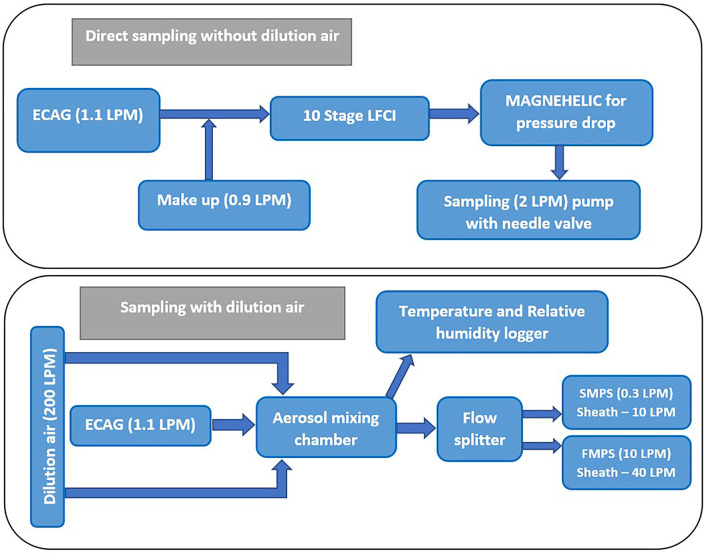
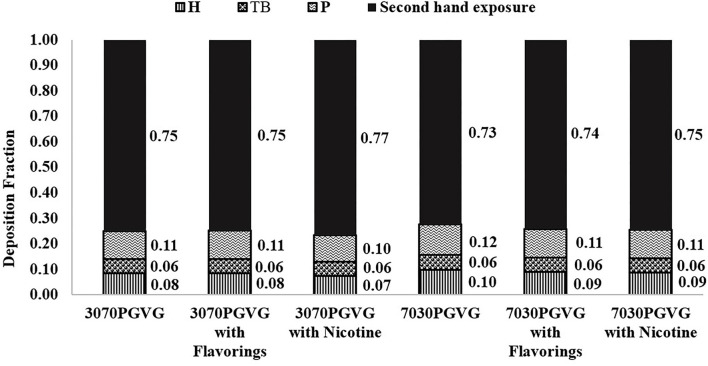
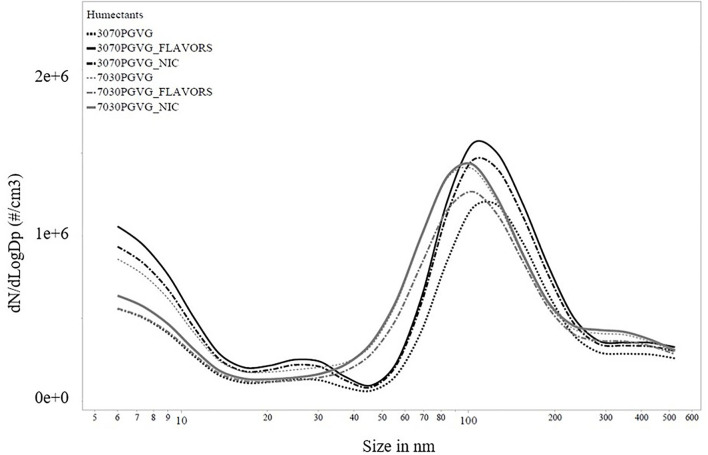
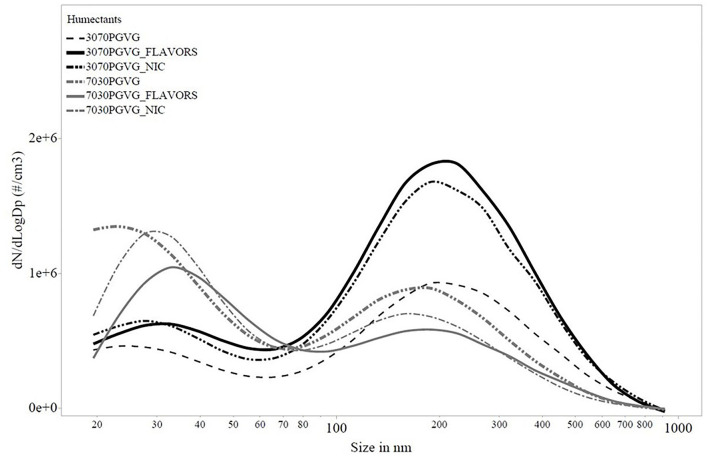
Electronic cigarette, or vaping, products are used to heat an e-liquid to form an aerosol (liquid droplets suspended in gas) that the user inhales; a portion of this aerosol deposits in their respiratory tract and the remainder is exhaled, thereby potentially creating opportunity for secondhand exposure to bystanders (e.g., in homes, automobiles, and workplaces). Particle size, a critical factor in respiratory deposition (and therefore potential for secondhand exposure), could be influenced by e-liquid composition. Hence, the purposes of this study were to (1) test the influence of laboratory-prepared e-liquid composition [ratio of propylene glycol (PG) to vegetable glycerin (VG) humectants, nicotine, and flavorings] on particle size distribution and (2) model respiratory dosimetry. All e-liquids were aerosolized using a second-generation reference e-cigarette. We measured particle size distribution based on mass using a low-flow cascade impactor (LFCI) and size distribution based on number using real-time mobility sizers. Mass median aerodynamic diameters (MMADs) of aerosol from e-liquids that contained only humectants were significantly larger compared with e-liquids that contained flavorings or nicotine ( = 0.005). Humectant ratio significantly influenced MMADs; all aerosols from e-liquids prepared with 70:30 PG:VG were significantly larger compared with e-liquids prepared with 30:70 PG:VG ( = 0.017). In contrast to the LFCI approach, the high dilution and sampling flow rate of a fast mobility particle sizer strongly influenced particle size measurements (i.e., all calculated MMAD values were < 75 nm). Dosimetry modeling using LFCI data indicated that a portion of inhaled particles will deposit throughout the respiratory tract, though statistical differences in aerosol MMADs among e-liquid formulations did not translate into large differences in deposition estimates. A portion of inhaled aerosol will be exhaled and could be a source for secondhand exposure. Use of laboratory-prepared e-liquids and a reference e-cigarette to standardize aerosol generation and a LFCI to measure particle size distribution without dilution represents an improved method to characterize physical properties of volatile aerosol particles and permitted determination of MMAD values more representative of e-cigarette aerosol , which in turn, can help to improve dose modeling for users and bystanders.
电子烟或蒸气产品用于加热电子液体以形成气溶胶(悬浮在气体中的液体液滴),使用者吸入该气溶胶;其中一部分气溶胶沉积在其呼吸道中,其余部分被呼出,从而有可能使旁观者(例如,在家庭,汽车和工作场所)遭受二手暴露。粒径是呼吸沉积的关键因素(因此也是二手暴露的潜在因素),可能受电子液体成分的影响。因此,本研究的目的是:(1)测试实验室制备的电子液体成分[丙二醇(PG)和植物甘油(VG)保湿剂,尼古丁和香精的比例]对粒径分布的影响;(2)模拟呼吸剂量。所有电子液体均使用第二代参考电子烟进行雾化。我们使用低流量级联冲击器(LFCI)基于质量测量粒径分布,使用实时迁移率粒径计基于数量测量粒径分布。仅含有保湿剂的电子液体产生的气溶胶的质量中值空气动力学直径(MMAD)明显大于含有香精或尼古丁的电子液体(= 0.005)。保湿剂比例对 MMAD 有显著影响;用 70:30 PG:VG 制备的所有电子液体的气溶胶均明显大于用 30:70 PG:VG 制备的电子液体(= 0.017)。与 LFCI 方法相反,快速迁移率粒子粒度仪的高稀释度和采样流速强烈影响粒径测量(即,所有计算的 MMAD 值均<75nm)。使用 LFCI 数据进行的剂量建模表明,吸入的颗粒的一部分将沉积在整个呼吸道中,尽管电子液体配方之间的气溶胶 MMAD 存在统计学差异,但并未转化为沉积估计值的较大差异。吸入的气溶胶的一部分将被呼出,并且可能是二手暴露的来源。使用实验室制备的电子液体和参考电子烟来标准化气溶胶的产生,使用 LFCI 进行测量而无需稀释即可代表一种改进的方法来表征挥发性气溶胶颗粒的物理特性,并可以确定更能代表电子烟气溶胶的 MMAD 值,从而有助于改善用户和旁观者的剂量建模。