Liu Wei, Tang Daijiao, Xu Xin-Xin, Liu Yan-Jun, Jiu Yaming
Shanghai Key Laboratory of Medical Epigenetics, International Co-laboratory of Medical Epigenetics and Metabolism (Ministry of Science and Technology), Department of Systems Biology for Medicine, Zhongshan Hospital, Shanghai Institute of Cardiovascular Diseases, Institutes of Biomedical Sciences, Fudan University, Shanghai, China.
The Center for Microbes, Development and Health, Key Laboratory of Molecular Virology and Immunology, Institut Pasteur of Shanghai, Chinese Academy of Sciences, Shanghai, China.
Front Bioeng Biotechnol. 2021 Oct 29;9:764516. doi: 10.3389/fbioe.2021.764516. eCollection 2021.
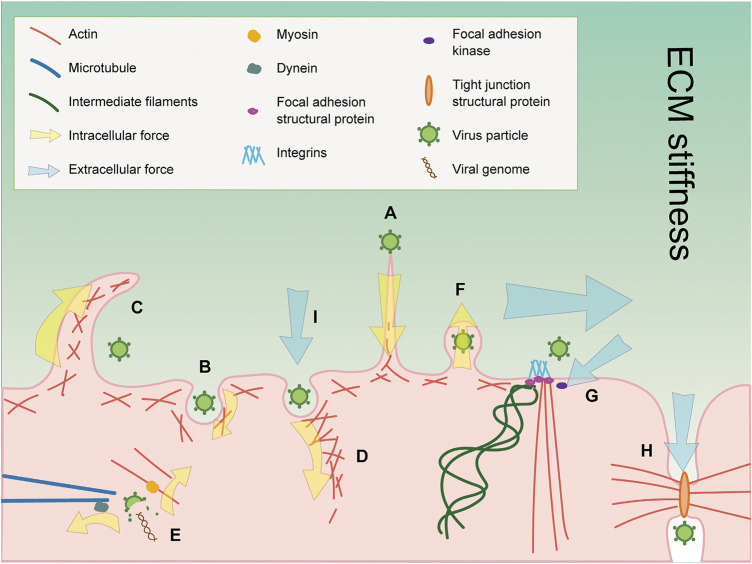
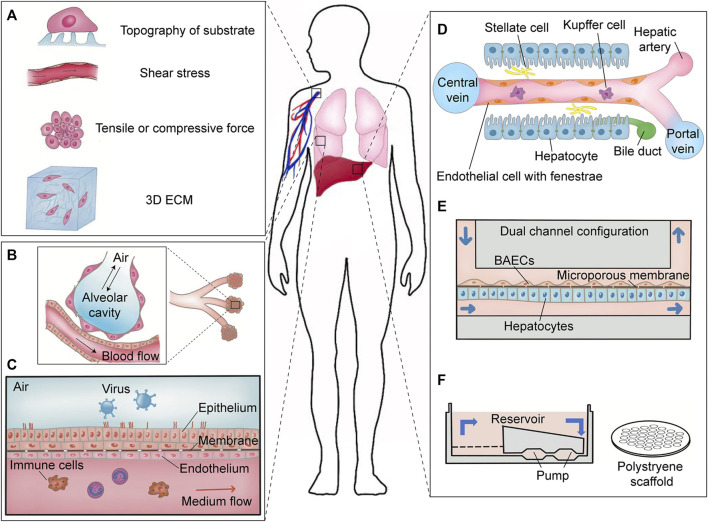
Pandemics caused by viruses have threatened lives of thousands of people. Understanding the complicated process of viral infection provides significantly directive implication to epidemic prevention and control. Viral infection is a complex and diverse process, and substantial studies have been complemented in exploring the biochemical and molecular interactions between viruses and hosts. However, the physical microenvironment where infections implement is often less considered, and the role of mechanobiology in viral infection remains elusive. Mechanobiology focuses on sensation, transduction, and response to intracellular and extracellular physical factors by tissues, cells, and extracellular matrix. The intracellular cytoskeleton and mechanosensors have been proven to be extensively involved in the virus life cycle. Furthermore, innovative methods based on micro- and nanofabrication techniques are being utilized to control and modulate the physical and chemical cell microenvironment, and to explore how extracellular factors including stiffness, forces, and topography regulate viral infection. Our current review covers how physical factors in the microenvironment coordinate viral infection. Moreover, we will discuss how this knowledge can be harnessed in future research on cross-fields of mechanobiology and virology.
由病毒引起的大流行已威胁到成千上万人的生命。了解病毒感染的复杂过程对疫情防控具有重要的指导意义。病毒感染是一个复杂多样的过程,在探索病毒与宿主之间的生化和分子相互作用方面已经有了大量的研究。然而,感染发生的物理微环境常常被忽视,机械生物学在病毒感染中的作用仍然不清楚。机械生物学专注于组织、细胞和细胞外基质对细胞内和细胞外物理因素的感知、转导和反应。细胞内细胞骨架和机械传感器已被证明广泛参与病毒生命周期。此外,基于微纳制造技术的创新方法正被用于控制和调节细胞物理和化学微环境,并探索包括硬度、力和拓扑结构在内的细胞外因素如何调节病毒感染。我们当前的综述涵盖了微环境中的物理因素如何协同病毒感染。此外,我们将讨论如何在未来机械生物学和病毒学交叉领域的研究中利用这些知识。