Department of Health Statistics, School of Public Health, Shanxi Medical University, Taiyuan, China.
Department of Cardiology, The First Hospital of Shanxi Medical University, Taiyuan, China.
ESC Heart Fail. 2022 Feb;9(1):595-605. doi: 10.1002/ehf2.13708. Epub 2021 Nov 14.
Chronic heart failure (CHF) has an increasing burden of comorbidities, which affect clinical outcomes. Few studies have focused on the clustering and hierarchical management of patients with CHF based on comorbidity. This study aimed to explore the cluster model of CHF patients based on comorbidities and to verify their relationship with clinical outcomes.
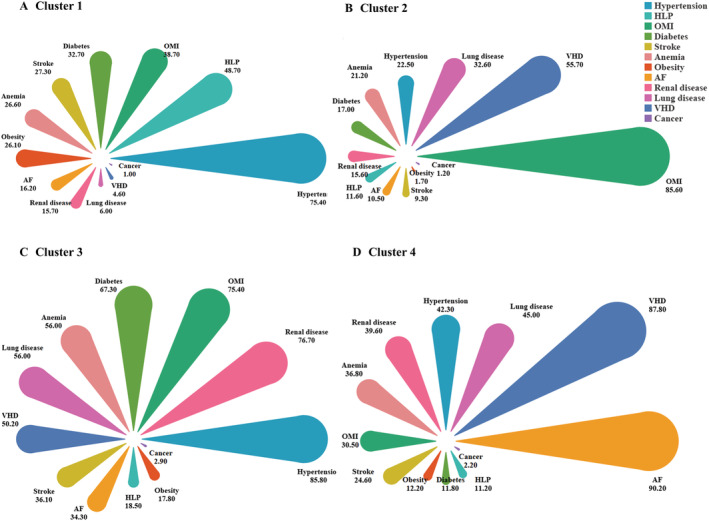
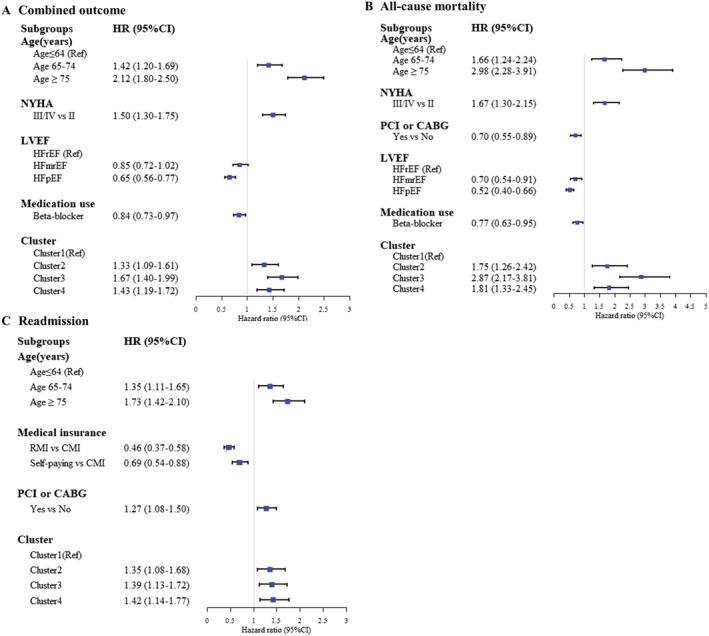
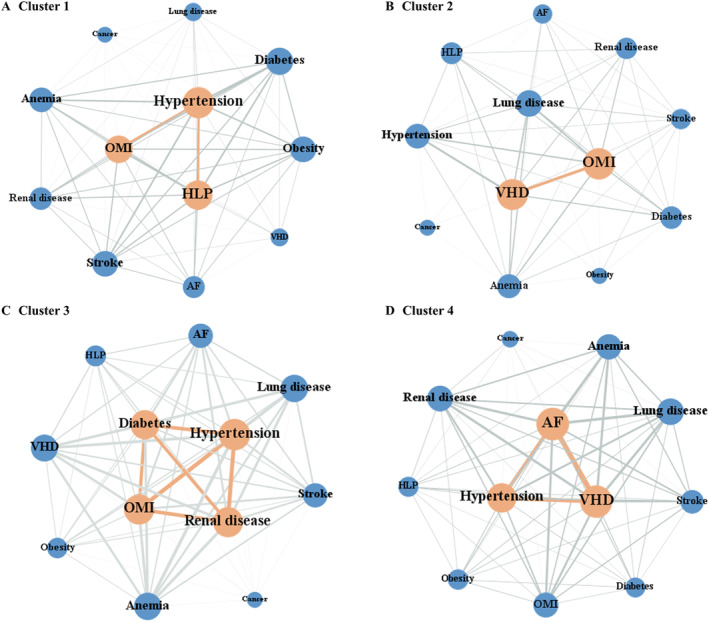
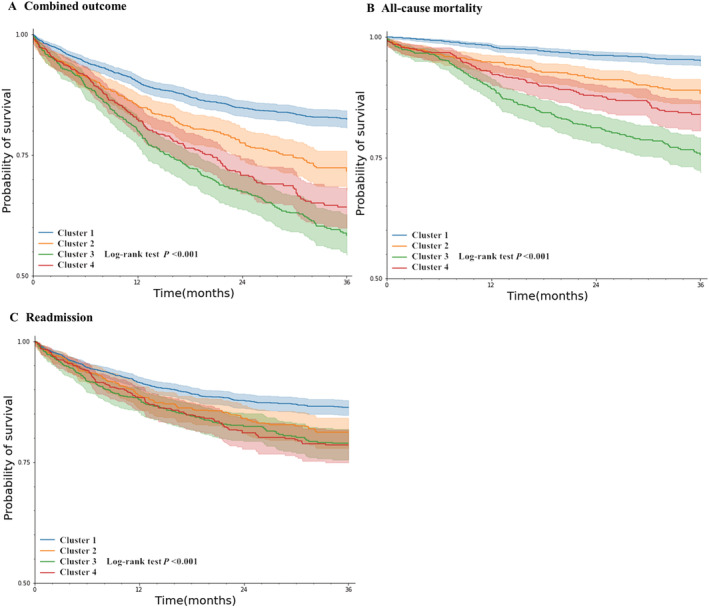
Electronic health records of patients hospitalized with CHF from January 2014 to April 2019 were collected, and 12 common comorbidities were included in the latent class analysis. The Fruchterman-Reingold layout was used to draw the comorbidity network, and analysis of variance was used to compare the weighted degrees among them. The incidence of clinical outcomes among different clusters was presented on Kaplan-Meier curves and compared using the log-rank test, and the hazard ratio was calculated using the Cox proportional risk model. Sensitivity analysis was performed according to the left ventricular ejection fraction. Four different clinical clusters from 4063 total patients were identified: metabolic, ischaemic, high comorbidity burden, and elderly-atrial fibrillation. Compared with the metabolic cluster, patients in the high comorbidity burden cluster had the highest adjusted risk of combined outcome and all-cause mortality {1.67 [95% confidence interval (CI), 1.40-1.99] and 2.87 [95% CI, 2.17-3.81], respectively}, followed by the elderly-atrial fibrillation and ischaemic clusters. The adjusted readmission risk of patients with ischaemic, high comorbidity burden, and elderly-atrial fibrillation clusters were 1.35 (95% CI, 1.08-1.68), 1.39 (95% CI, 1.13-1.72), and 1.42 (95% CI, 1.14-1.77), respectively. The comorbidity network analysis found that patients in the high comorbidity burden cluster had more and higher comorbidity correlations than those in other clusters. Sensitivity analysis revealed that patients in the high comorbidity burden cluster had the highest risk of combined outcome and all-cause mortality (P < 0.05).
The difference in adverse outcomes among clusters confirmed the heterogeneity of CHF and the importance of hierarchical management. This study can provide a basis for personalized treatment and management of patients with CHF, and provide a new perspective for clinical decision making.
慢性心力衰竭(CHF)的合并症负担日益加重,这会影响临床结局。很少有研究关注基于合并症的 CHF 患者聚类和分层管理。本研究旨在探讨基于合并症的 CHF 患者聚类模型,并验证其与临床结局的关系。
收集了 2014 年 1 月至 2019 年 4 月因 CHF 住院的患者的电子健康记录,并纳入了 12 种常见合并症进行潜在类别分析。采用 Fruchterman-Reingold 布局绘制合并症网络,并采用方差分析比较它们之间的加权度。不同聚类患者的临床结局发生率用 Kaplan-Meier 曲线表示,并通过对数秩检验进行比较,使用 Cox 比例风险模型计算危险比。根据左心室射血分数进行敏感性分析。从 4063 例患者中识别出 4 个不同的临床聚类:代谢、缺血、高合并症负担和老年-心房颤动。与代谢聚类相比,高合并症负担聚类的患者发生复合结局和全因死亡率的调整风险最高{1.67[95%置信区间(CI),1.40-1.99]和 2.87[95%CI,2.17-3.81],分别},其次是老年-心房颤动和缺血聚类。缺血、高合并症负担和老年-心房颤动聚类患者的再入院风险调整分别为 1.35[95%CI,1.08-1.68]、1.39[95%CI,1.13-1.72]和 1.42[95%CI,1.14-1.77]。合并症网络分析发现,高合并症负担聚类的患者比其他聚类的患者有更多和更高的合并症相关性。敏感性分析显示,高合并症负担聚类的患者发生复合结局和全因死亡率的风险最高(P<0.05)。
不同聚类患者不良结局的差异证实了 CHF 的异质性和分层管理的重要性。本研究可为 CHF 患者的个体化治疗和管理提供依据,并为临床决策提供新视角。