Quisumbing Agnes, Heckert Jessica, Faas Simone, Ramani Gayathri, Raghunathan Kalyani, Malapit Hazel
International Food Policy Research Institute, Washington, DC USA.
International Food Policy Research Institute, New Delhi, India.
Food Secur. 2021;13(5):1101-1124. doi: 10.1007/s12571-021-01193-5. Epub 2021 Sep 3.
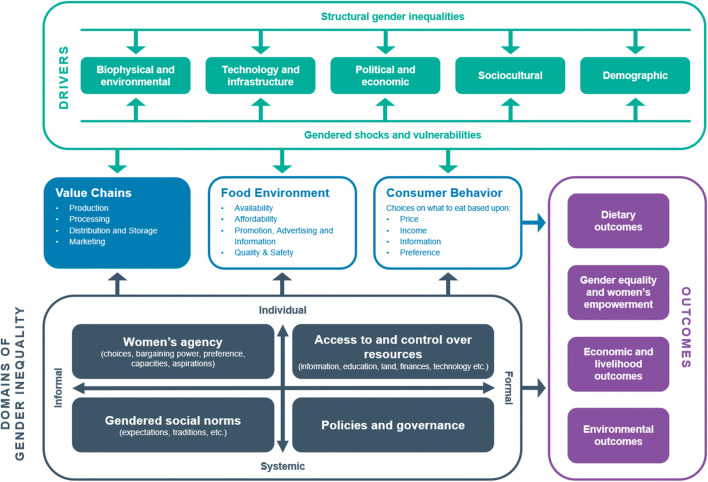
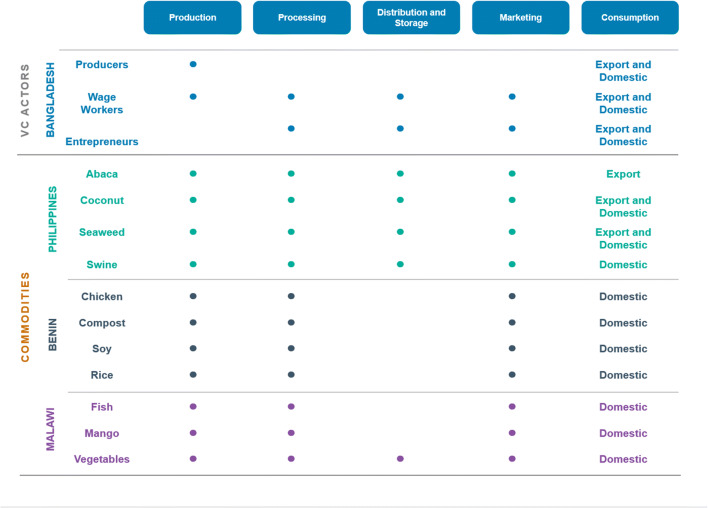
Women play important roles at different nodes of both agricultural and off-farm value chains, but in many countries their contributions are either underestimated or limited by prevailing societal norms or gender-specific barriers. We use primary data collected in Asia (Bangladesh, Philippines) and Africa (Benin, Malawi) to examine the relationships between women's empowerment, gender equality, and participation in a variety of local agricultural value chains that comprise the food system. We find that the value chain and the specific node of engagement matter, as do other individual and household characteristics, but in different ways depending on country context. Entrepreneurship-often engaged in by wealthier households with greater ability to take risks-is not necessarily empowering for women; nor is household wealth, as proxied by their asset ownership. Increased involvement in the market is not necessarily correlated with greater gender equality. Education is positively correlated with higher empowerment of both men and women, but the strength of this association varies. Training and extension services are generally positively associated with empowerment but could also exacerbate the inequality in empowerment between men and women in the same household. All in all, culture and context determine whether participation in value chains-and which node of the value chain-is empowering. In designing food systems interventions, care should be taken to consider the social and cultural contexts in which these food systems operate, so that interventions do not exacerbate existing gender inequalities.
女性在农业和非农业价值链的不同环节都发挥着重要作用,但在许多国家,她们的贡献要么被低估,要么受到主流社会规范或性别特定障碍的限制。我们利用在亚洲(孟加拉国、菲律宾)和非洲(贝宁、马拉维)收集的原始数据,研究妇女赋权、性别平等与参与构成粮食系统的各种地方农业价值链之间的关系。我们发现,价值链和具体的参与节点很重要,其他个人和家庭特征也很重要,但根据国家背景的不同,其方式也有所不同。创业活动——通常由更富裕、更有冒险能力的家庭参与——不一定能赋予女性权力;家庭财富(以资产所有权来衡量)也不能。市场参与度的提高不一定与更大程度的性别平等相关。教育与男性和女性更高的赋权呈正相关,但这种关联的强度各不相同。培训和推广服务通常与赋权呈正相关,但也可能加剧同一家庭中男女在赋权方面的不平等。总而言之,文化和背景决定了参与价值链——以及价值链的哪个节点——是否能赋予权力。在设计粮食系统干预措施时,应注意考虑这些粮食系统运行所处的社会和文化背景,以便干预措施不会加剧现有的性别不平等。