Shin Seong Kee, Lee Do Kyung, Shin Dae Won, Yum Tae Hoon, Kim Jun-Ho
Department of Orthopedic Surgery, Seoul Medical Center, Seoul, Republic of Korea.
Department of Orthopaedic Surgery, Samsung Changwon Hospital, Sungkyunkwan University School of Medicine, Changwon, Republic of Korea.
Orthop J Sports Med. 2021 Nov 12;9(11):23259671211050616. doi: 10.1177/23259671211050616. eCollection 2021 Nov.
Anterior cruciate ligament reconstruction (ACLR) is often performed on an outpatient basis; thus, effective pain management is essential to improving patient satisfaction and function. Local infiltration analgesia (LIA) and femoral nerve block (FNB) have been commonly used for pain management in ACLR. However, the comparative efficacy and safety between the 2 techniques remains a topic of controversy.
To compare pain reduction, opioid consumption, and side effects of LIA and FNB after ACLR.
Systematic review; Level of evidence, 3.
A systematic search of MEDLINE, Embase, and Cochrane Library databases was performed to identify studies comparing pain on the visual analog scale (a 100-mm scale), total morphine-equivalent consumption, and side effects between the 2 techniques after ACLR at the early postoperative period. The LIA was categorized into intra-articular injection and periarticular injection, and subgroup analyses were performed comparing either intra-articular injection or periarticular injection with FNB. Two reviewers performed study selection, risk-of-bias assessment, and data extraction.
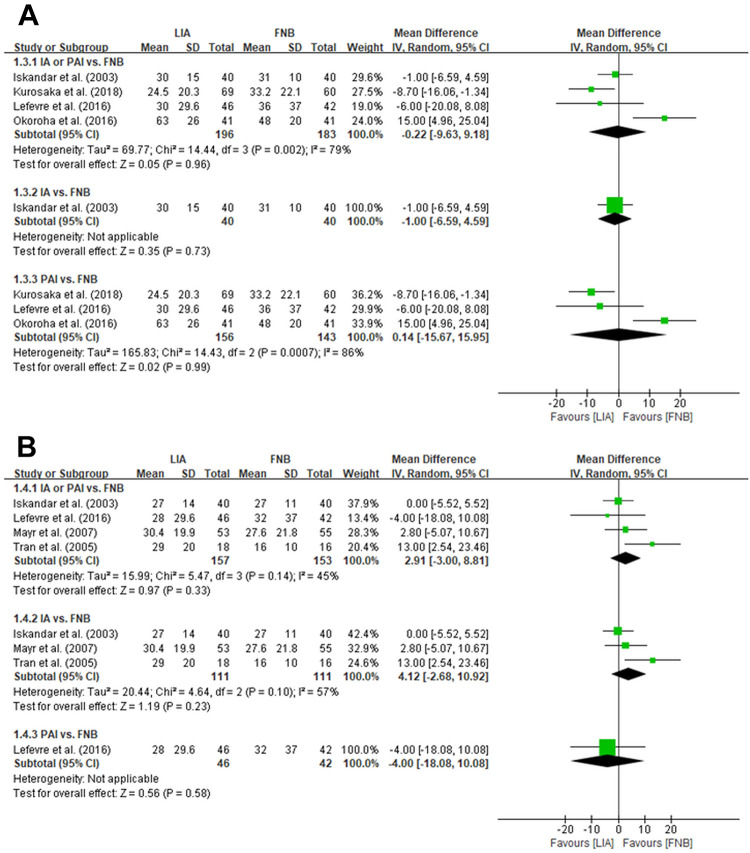
A total of 10 studies were included in this systematic review and meta-analysis. In terms of VAS pain scores, our pooled analysis indicated that FNB was significantly more effective at 2 hours postoperatively compared with LIA (mean difference, 8.19 [95% confidence interval (CI), 0.75 to 15.63]; = .03), with no significant difference between the 2 techniques at 4, 8, and 12 hours postoperatively; however, LIA was significantly more effective at 24 hours postoperatively compared with FNB (mean difference, 5.61 [95% CI, -10.43 to -0.79]; = .02). Moreover, periarticular injection showed a significant improved VAS pain score compared with FNB at 24 hours postoperatively (mean difference, 11.44 [95% CI, -20.08 to -2.80]; = .009), and the improvement reached the threshold of minimal clinically important difference of 9.9. Total morphine-equivalent consumption showed no difference between the 2 techniques, and side effects were unable to be quantified for the meta-analysis because of a lack of data.
Compared with FNB, LIA was not as effective at 2 hours, comparable within 12 hours, and significantly more effective at 24 hours postoperatively for reducing pain after ACLR. Total morphine-equivalent consumption showed no significant differences between the 2 techniques.
前交叉韧带重建术(ACLR)通常在门诊进行;因此,有效的疼痛管理对于提高患者满意度和功能至关重要。局部浸润镇痛(LIA)和股神经阻滞(FNB)已常用于ACLR的疼痛管理。然而,这两种技术之间的相对疗效和安全性仍是一个有争议的话题。
比较ACLR后LIA和FNB的疼痛减轻程度、阿片类药物消耗量及副作用。
系统评价;证据等级,3级。
对MEDLINE、Embase和Cochrane图书馆数据库进行系统检索,以确定比较术后早期ACLR后两种技术在视觉模拟量表(100mm量表)上的疼痛、总吗啡当量消耗量及副作用的研究。LIA分为关节内注射和关节周围注射,并进行亚组分析,比较关节内注射或关节周围注射与FNB。两名评价者进行研究选择、偏倚风险评估和数据提取。
本系统评价和荟萃分析共纳入10项研究。在视觉模拟量表疼痛评分方面,我们的汇总分析表明,与LIA相比,FNB在术后2小时镇痛效果显著更好(平均差值,8.19[95%置信区间(CI),0.75至15.63];P = 0.03),术后4、8和12小时两种技术之间无显著差异;然而,与FNB相比,LIA在术后24小时镇痛效果显著更好(平均差值,5.61[95%CI,-10.43至-0.79];P = 0.02)。此外,关节周围注射在术后24小时的视觉模拟量表疼痛评分较FNB有显著改善(平均差值,11.44[95%CI,-20.08至-2.80];P = 0.009),且改善程度达到最小临床重要差异9.9的阈值。两种技术的总吗啡当量消耗量无差异,由于缺乏数据,副作用无法进行荟萃分析量化。
与FNB相比,LIA在术后2小时镇痛效果不如FNB,12小时内相当,24小时镇痛效果显著更好。两种技术的总吗啡当量消耗量无显著差异。