
锂硫电池与静电纺丝技术:最新进展及实现高重量和体积能量密度的关键参数
Lithium-Sulfur Batteries Meet Electrospinning: Recent Advances and the Key Parameters for High Gravimetric and Volume Energy Density.
作者信息
Zhang Yongshang, Zhang Xilai, Silva S Ravi P, Ding Bin, Zhang Peng, Shao Guosheng
机构信息
State Center for International Cooperation on Designer Low-Carbon & Environmental Materials (CDLCEM), School of Materials Science and Engineering, 100 Kexue Avenue, Zhengzhou University, Zhengzhou, 450001, China.
Zhengzhou Materials Genome Institute (ZMGI), Xingyang, Zhengzhou, 450100, China.
出版信息
Adv Sci (Weinh). 2022 Feb;9(4):e2103879. doi: 10.1002/advs.202103879. Epub 2021 Nov 18.
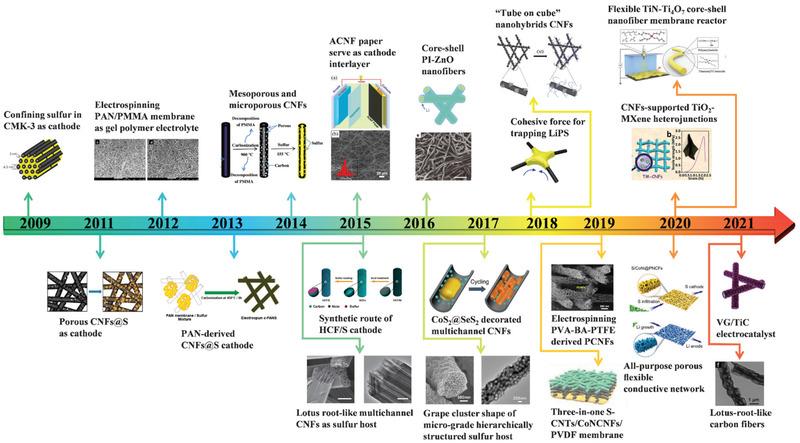
Lithium-sulfur (Li-S) batteries have been regarded as a promising next-generation energy storage technology for their ultrahigh theoretical energy density compared with those of the traditional lithium-ion batteries. However, the practical applications of Li-S batteries are still blocked by notorious problems such as the shuttle effect and the uncontrollable growth of lithium dendrites. Recently, the rapid development of electrospinning technology provides reliable methods in preparing flexible nanofibers materials and is widely applied to Li-S batteries serving as hosts, interlayers, and separators, which are considered as a promising strategy to achieve high energy density flexible Li-S batteries. In this review, a fundamental introduction of electrospinning technology and multifarious electrospinning-based nanofibers used in flexible Li-S batteries are presented. More importantly, crucial parameters of specific capacity, electrolyte/sulfur (E/S) ratio, sulfur loading, and cathode tap density are emphasized based on the proposed mathematic model, in which the electrospinning-based nanofibers are used as important components in Li-S batteries to achieve high gravimetric (W ) and volume (W ) energy density of 500 Wh kg and 700 Wh L , respectively. These systematic summaries not only provide the principles in nanofiber-based electrode design but also propose enlightening directions for the commercialized Li-S batteries with high W and W .
锂硫(Li-S)电池因其与传统锂离子电池相比具有超高的理论能量密度,而被视为一种很有前景的下一代储能技术。然而,Li-S电池的实际应用仍受到诸如穿梭效应和锂枝晶不可控生长等严重问题的阻碍。近年来,静电纺丝技术的快速发展为制备柔性纳米纤维材料提供了可靠的方法,并被广泛应用于Li-S电池中作为主体、中间层和隔膜,这被认为是实现高能量密度柔性Li-S电池的一种有前景的策略。在这篇综述中,介绍了静电纺丝技术的基本原理以及用于柔性Li-S电池的各种基于静电纺丝的纳米纤维。更重要的是,基于所提出的数学模型,强调了比容量、电解质/硫(E/S)比、硫负载量和阴极振实密度等关键参数,其中基于静电纺丝的纳米纤维被用作Li-S电池中的重要组件,以分别实现500 Wh/kg和700 Wh/L的高重量(W)和体积(W)能量密度。这些系统的总结不仅提供了基于纳米纤维的电极设计原理,还为具有高W和W的商业化Li-S电池提出了具有启发性的方向。




 Zotero 插件