Biostatistics Unit, South African Medical Research Council, Parow 7575, South Africa.
Sport, Exercise Medicine and Lifestyle Institute (SEMLI), Faculty of Health Sciences, University of Pretoria, Pretoria 0081, South Africa; International Olympic Committee (IOC) Research Centre, Pretoria 0081, South Africa.
J Sport Health Sci. 2022 May;11(3):339-346. doi: 10.1016/j.jshs.2021.11.002. Epub 2021 Nov 18.
There are limited data on factors that predict an increased risk of multiple injuries among distance runners. The objective of this study was to determine risk factors that are predictive of individual runners with a high annual multiple injury risk (MIR).
A retrospective, cross-sectional study at 4 annual (2012-2015) Two Oceans 21.1 km and 56.0 km races in South Africa with 75,401 consenting race entrants. Running-related injury data were collected retrospectively through an online pre-race medical screening questionnaire. The average number of injuries for each runner every year was calculated by taking a runner's race entry history and injury history into account and categorizing entrants into 4 MIR categories (high, intermediate, low, and very low (reference)). Multiple logistic regression modeling (odds ratios) was used to determine whether the following factors were predictive of a high MIR (average > 1 injury/year): demographics, training and racing, chronic-disease history (composite chronic disease score (CCDS)), and history of allergies.
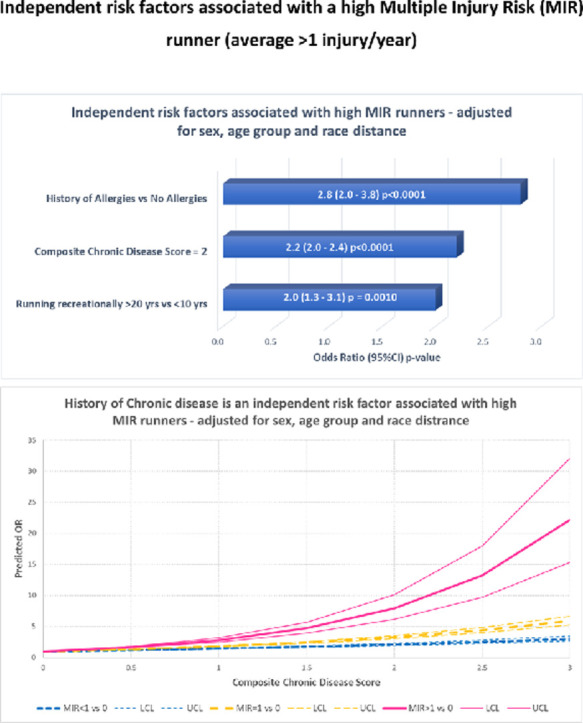
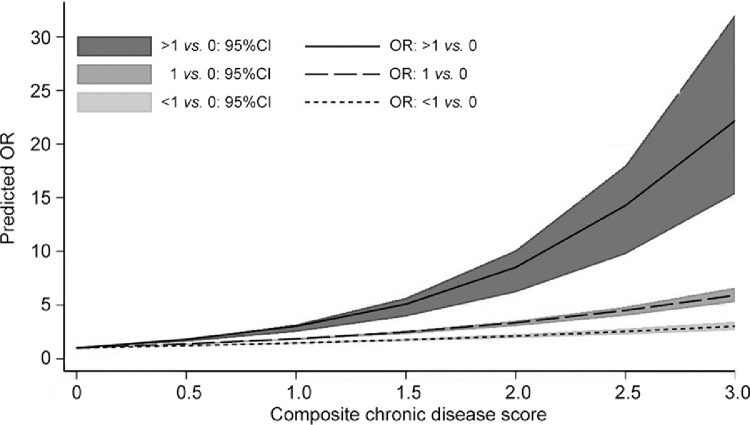
Of all entrants, 9.2% reported at least 1 injury, and 0.4% of entrants were in the high MIR category; the incidence rate was 2.5 injuries per 10 runner-years (95% confidence interval (95%CI): 2.4-2.7). Significant factors predictive of runners in the high MIR category were: running for > 20 years: OR = 2.0 (95%CI: 1.3-3.1; p = 0.0010); a higher CCDS: OR = 2.2 (95%CI: 2.0-2.4; p < 0.0001); and a history of allergies: OR = 2.8 (95%CI: 2.0-3.8; p < 0.0001).
Runners who have been running recreationally for > 20 years and those with multiple chronic diseases or a history of allergies were at higher risk of multiple running-related injuries. This high-risk group can be targeted for further study and possible injury-prevention interventions.
关于预测长跑运动员多发性损伤风险增加的因素的数据有限。本研究的目的是确定可预测个体跑步者具有高年度多发性损伤风险(MIR)的危险因素。
这是一项在南非进行的回顾性、横断面研究,涉及 4 次两年一度的 Two Oceans 21.1 公里和 56.0 公里比赛(2012-2015 年),共有 75401 名同意参赛的选手。通过在线赛前医学筛查问卷回顾性收集与跑步相关的损伤数据。根据每位选手的参赛记录和受伤记录,计算出每位选手每年的平均受伤次数,并将选手分为 4 个 MIR 类别(高、中、低和极低(参考))。采用多变量逻辑回归模型(比值比)确定以下因素是否可预测高 MIR(平均>1 次/年):人口统计学、训练和比赛、慢性疾病史(复合慢性疾病评分(CCDS))和过敏史。
所有参赛选手中有 9.2%报告至少有 1 次损伤,0.4%的参赛选手属于高 MIR 类别;发病率为每 10 名跑步者年 2.5 次损伤(95%置信区间(95%CI):2.4-2.7)。可预测高 MIR 类别的跑步者的显著因素包括:跑步时间超过 20 年:OR=2.0(95%CI:1.3-3.1;p=0.0010);更高的 CCDS:OR=2.2(95%CI:2.0-2.4;p<0.0001);以及过敏史:OR=2.8(95%CI:2.0-3.8;p<0.0001)。
长期进行娱乐性跑步且患有多种慢性疾病或过敏史的跑步者多发性跑步相关损伤的风险更高。这个高风险群体可以作为进一步研究和可能的损伤预防干预的目标。