Department of Pathology, The University of Tokyo, 7-3-1 Hongo, Bunkyo-ku, Tokyo, 113-0033, Japan.
Sci Rep. 2021 Nov 22;11(1):22636. doi: 10.1038/s41598-021-02168-4.
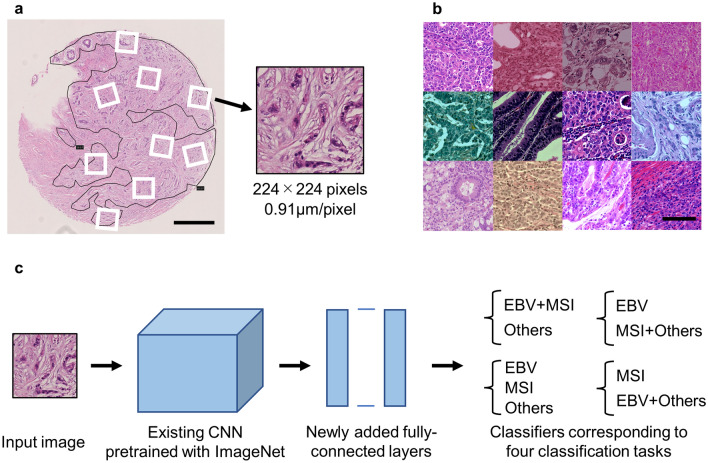
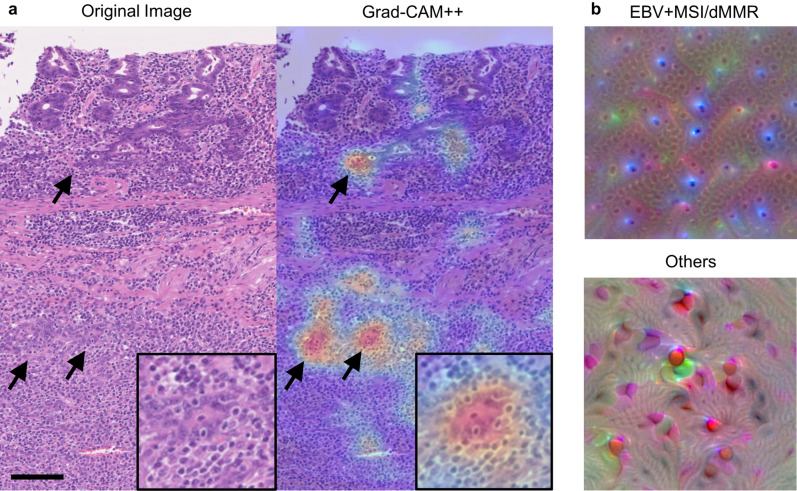
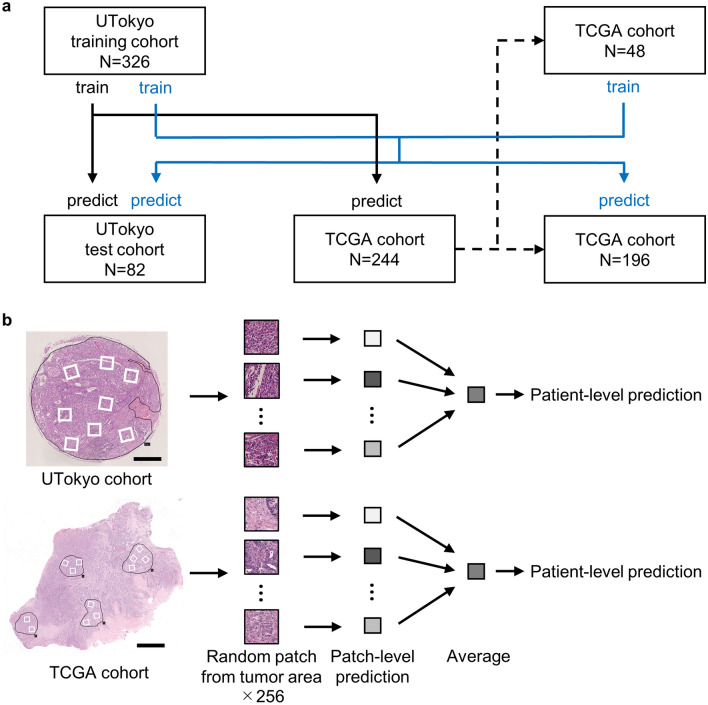
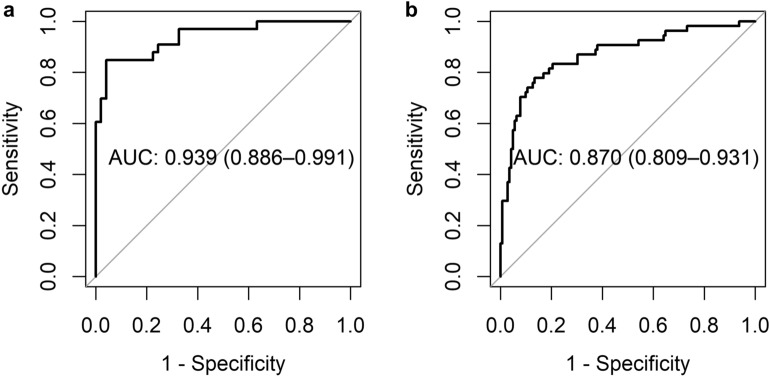
Immune checkpoint inhibitor (ICI) therapy is widely used but effective only in a subset of gastric cancers. Epstein-Barr virus (EBV)-positive and microsatellite instability (MSI) / mismatch repair deficient (dMMR) tumors have been reported to be highly responsive to ICIs. However, detecting these subtypes requires costly techniques, such as immunohistochemistry and molecular testing. In the present study, we constructed a histology-based deep learning model that aimed to screen this immunotherapy-sensitive subgroup efficiently. We processed whole slide images of 408 cases of gastric adenocarcinoma, including 108 EBV, 58 MSI/dMMR, and 242 other subtypes. Many images generated by data augmentation of the learning set were used for training convolutional neural networks to establish an automatic detection platform for EBV and MSI/dMMR subtypes, and the test sets of images were used to verify the learning outcome. Our model detected the subgroup (EBV + MSI/dMMR tumors) with high accuracy in test cases with an area under the curve of 0.947 (0.901-0.992). This result was slightly better than when EBV and MSI/dMMR tumors were detected separately. In an external validation cohort including 244 gastric cancers from The Cancer Genome Atlas database, our model showed a favorable result for detecting the "EBV + MSI/dMMR" subgroup with an AUC of 0.870 (0.809-0.931). In addition, a visualization of the trained neural network highlighted intraepithelial lymphocytosis as the ground for prediction, suggesting that this feature is a discriminative characteristic shared by EBV and MSI/dMMR tumors. Histology-based deep learning models are expected to be used for detecting EBV and MSI/dMMR gastric cancers as economical and less time-consuming alternatives, which may help to effectively stratify patients who respond to ICIs.
免疫检查点抑制剂 (ICI) 治疗被广泛应用,但仅对一部分胃癌患者有效。已报道 EBV 阳性和微卫星不稳定 (MSI)/错配修复缺陷 (dMMR) 肿瘤对 ICI 高度敏感。然而,检测这些亚型需要昂贵的技术,如免疫组织化学和分子检测。在本研究中,我们构建了一个基于组织学的深度学习模型,旨在有效地筛选这种免疫治疗敏感亚组。我们处理了 408 例胃腺癌的全切片图像,包括 108 例 EBV、58 例 MSI/dMMR 和 242 例其他亚型。通过学习集的数据增强生成了许多图像,用于训练卷积神经网络,以建立 EBV 和 MSI/dMMR 亚型的自动检测平台,并使用测试集的图像验证学习结果。我们的模型在测试病例中以 0.947(0.901-0.992)的曲线下面积高度准确地检测到亚组(EBV+MSI/dMMR 肿瘤)。这一结果略优于分别检测 EBV 和 MSI/dMMR 肿瘤时的结果。在包括来自 The Cancer Genome Atlas 数据库的 244 例胃癌的外部验证队列中,我们的模型在检测“EBV+MSI/dMMR”亚组时表现出良好的结果,AUC 为 0.870(0.809-0.931)。此外,对训练神经网络的可视化突出了上皮内淋巴细胞增多作为预测的基础,表明这一特征是 EBV 和 MSI/dMMR 肿瘤的一个有区别的特征。基于组织学的深度学习模型有望作为经济且耗时更少的替代方法用于检测 EBV 和 MSI/dMMR 胃癌,这可能有助于有效地对对 ICI 有反应的患者进行分层。