Department of General Surgery & Guangdong Provincial Key Laboratory of Precision Medicine for Gastrointestinal Tumor, Nanfang Hospital, The First School of Clinical Medicine,Southern Medical University, Guangzhou, Guangdong, China.
Department of Gastroenterology, The First Hospital of Jilin University, Changchun, Jilin, China.
J Immunother Cancer. 2024 May 15;12(5):e008927. doi: 10.1136/jitc-2024-008927.
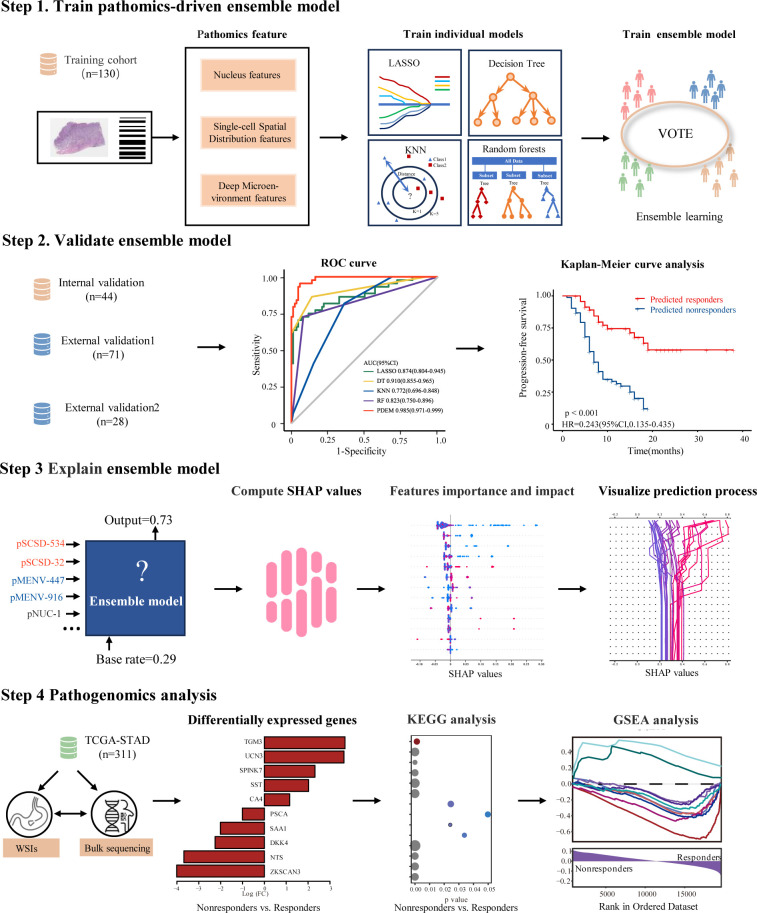
Only a subset of patients with gastric cancer experience long-term benefits from immune checkpoint inhibitors (ICIs). Currently, there is a deficiency in precise predictive biomarkers for ICI efficacy. The aim of this study was to develop and validate a pathomics-driven ensemble model for predicting the response to ICIs in gastric cancer, using H&E-stained whole slide images (WSI).
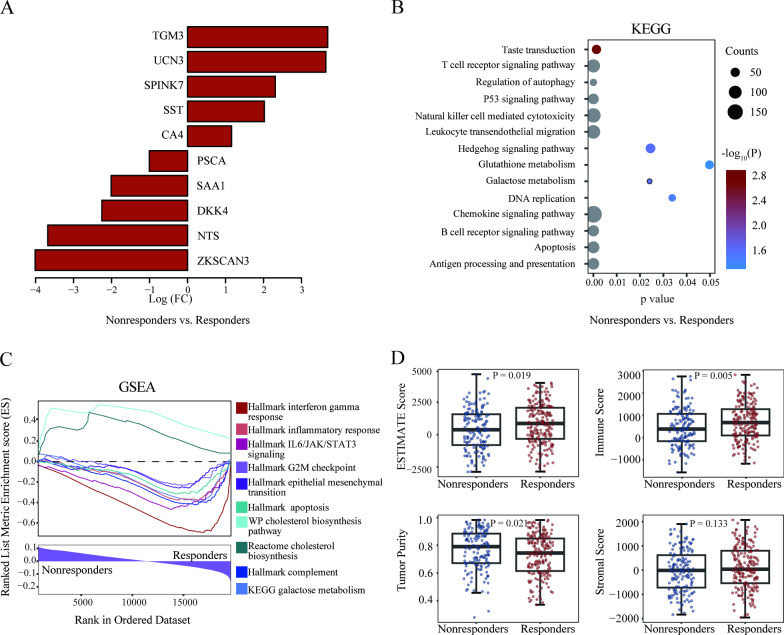
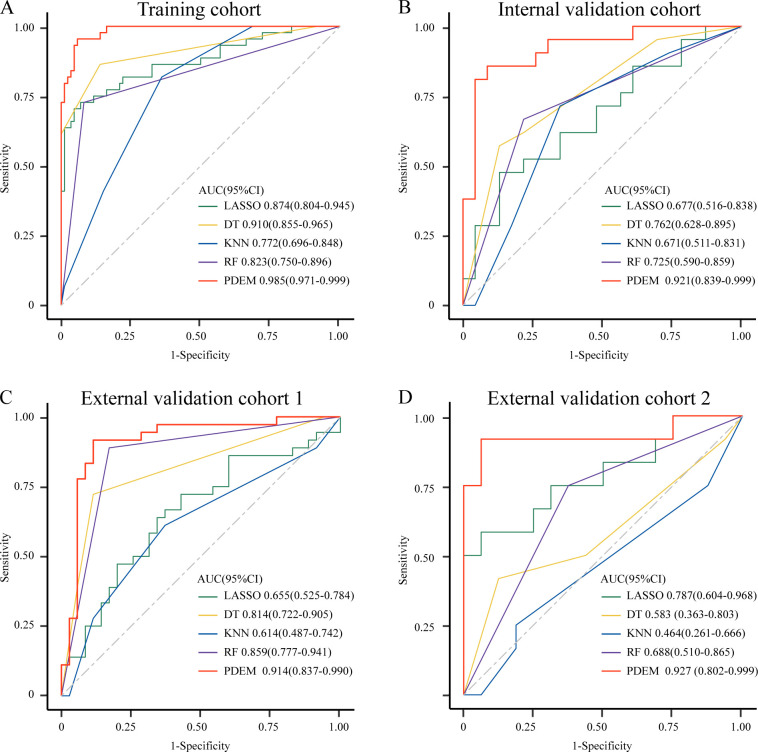
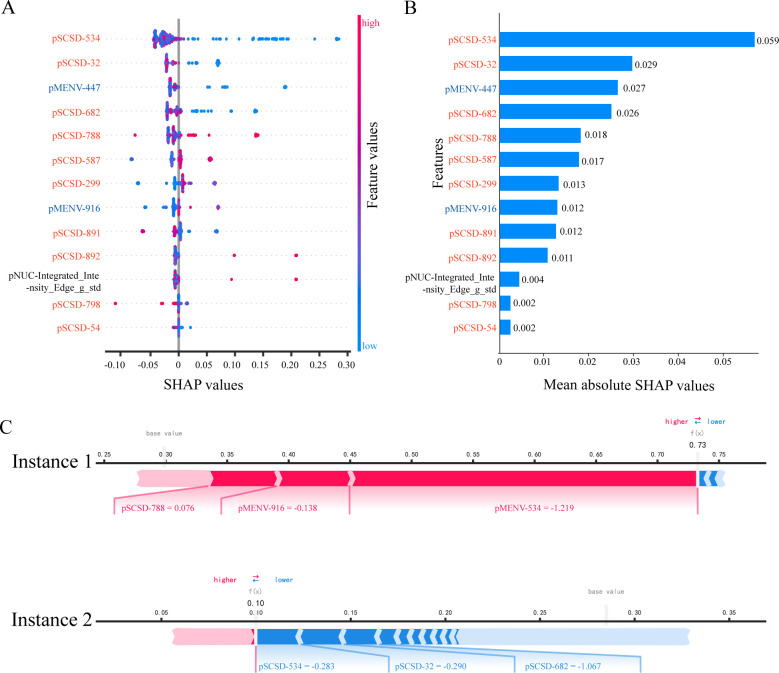
This multicenter study retrospectively collected and analyzed H&E-stained WSIs and clinical data from 584 patients with gastric cancer. An ensemble model, integrating four classifiers: least absolute shrinkage and selection operator, k-nearest neighbors, decision trees, and random forests, was developed and validated using pathomics features, with the objective of predicting the therapeutic efficacy of immune checkpoint inhibition. Model performance was evaluated using metrics including the area under the curve (AUC), sensitivity, and specificity. Additionally, SHAP (SHapley Additive exPlanations) analysis was used to explain the model's predicted values as the sum of the attribution values for each input feature. Pathogenomics analysis was employed to explain the molecular mechanisms underlying the model's predictions.
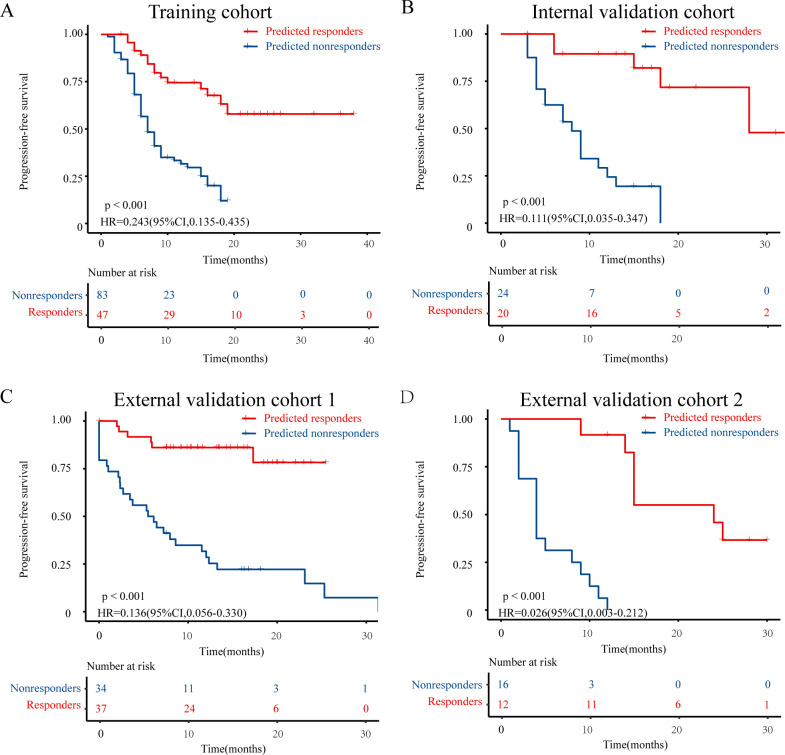
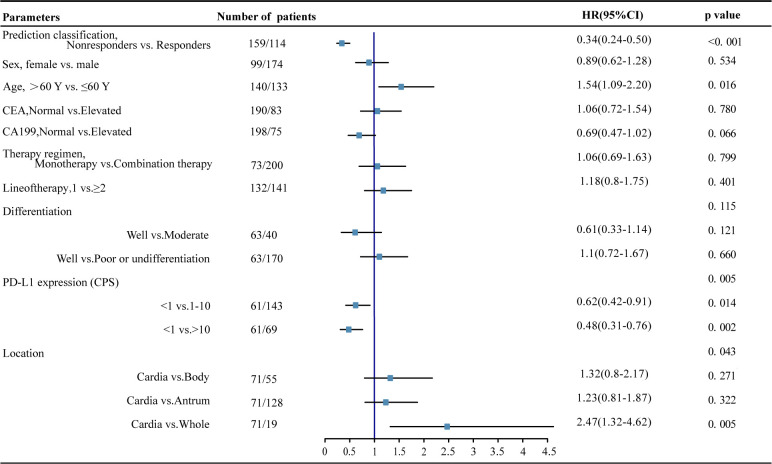
Our pathomics-driven ensemble model effectively stratified the response to ICIs in training cohort (AUC 0.985 (95% CI 0.971 to 0.999)), which was further validated in internal validation cohort (AUC 0.921 (95% CI 0.839 to 0.999)), as well as in external validation cohort 1 (AUC 0.914 (95% CI 0.837 to 0.990)), and external validation cohort 2 (0.927 (95% CI 0.802 to 0.999)). The univariate Cox regression analysis revealed that the prediction signature of pathomics-driven ensemble model was a prognostic factor for progression-free survival in patients with gastric cancer who underwent immunotherapy (p<0.001, HR 0.35 (95% CI 0.24 to 0.50)), and remained an independent predictor after multivariable Cox regression adjusted for clinicopathological variables, (including sex, age, carcinoembryonic antigen, carbohydrate antigen 19-9, therapy regime, line of therapy, differentiation, location and programmed death ligand 1 (PD-L1) expression in all patients (p<0.001, HR 0.34 (95% CI 0.24 to 0.50)). Pathogenomics analysis suggested that the ensemble model is driven by molecular-level immune, cancer, metabolism-related pathways, and was correlated with the immune-related characteristics, including immune score, Estimation of STromal and Immune cells in MAlignant Tumor tissues using Expression data score, and tumor purity.
Our pathomics-driven ensemble model exhibited high accuracy and robustness in predicting the response to ICIs using WSIs. Therefore, it could serve as a novel and valuable tool to facilitate precision immunotherapy.
只有一部分胃癌患者能从免疫检查点抑制剂(ICI)中获得长期获益。目前,对于ICI 疗效的精确预测生物标志物还存在不足。本研究旨在开发和验证一种基于病理组学的综合模型,以使用 H&E 染色全切片图像(WSI)预测胃癌对 ICI 的反应。
这项多中心研究回顾性地收集和分析了来自 584 名胃癌患者的 H&E 染色 WSI 和临床数据。该综合模型整合了四个分类器:最小绝对收缩和选择算子、k 最近邻、决策树和随机森林,使用病理组学特征进行开发和验证,目的是预测免疫检查点抑制的治疗效果。使用曲线下面积(AUC)、敏感性和特异性等指标评估模型性能。此外,还使用 SHAP(SHapley Additive exPlanations)分析来解释模型的预测值,即将每个输入特征的归因值相加。对病原体组学分析进行了研究,以解释模型预测的分子机制。
我们的基于病理组学的综合模型在训练队列中有效地对 ICI 反应进行了分层(AUC 0.985(95%CI 0.971 至 0.999)),并在内部验证队列中进一步得到验证(AUC 0.921(95%CI 0.839 至 0.999)),以及在外部验证队列 1(AUC 0.914(95%CI 0.837 至 0.990))和外部验证队列 2(0.927(95%CI 0.802 至 0.999))。单因素 Cox 回归分析显示,基于病理组学的综合模型的预测特征是接受免疫治疗的胃癌患者无进展生存期的预后因素(p<0.001,HR 0.35(95%CI 0.24 至 0.50)),并且在调整了临床病理变量(包括性别、年龄、癌胚抗原、碳水化合物抗原 19-9、治疗方案、治疗线、分化、位置和程序性死亡配体 1(PD-L1)表达)后,仍然是独立的预测因素所有患者(p<0.001,HR 0.34(95%CI 0.24 至 0.50))。病原体组学分析表明,该综合模型由分子水平的免疫、癌症、代谢相关途径驱动,并与免疫相关特征相关,包括免疫评分、使用表达数据估计的基质和免疫细胞在恶性肿瘤组织中的评分以及肿瘤纯度。
我们的基于病理组学的综合模型在使用 WSI 预测 ICI 反应方面表现出了很高的准确性和稳健性。因此,它可以作为一种新的有价值的工具,促进精准免疫治疗。