• 文献检索
  • 文档翻译
  • 深度研究
  • 学术资讯
  • Suppr Zotero 插件Zotero 插件
  • 邀请有礼
  • 套餐&价格
  • 历史记录
应用&插件
Suppr Zotero 插件Zotero 插件浏览器插件Mac 客户端Windows 客户端微信小程序
定价
高级版会员购买积分包购买API积分包
服务
文献检索文档翻译深度研究API 文档MCP 服务
关于我们
关于 Suppr公司介绍联系我们用户协议隐私条款
关注我们

Suppr 超能文献

核心技术专利:CN118964589B侵权必究
粤ICP备2023148730 号-1Suppr @ 2026

文献检索

告别复杂PubMed语法,用中文像聊天一样搜索,搜遍4000万医学文献。AI智能推荐,让科研检索更轻松。

立即免费搜索

文件翻译

保留排版,准确专业,支持PDF/Word/PPT等文件格式,支持 12+语言互译。

免费翻译文档

深度研究

AI帮你快速写综述,25分钟生成高质量综述,智能提取关键信息,辅助科研写作。

立即免费体验

英国国民保健制度 (NHS) COVID-19 接触者追踪应用程序的公众采用和信任:定量在线调查研究。

Public Adoption of and Trust in the NHS COVID-19 Contact Tracing App in the United Kingdom: Quantitative Online Survey Study.

机构信息

Horizon Digital Economy Research, University of Nottingham, Nottingham, United Kingdom.

School of Computer Science, University of Nottingham, Nottingham, United Kingdom.

出版信息

J Med Internet Res. 2021 Sep 17;23(9):e29085. doi: 10.2196/29085.

DOI:10.2196/29085
PMID:34406960
原文链接:https://pmc.ncbi.nlm.nih.gov/articles/PMC8451731/
Abstract

BACKGROUND

Digital contact tracing is employed to monitor and manage the spread of COVID-19. However, to be effective the system must be adopted by a substantial proportion of the population. Studies of mostly hypothetical contact tracing apps show generally high acceptance, but little is known about the drivers and barriers to adoption of deployed systems.

OBJECTIVE

The aim of this study was to investigate adoption of and attitudes toward the NHS (National Health Service) COVID-19 smartphone app, the digital contact tracing solution in the United Kingdom.

METHODS

An online survey based on the extended Technology Acceptance Model with the added factor of trust was carried out with a representative sample of the UK population. Statistical analysis showed adoption rates, attitudes toward and trust in the app, and compliance with self-isolation advice and highlighted differences for vulnerable populations (ie, older adults aged 65 years and over and members of Black, Asian, and minority ethnic [BAME] communities).

RESULTS

A total of 1001 participants took part in the study. Around half of the participants who had heard of the NHS COVID-19 mobile phone app (490/963, 50.9%; 95% CI 47.8%-54.0%) had downloaded and kept the app, but more than one-third (345/963, 35.8%; 95% CI 32.8%-38.8%) either did not intend to download it or had deleted it. Significantly more BAME respondents than White respondents had deleted the app (16/115, 13.9%; 95% CI 11.8%-16.0%, vs 65/876, 7.4%; 95% CI 5.8%-9.0%), and significantly more older adults 65 years and over than those under 65 years did not intend to download it (44/127, 34.6%; 95% CI 31.7%-37.5%, vs 220/874, 25.2%; 95% CI 22.5%-27.9%). Broadly, one of the reasons for uptake was to help the NHS and other people, especially among older adults, although significantly fewer BAME participants agreed that they did so to help the NHS. Reported compliance with received notifications to self-isolate was high but was significantly lower than reported intended compliance without received notifications. Only one-fifth (136/699, 19.5%; 95% CI 17.0%-22.0%) of participants understood that the decision to send self-isolation notifications was automated by the app. There were a range of significantly more negative views among BAME participants, including lower trust in the NHS, while older adults were often significantly more positive. Respondents without the app reported significantly lower trust and more negative views toward the app and were less likely to report that they understood how the app works.

CONCLUSIONS

While compliance on the part of the approximately 50% of participants who had the app was fairly high, there were issues surrounding trust and understanding that hindered adoption and, therefore, the effectiveness of digital contact tracing, particularly among BAME communities. This study highlights that more needs to be done to improve adoption among groups who are more vulnerable to the effects of the virus in order to enhance uptake and acceptance of contact tracing apps.

摘要

背景

数字接触者追踪被用于监测和管理 COVID-19 的传播。然而,要想使其有效,系统必须被相当一部分人口所采用。对主要是假设性接触追踪应用程序的研究表明,一般接受程度较高,但对于部署系统的采用的驱动因素和障碍知之甚少。

目的

本研究旨在调查英国国民保健服务(NHS)COVID-19 智能手机应用程序(数字接触追踪解决方案)的采用情况和人们对其的态度。

方法

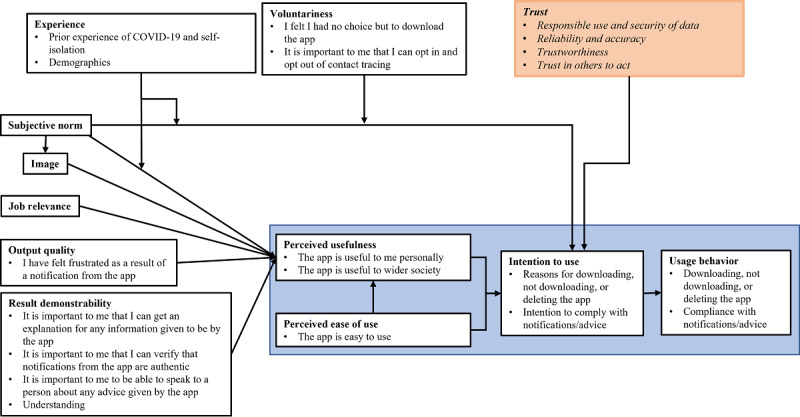
对具有代表性的英国人口进行了基于扩展技术接受模型的在线调查,其中增加了信任因素。统计分析显示了应用程序的采用率、态度和信任度,以及对自我隔离建议的遵守情况,并突出了脆弱人群(即 65 岁及以上的老年人和黑人和少数族裔[BAME]社区的成员)的差异。

结果

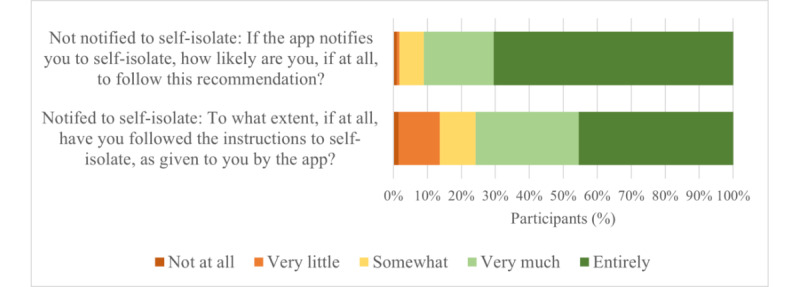
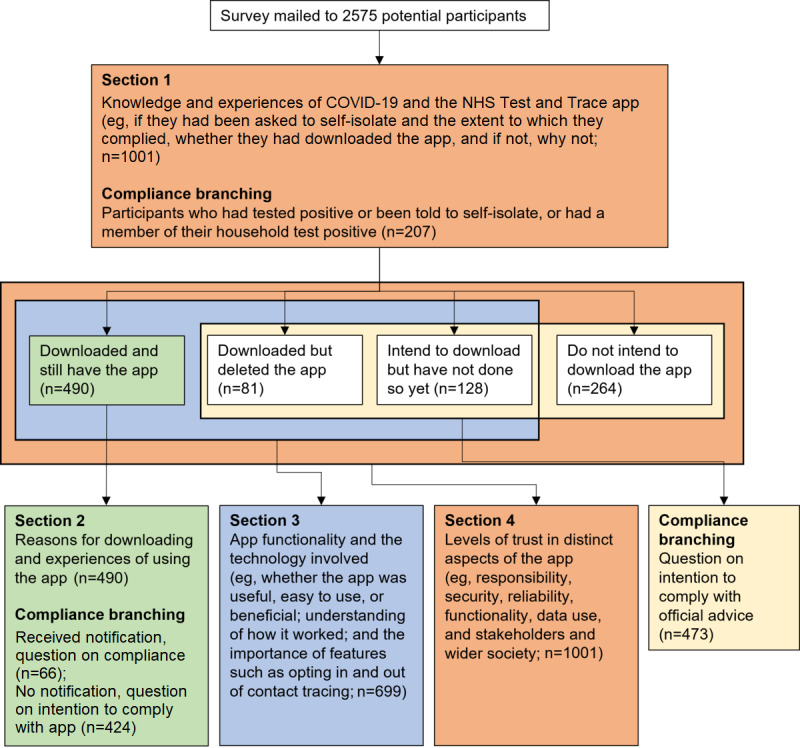
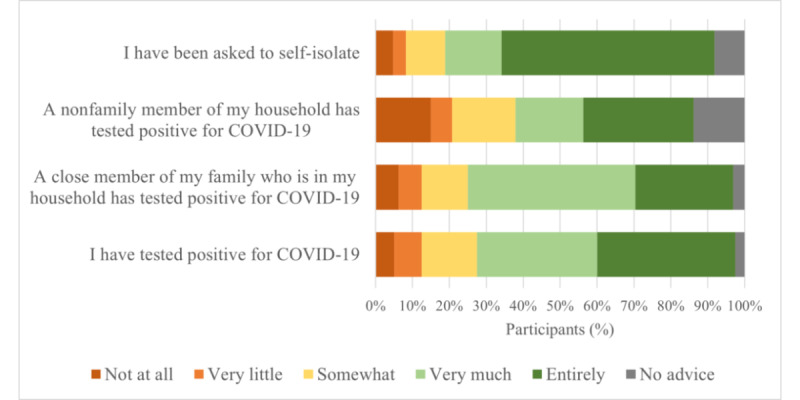
共有 1001 名参与者参加了这项研究。听说过国民保健服务 COVID-19 手机应用程序的参与者中,约有一半(490/963,50.9%;95%CI 47.8%-54.0%)已经下载并保留了该应用程序,但超过三分之一(345/963,35.8%;95%CI 32.8%-38.8%)的参与者要么不打算下载,要么已经删除了该应用程序。与白人受访者相比,BAME 受访者删除该应用程序的比例明显更高(16/115,13.9%;95%CI 11.8%-16.0%,vs 65/876,7.4%;95%CI 5.8%-9.0%),而 65 岁及以上的老年人比 65 岁以下的人更不打算下载该应用程序(44/127,34.6%;95%CI 31.7%-37.5%,vs 220/874,25.2%;95%CI 22.5%-27.9%)。总的来说,采用该应用程序的原因之一是为了帮助 NHS 和其他人,尤其是老年人,尽管 BAME 参与者中表示这样做是为了帮助 NHS 的比例明显较低。报告的自我隔离通知的遵守率很高,但明显低于未收到通知时报告的预期遵守率。只有五分之一(136/699,19.5%;95%CI 17.0%-22.0%)的参与者了解到,应用程序自动决定发送自我隔离通知。BAME 参与者的看法明显更为负面,包括对 NHS 的信任度较低,而老年人的看法往往更为积极。没有该应用程序的受访者对该应用程序的信任度和看法明显较低,并且不太可能表示他们了解该应用程序的工作原理。

结论

虽然大约 50%拥有该应用程序的参与者的遵守率相当高,但在信任和理解方面存在一些问题,这些问题阻碍了应用程序的采用,从而影响了数字接触追踪的有效性,尤其是在 BAME 社区。本研究强调,需要做更多的工作来提高那些更容易受到病毒影响的群体的采用率,以增强接触者追踪应用程序的采用和接受度。
https://cdn.ncbi.nlm.nih.gov/pmc/blobs/810b/8451731/a7b6f7f4801b/jmir_v23i9e29085_fig4.jpg
https://cdn.ncbi.nlm.nih.gov/pmc/blobs/810b/8451731/0c1abf6f74b3/jmir_v23i9e29085_fig1.jpg
https://cdn.ncbi.nlm.nih.gov/pmc/blobs/810b/8451731/0657e89f13d0/jmir_v23i9e29085_fig2.jpg
https://cdn.ncbi.nlm.nih.gov/pmc/blobs/810b/8451731/b13f5c5df0c0/jmir_v23i9e29085_fig3.jpg
https://cdn.ncbi.nlm.nih.gov/pmc/blobs/810b/8451731/a7b6f7f4801b/jmir_v23i9e29085_fig4.jpg
https://cdn.ncbi.nlm.nih.gov/pmc/blobs/810b/8451731/0c1abf6f74b3/jmir_v23i9e29085_fig1.jpg
https://cdn.ncbi.nlm.nih.gov/pmc/blobs/810b/8451731/0657e89f13d0/jmir_v23i9e29085_fig2.jpg
https://cdn.ncbi.nlm.nih.gov/pmc/blobs/810b/8451731/b13f5c5df0c0/jmir_v23i9e29085_fig3.jpg
https://cdn.ncbi.nlm.nih.gov/pmc/blobs/810b/8451731/a7b6f7f4801b/jmir_v23i9e29085_fig4.jpg

相似文献

1
Public Adoption of and Trust in the NHS COVID-19 Contact Tracing App in the United Kingdom: Quantitative Online Survey Study.英国国民保健制度 (NHS) COVID-19 接触者追踪应用程序的公众采用和信任:定量在线调查研究。
J Med Internet Res. 2021 Sep 17;23(9):e29085. doi: 10.2196/29085.
2
Understanding Trust and Changes in Use After a Year With the NHS COVID-19 Contact Tracing App in the United Kingdom: Longitudinal Mixed Methods Study.理解信任和在英国使用 NHS COVID-19 接触者追踪应用程序一年后的变化:纵向混合方法研究。
J Med Internet Res. 2022 Oct 14;24(10):e40558. doi: 10.2196/40558.
3
The relationship between trust and attitudes towards the COVID-19 digital contact-tracing app in the UK.英国民众对 COVID-19 数字接触追踪应用程序的信任与态度之间的关系。
PLoS One. 2022 Oct 27;17(10):e0276661. doi: 10.1371/journal.pone.0276661. eCollection 2022.
4
Drivers of Acceptance of COVID-19 Proximity Tracing Apps in Switzerland: Panel Survey Analysis.瑞士 COVID-19 接触追踪应用接受度的驱动因素:面板调查分析。
JMIR Public Health Surveill. 2021 Jan 6;7(1):e25701. doi: 10.2196/25701.
5
Using Venn Diagrams to Evaluate Digital Contact Tracing: Panel Survey Analysis.使用文氏图评估数字接触者追踪:面板调查分析。
JMIR Public Health Surveill. 2021 Dec 6;7(12):e30004. doi: 10.2196/30004.
6
Reasons for Nonuse, Discontinuation of Use, and Acceptance of Additional Functionalities of a COVID-19 Contact Tracing App: Cross-sectional Survey Study.新冠接触者追踪应用程序的未使用、停用和接受额外功能的原因:横断面调查研究。
JMIR Public Health Surveill. 2022 Jan 14;8(1):e22113. doi: 10.2196/22113.
7
Public attitudes towards COVID-19 contact tracing apps: A UK-based focus group study.公众对 COVID-19 接触者追踪应用程序的态度:基于英国的焦点小组研究。
Health Expect. 2021 Apr;24(2):377-385. doi: 10.1111/hex.13179. Epub 2021 Jan 12.
8
Prosociality and the Uptake of COVID-19 Contact Tracing Apps: Survey Analysis of Intergenerational Differences in Japan.亲社会行为与 COVID-19 接触者追踪应用程序的采用:日本代际差异的调查分析。
JMIR Mhealth Uhealth. 2021 Aug 19;9(8):e29923. doi: 10.2196/29923.
9
Acceptability of App-Based Contact Tracing for COVID-19: Cross-Country Survey Study.基于应用程序的 COVID-19 接触者追踪的可接受性:跨国调查研究。
JMIR Mhealth Uhealth. 2020 Aug 28;8(8):e19857. doi: 10.2196/19857.
10
Adaptation and Utilization of a Postmarket Evaluation Model for Digital Contact Tracing Mobile Health Tools in the United States: Observational Cross-sectional Study.美国数字接触者追踪移动健康工具的上市后评估模型的调整和利用:观察性横断面研究。
JMIR Public Health Surveill. 2023 Mar 22;9:e38633. doi: 10.2196/38633.

引用本文的文献

1
Predicting digital contact tracing tool adoption during COVID-19 from the perspective of TAM: The role of trust, fear, privacy, anxiety, and social media.从技术接受模型的角度预测COVID-19期间数字接触追踪工具的采用:信任、恐惧、隐私、焦虑和社交媒体的作用。
Digit Health. 2025 May 5;11:20552076251336271. doi: 10.1177/20552076251336271. eCollection 2025 Jan-Dec.
2
"A one-stop shop": Real-world use and app-users' experiences of a psychoeducational smartphone app for adults with ADHD.“一站式服务”:一款针对患有注意力缺陷多动障碍的成年人的心理教育智能手机应用程序在现实世界中的使用情况及应用用户体验
Internet Interv. 2025 Feb 4;39:100807. doi: 10.1016/j.invent.2025.100807. eCollection 2025 Mar.
3

本文引用的文献

1
COVID-19 vaccine hesitancy in an ethnically diverse community: descriptive findings from the Born in Bradford study.种族多元化社区中对新冠疫苗的犹豫态度:来自布拉德福德出生队列研究的描述性结果
Wellcome Open Res. 2021 Aug 16;6:23. doi: 10.12688/wellcomeopenres.16576.2. eCollection 2021.
2
The epidemiological impact of the NHS COVID-19 app.NHS COVID-19 应用程序的流行病学影响。
Nature. 2021 Jun;594(7863):408-412. doi: 10.1038/s41586-021-03606-z. Epub 2021 May 12.
3
Researching COVID-19 tracing app acceptance: incorporating theory from the technological acceptance model.
"ChatGPT says no": agency, trust, and blame in Twitter discourses after the launch of ChatGPT.
“ChatGPT 表示否定”:ChatGPT 推出后推特话语中的机构、信任与指责
AI Ethics. 2025;5(1):653-675. doi: 10.1007/s43681-023-00414-1. Epub 2024 Jan 23.
4
Identifying Barriers to the Adoption of Digital Contact Tracing Apps in England: Semistructured Interview Study With Professionals Involved in the Pandemic Response.识别英国采用数字接触者追踪应用程序的障碍:对参与疫情应对的专业人员进行的半结构化访谈研究
JMIR Form Res. 2024 Aug 12;8:e56000. doi: 10.2196/56000.
5
Exploring individual's public trust in the NHS Test and Trace System - A pragmatic reflexive thematic analysis.探索个体对英国国民医疗服务体系检测与追踪系统的公众信任——一项务实的反思性主题分析。
Internet Interv. 2024 Apr 4;36:100740. doi: 10.1016/j.invent.2024.100740. eCollection 2024 Jun.
6
Perceptions of the Agency and Responsibility of the NHS COVID-19 App on Twitter: Critical Discourse Analysis.在 Twitter 上对国民保健署 (NHS) COVID-19 应用程序的看法:批评性话语分析。
J Med Internet Res. 2024 Feb 1;26:e50388. doi: 10.2196/50388.
7
Adoption of a COVID-19 Contact Tracing App by Czech Youth: Cross-Cultural Replication Study.采用 COVID-19 接触者追踪应用程序的捷克青年:跨文化复制研究。
JMIR Hum Factors. 2023 Nov 16;10:e45481. doi: 10.2196/45481.
8
Individual level analysis of digital proximity tracing for COVID-19 in Belgium highlights major bottlenecks.比利时对 COVID-19 的数字接触追踪的个体层面分析凸显出主要瓶颈。
Nat Commun. 2023 Oct 23;14(1):6717. doi: 10.1038/s41467-023-42518-6.
9
An open-source digital contact tracing system tailored to haulage.一款专为运输行业量身定制的开源数字接触者追踪系统。
Front Digit Health. 2023 Jul 19;5:1199635. doi: 10.3389/fdgth.2023.1199635. eCollection 2023.
10
The reception of public health messages during the COVID-19 pandemic.新冠疫情期间公众健康信息的接收情况。
Appl Corpus Linguistics. 2023 Apr;3(1):100037. doi: 10.1016/j.acorp.2022.100037. Epub 2022 Nov 3.
研究新冠病毒接触者追踪应用程序的接受度:纳入技术接受模型的理论
PeerJ Comput Sci. 2021 Jan 4;7:e316. doi: 10.7717/peerj-cs.316. eCollection 2021.
4
Predictors of COVID-19 vaccine hesitancy in the UK household longitudinal study.英国家庭纵向研究中 COVID-19 疫苗犹豫的预测因素。
Brain Behav Immun. 2021 May;94:41-50. doi: 10.1016/j.bbi.2021.03.008. Epub 2021 Mar 11.
5
Ethnic inequalities in health-related quality of life among older adults in England: secondary analysis of a national cross-sectional survey.英格兰老年人健康相关生活质量的种族不平等:一项全国性横断面调查的二次分析。
Lancet Public Health. 2021 Mar;6(3):e145-e154. doi: 10.1016/S2468-2667(20)30287-5. Epub 2021 Jan 29.
6
Drivers of Acceptance of COVID-19 Proximity Tracing Apps in Switzerland: Panel Survey Analysis.瑞士 COVID-19 接触追踪应用接受度的驱动因素:面板调查分析。
JMIR Public Health Surveill. 2021 Jan 6;7(1):e25701. doi: 10.2196/25701.
7
Belief of having had unconfirmed Covid-19 infection reduces willingness to participate in app-based contact tracing.认为曾感染过未经确诊的新冠病毒会降低参与基于应用程序的接触者追踪的意愿。
NPJ Digit Med. 2020 Nov 6;3(1):146. doi: 10.1038/s41746-020-00357-5.
8
A national survey of attitudes to COVID-19 digital contact tracing in the Republic of Ireland.爱尔兰共和国对 COVID-19 数字接触追踪的全国性态度调查。
Ir J Med Sci. 2021 Aug;190(3):863-887. doi: 10.1007/s11845-020-02389-y. Epub 2020 Oct 16.
9
Attitudes and opinions on quarantine and support for a contact-tracing application in France during the COVID-19 outbreak.法国 COVID-19 疫情期间对隔离的态度和意见,以及对接触者追踪应用程序的支持。
Public Health. 2020 Nov;188:21-31. doi: 10.1016/j.puhe.2020.08.026. Epub 2020 Oct 12.
10
Concerns and Misconceptions About the Australian Government's COVIDSafe App: Cross-Sectional Survey Study.对澳大利亚政府 COVIDSafe 应用的担忧和误解:横断面调查研究。
JMIR Public Health Surveill. 2020 Nov 4;6(4):e23081. doi: 10.2196/23081.