Committee on Medical Physics, University of Chicago, Chicago, IL, 60637, USA.
Department of Radiology, Weill Cornell Medicine, New York, NY, 10021, USA.
Sci Rep. 2021 Nov 23;11(1):22805. doi: 10.1038/s41598-021-02030-7.
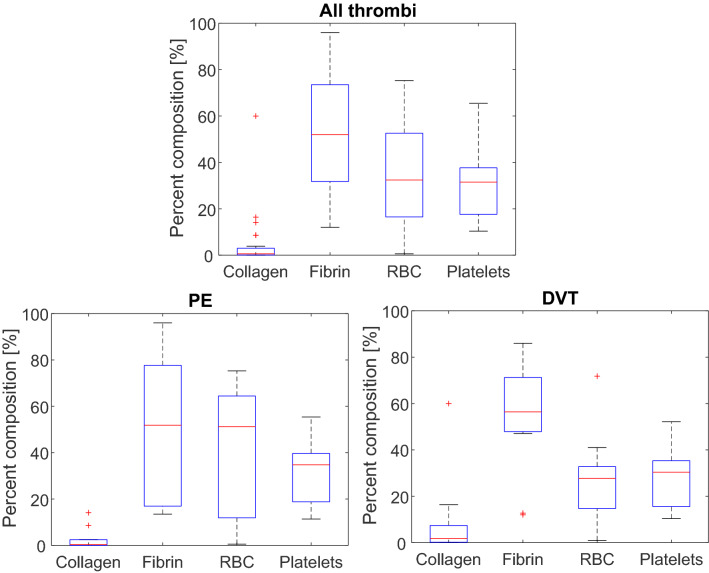
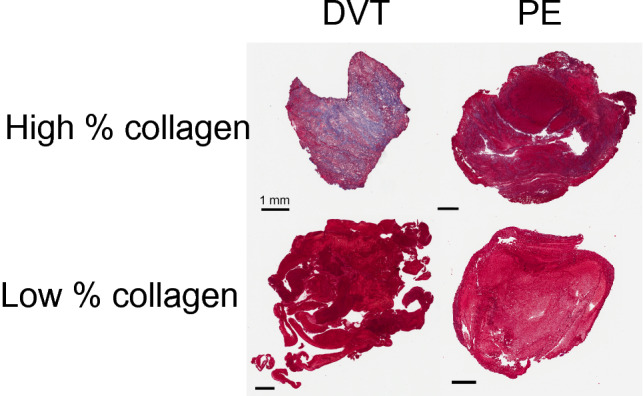
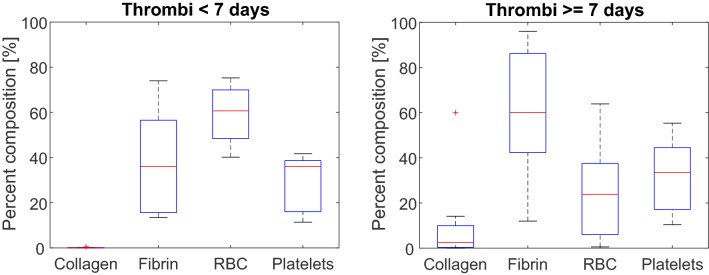
Venous thromboembolism is a significant source of morbidity and mortality worldwide. Catheter-directed thrombolytics is the primary treatment used to relieve critical obstructions, though its efficacy varies based on the thrombus composition. Non-responsive portions of the specimen often remain in situ, which prohibits mechanistic investigation of lytic resistance or the development of diagnostic indicators for treatment outcomes. In this study, thrombus samples extracted from venous thromboembolism patients were analyzed ex vivo to determine their histological properties, susceptibility to lytic therapy, and imaging characteristics. A wide range of thrombus morphologies were observed, with a dependence on age and etymology of the specimen. Fibrinolytic inhibitors including PAI-1, alpha 2-antiplasmin, and TAFI were present in samples, which may contribute to the response venous thrombi to catheter-directed thrombolytics. Finally, a weak but significant correlation was observed between the response of the sample to lytic drug and its magnetic microstructure assessed with a quantitative MRI sequence. These findings highlight the myriad of changes in venous thrombi that may promote lytic resistance, and imaging metrics that correlate with treatment outcomes.
静脉血栓栓塞是全球范围内发病率和死亡率的重要来源。导管定向溶栓是用于缓解危急阻塞的主要治疗方法,但其疗效因血栓组成而异。标本中无反应的部分往往仍留在原处,这妨碍了对溶栓抵抗的机制研究或治疗结果的诊断指标的开发。在这项研究中,从静脉血栓栓塞患者中提取的血栓样本进行了离体分析,以确定其组织学特性、对溶栓治疗的敏感性和成像特征。观察到广泛的血栓形态,这取决于标本的年龄和病因。在样本中存在纤维蛋白溶解抑制剂,包括 PAI-1、α2-抗纤溶酶和 TAFI,这可能导致静脉血栓对导管定向溶栓的反应。最后,观察到样本对溶栓药物的反应与其用定量 MRI 序列评估的磁微观结构之间存在微弱但显著的相关性。这些发现强调了静脉血栓中可能促进溶栓抵抗的多种变化,以及与治疗结果相关的成像指标。