Department of Breast Surgery, Harbin Medical University Cancer Hospital, Harbin, China.
CAS Key Laboratory of Tissue Microenvironment and Tumor, Shanghai Institute of Nutrition and Health, University of Chinese Academy of Sciences, Chinese Academy of Sciences, Shanghai, China.
Theranostics. 2021 Oct 11;11(20):9821-9832. doi: 10.7150/thno.62187. eCollection 2021.
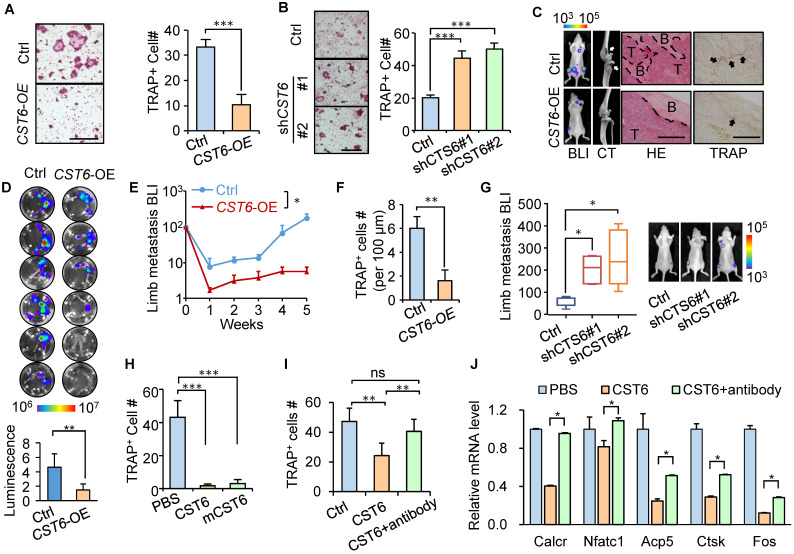
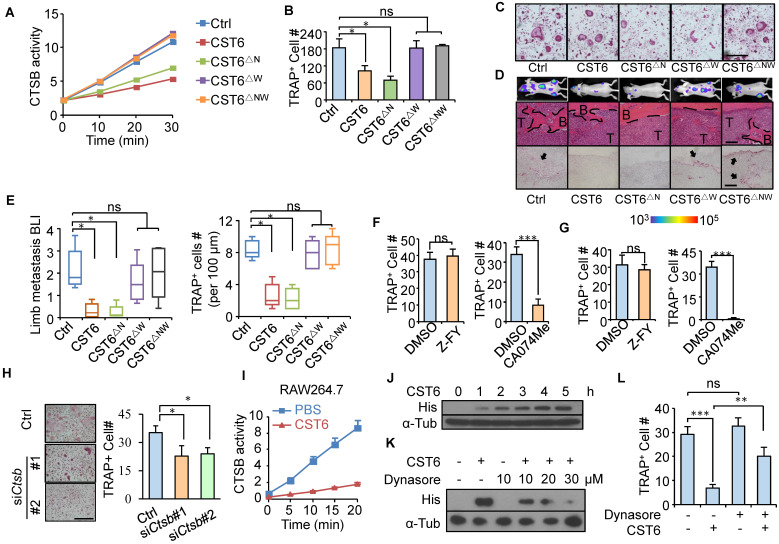
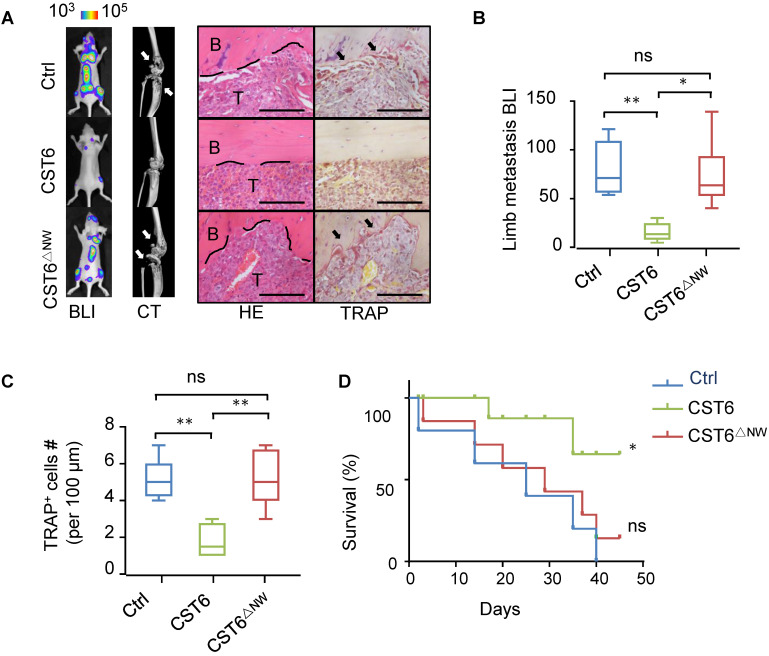
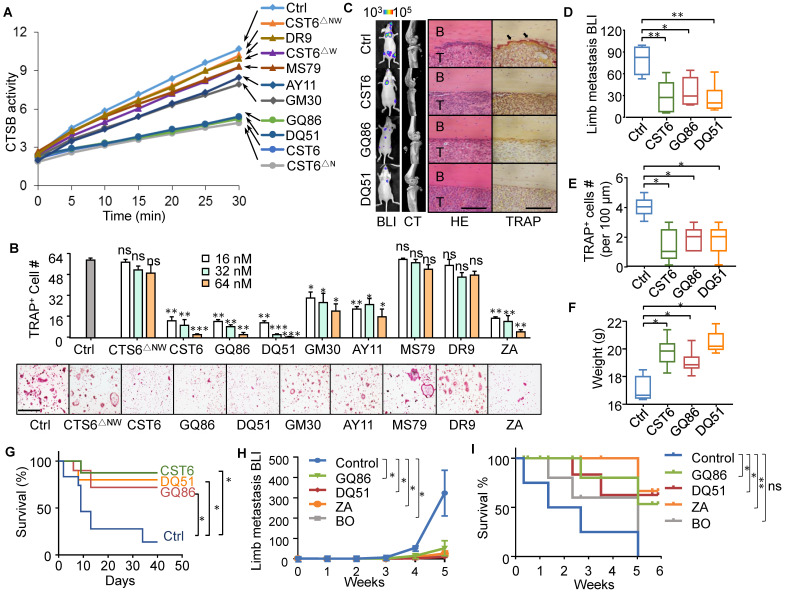
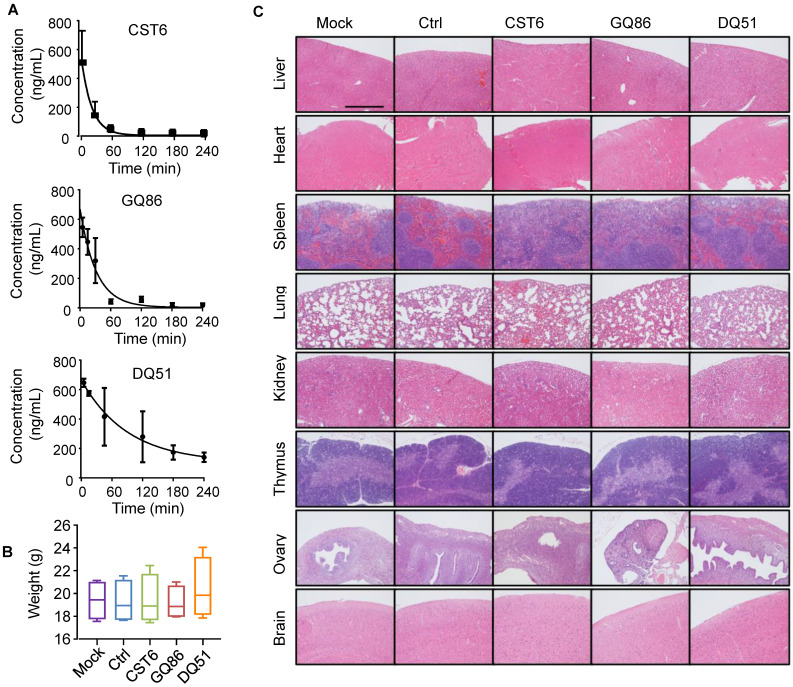
Bone metastasis is a frequent symptom of breast cancer and current targeted therapy has limited efficacy. Osteoclasts play critical roles to drive osteolysis and metastatic outgrowth of tumor cells in bone. Previously we identified CST6 as a secretory protein significantly downregulated in bone-metastatic breast cancer cells. Functional analysis showed that CST6 suppresses breast-to-bone metastasis in animal models. However, the functional mechanism and therapeutic potential of CST6 in bone metastasis is unknown. Using osteoclastogenesis and metastasis assays, we studied the effect and mechanism of extracellular CST6 protein in suppressing osteoclastic niches and bone metastasis of breast cancer. A number of peptides containing the functional domain of CST6 were screened to inhibit bone metastasis. The efficacy, stability and toxicity of CST6 recombinant protein and peptides were evaluated in preclinical metastasis models. We show here that CST6 inhibits osteolytic bone metastasis by inhibiting osteoclastogenesis. Cancer cell-derived CST6 enters osteoclasts by endocytosis and suppresses the cysteine protease CTSB, leading to up-regulation of the CTSB hydrolytic substrate SPHK1. SPHK1 suppresses osteoclast maturation by inhibiting the RANKL-induced p38 activation. Importantly, recombinant CST6 protein effectively suppresses bone metastasis and . We further identified several peptides mimicking the function of CST6 to suppress cancer cell-induced osteoclastogenesis and bone metastasis. Pre-clinical analyses of CTS6 recombinant protein and peptides demonstrated their potentials in treatment of breast cancer bone metastasis. These findings reveal the CST6-CTSB-SPHK1 signaling axis in osteoclast differentiation and provide a promising approach to treat bone diseases with CST6-based peptides.
骨转移是乳腺癌的常见症状,目前的靶向治疗效果有限。破骨细胞在驱动肿瘤细胞在骨中的溶骨性和转移性生长中起关键作用。我们之前发现 CST6 是一种在骨转移的乳腺癌细胞中显著下调的分泌蛋白。功能分析表明 CST6 抑制了动物模型中的乳腺癌向骨转移。然而,CST6 在骨转移中的功能机制和治疗潜力尚不清楚。 通过破骨细胞生成和转移测定,我们研究了细胞外 CST6 蛋白抑制破骨细胞龛和乳腺癌骨转移的作用和机制。筛选了含有 CST6 功能域的多种肽来抑制骨转移。在临床前转移模型中评估了 CST6 重组蛋白和肽的疗效、稳定性和毒性。 我们在这里表明,CST6 通过抑制破骨细胞生成来抑制溶骨性骨转移。癌细胞衍生的 CST6 通过内吞作用进入破骨细胞,并抑制半胱氨酸蛋白酶 CTSB,导致 CTSB 水解底物 SPHK1 的上调。SPHK1 通过抑制 RANKL 诱导的 p38 激活来抑制破骨细胞成熟。重要的是,重组 CST6 蛋白有效地抑制了骨转移。我们进一步鉴定了几种模拟 CST6 功能的肽,以抑制癌细胞诱导的破骨细胞生成和骨转移。CTS6 重组蛋白和肽的临床前分析表明它们具有治疗乳腺癌骨转移的潜力。 这些发现揭示了 CST6-CTSB-SPHK1 信号轴在破骨细胞分化中的作用,并为基于 CST6 的肽治疗骨疾病提供了一种有前途的方法。