Nguyen Bichlien H, Takahashi Christopher N, Gupta Gagan, Smith Jake A, Rouse Richard, Berndt Paul, Yekhanin Sergey, Ward David P, Ang Siena D, Garvan Patrick, Parker Hsing-Yeh, Carlson Rob, Carmean Douglas, Ceze Luis, Strauss Karin
Microsoft Research, Redmond, WA, USA.
Paul G. Allen School of Computer Science and Engineering, University of Washington, Seattle, WA, USA.
Sci Adv. 2021 Nov 26;7(48):eabi6714. doi: 10.1126/sciadv.abi6714. Epub 2021 Nov 24.
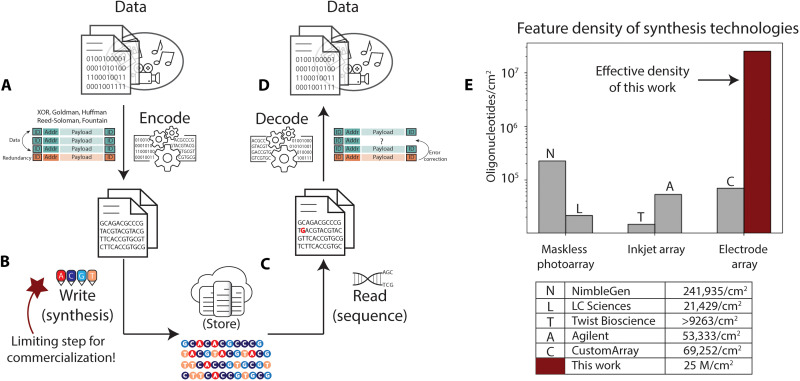
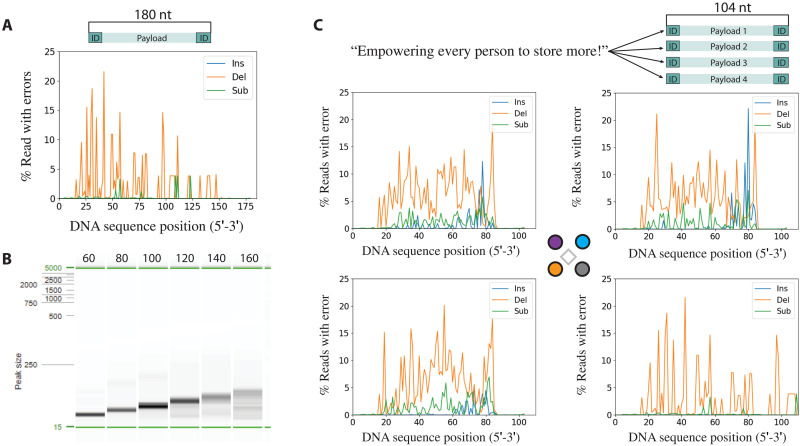
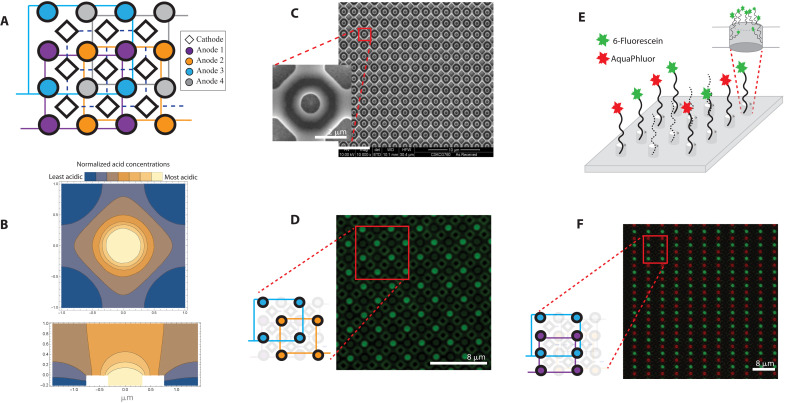
Synthetic DNA is an attractive medium for long-term data storage because of its density, ease of copying, sustainability, and longevity. Recent advances have focused on the development of new encoding algorithms, automation, preservation, and sequencing technologies. Despite progress in these areas, the most challenging hurdle in deployment of DNA data storage remains the write throughput, which limits data storage capacity. We have developed the first nanoscale DNA storage writer, which we expect to scale DNA write density to 25 × 10 sequences per square centimeter, three orders of magnitude improvement over existing DNA synthesis arrays. We show confinement of DNA synthesis to an area under 1 square micrometer, parallelized over millions of nanoelectrode wells and then successfully write and decode a message in DNA. DNA synthesis on this scale will enable write throughputs to reach megabytes per second and is a key enabler to a practical DNA data storage system.
合成DNA因其密度、易于复制、可持续性和长寿性,是一种极具吸引力的长期数据存储介质。最近的进展集中在新编码算法、自动化、保存和测序技术的开发上。尽管在这些领域取得了进展,但DNA数据存储部署中最具挑战性的障碍仍然是写入吞吐量,它限制了数据存储容量。我们开发了首个纳米级DNA存储写入器,预计可将DNA写入密度扩大到每平方厘米25×10个序列,比现有的DNA合成阵列提高三个数量级。我们展示了将DNA合成限制在1平方微米以下的区域,在数百万个纳米电极孔中并行进行,然后成功地在DNA中写入和解码一条信息。这种规模的DNA合成将使写入吞吐量达到每秒兆字节,是实用DNA数据存储系统的关键推动因素。