Heron Emma, McArdle Adelle, Karim Md Nazmul, Cooper Melinda, Geddes Donna, McKenna Leanda
School of Allied Health, Curtin University, Bentley, Western Australia, Australia.
Monash Rural Health, Monash University, Churchill, Victoria, Australia.
PeerJ. 2021 Nov 16;9:e12439. doi: 10.7717/peerj.12439. eCollection 2021.
Inflammatory Conditions of the Lactating Breast (ICLB) affect more than one in five lactating mothers, yet no fully validated outcome measures exist to aid clinicians in their patient-centred care of women with ICLB. The Breast Inflammatory Symptom Severity Index (BISSI) is an ICLB-specific clinician administered patient-reported outcome measure, currently used by Australian clinicians, who treat mothers with ICLB. To date the BISSI has undergone partial psychometric development. This study, therefore, aimed to undertake the next stage of psychometric development by determining the construct validity and internal consistency of the BISSI.
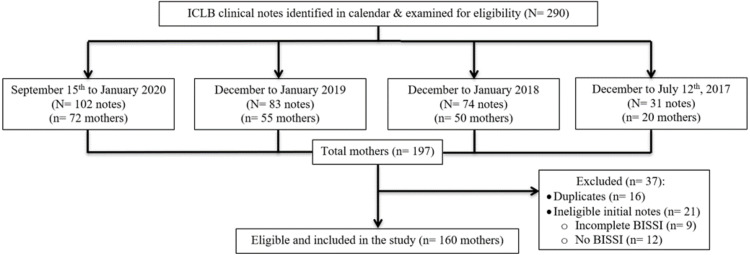
A retrospective audit was conducted on patient records of 160 mothers who were treated for ICLB, at a private physiotherapy practice in Melbourne, Australia. An electronic data capture tool was used to collate BISSI scores and associated ICLB assessment variables. Construct validity was determined through factor analysis and discriminant performance. Reliability was determined by assessing measures of internal consistency.
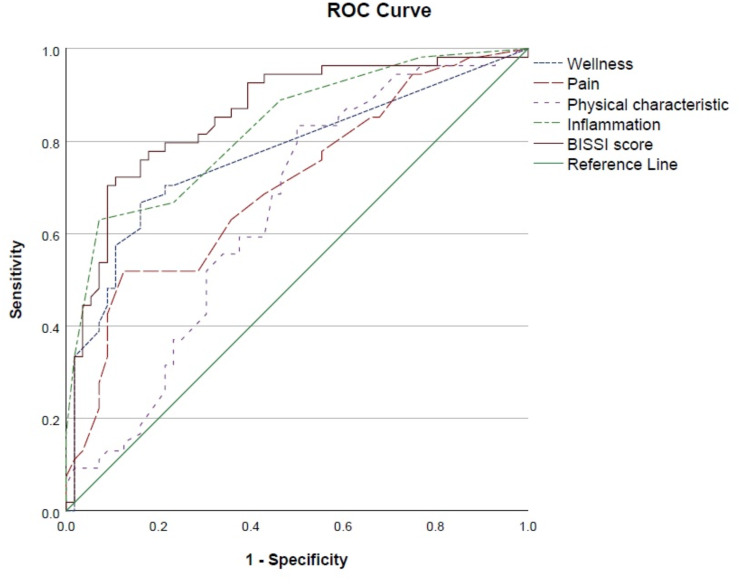
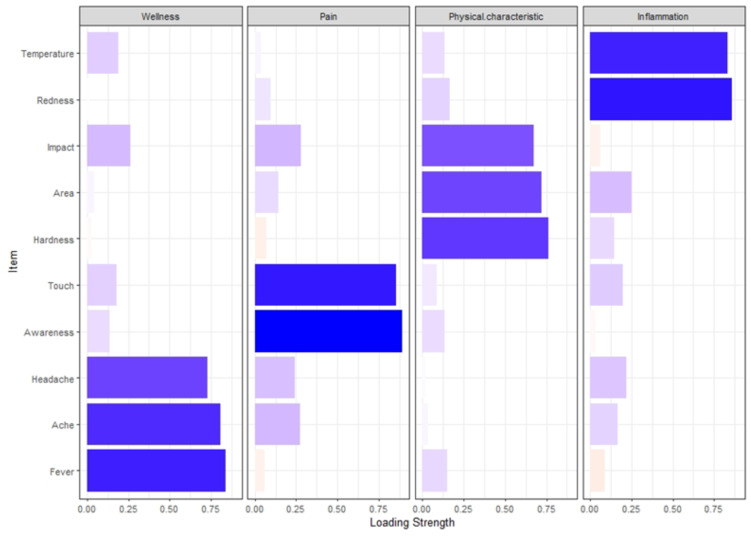
Factor analysis established that BISSI items ( = 10) loaded on to four factors, Wellness, Pain, Physical Characteristics of Affected Area (PCAA), and Inflammation, which together, explained 71.2% of variance. The remaining item ('Wellness/sickness unspecified') did not load. Wellness, Pain, PCAA and Inflammation factors individually and collectively displayed the ability to discriminate symptom severity, as scores were significantly higher in mothers with high symptom severity (assessed via AUC close to or >0.7 and value <0.005 for each factor). The BISSI demonstrated internal consistency with an overall Cronbach alpha of 0.742.
The BISSI has adequate construct validity, demonstrating behaviour consistent with theoretical constructs of inflammation severity, via its dimensionality and ability to discriminate symptom severity. The BISSI also has adequate internal consistency demonstrating reliability. Therefore, clinicians can have confidence that the BISSI is valid, the individual item scores are correlated, and the concepts are consistently measured.
哺乳期乳腺炎(ICLB)影响着五分之一以上的哺乳期母亲,但目前尚无经过充分验证的结局指标来帮助临床医生以患者为中心地护理患有ICLB的女性。乳腺炎症状严重程度指数(BISSI)是一种专门针对ICLB的、由临床医生管理的患者报告结局指标,目前澳大利亚治疗患有ICLB母亲的临床医生正在使用。迄今为止,BISSI已经历了部分心理测量学的发展。因此,本研究旨在通过确定BISSI的结构效度和内部一致性来进行心理测量学发展的下一阶段。
对澳大利亚墨尔本一家私人理疗诊所治疗的160名患有ICLB的母亲的病历进行回顾性审计。使用电子数据采集工具整理BISSI评分和相关的ICLB评估变量。通过因子分析和判别性能确定结构效度。通过评估内部一致性指标来确定信度。
因子分析表明,BISSI项目(n = 10)加载到四个因子上,即健康、疼痛、患侧区域身体特征(PCAA)和炎症,这四个因子共同解释了71.2%的方差。其余项目(“未明确的健康/疾病”)未加载。健康、疼痛、PCAA和炎症因子单独和共同都显示出区分症状严重程度的能力,因为症状严重程度高的母亲(通过AUC接近或>0.7以及每个因子的p值<0.005评估)的得分显著更高。BISSI显示出内部一致性,总体Cronbach α为0.742。
BISSI具有足够的结构效度,通过其维度和区分症状严重程度的能力,表现出与炎症严重程度理论结构一致的行为。BISSI也具有足够的内部一致性,证明了其可靠性。因此,临床医生可以确信BISSI是有效的,各个项目得分相关,并且概念得到了一致的测量。