• 文献检索
  • 文档翻译
  • 深度研究
  • 学术资讯
  • Suppr Zotero 插件Zotero 插件
  • 邀请有礼
  • 套餐&价格
  • 历史记录
应用&插件
Suppr Zotero 插件Zotero 插件浏览器插件Mac 客户端Windows 客户端微信小程序
定价
高级版会员购买积分包购买API积分包
服务
文献检索文档翻译深度研究API 文档MCP 服务
关于我们
关于 Suppr公司介绍联系我们用户协议隐私条款
关注我们

Suppr 超能文献

核心技术专利:CN118964589B侵权必究
粤ICP备2023148730 号-1Suppr @ 2026

文献检索

告别复杂PubMed语法,用中文像聊天一样搜索,搜遍4000万医学文献。AI智能推荐,让科研检索更轻松。

立即免费搜索

文件翻译

保留排版,准确专业,支持PDF/Word/PPT等文件格式,支持 12+语言互译。

免费翻译文档

深度研究

AI帮你快速写综述,25分钟生成高质量综述,智能提取关键信息,辅助科研写作。

立即免费体验

用于哺乳期乳腺炎症性疾病的临床推理模型的改编:一项回顾性混合方法研究。

Adaptation of a clinical reasoning model for use in inflammatory conditions of the lactating breast: a retrospective mixed-methods study.

机构信息

School of Allied Health, Curtin University, Bentley, Western Australia, Australia.

Monash Rural Health, Monash University, Churchill, Victoria, Australia.

出版信息

PeerJ. 2022 Jul 25;10:e13627. doi: 10.7717/peerj.13627. eCollection 2022.

DOI:10.7717/peerj.13627
PMID:35910773
原文链接:https://pmc.ncbi.nlm.nih.gov/articles/PMC9332403/
Abstract

BACKGROUND

Many potential factors associated with Inflammatory Conditions of the Lactating Breast (ICLB) have been reported in the literature, by lactating mothers and clinicians. Clinicians, including general practitioners, lactation consultants and physiotherapists, require a clinical reasoning model that summarises associated or linked factors, to aid in the assessment, treatment, and prevention of ICLB. Thus, we aimed to adapt the existing Breastfeeding Pain Reasoning Model (BPRM), for use in the management of ICLB, using prior research and clinical audit data to guide adaptation. The existing BPRM categorises contributing factors for breastfeeding nipple pain, rather than ICLB.

METHODS

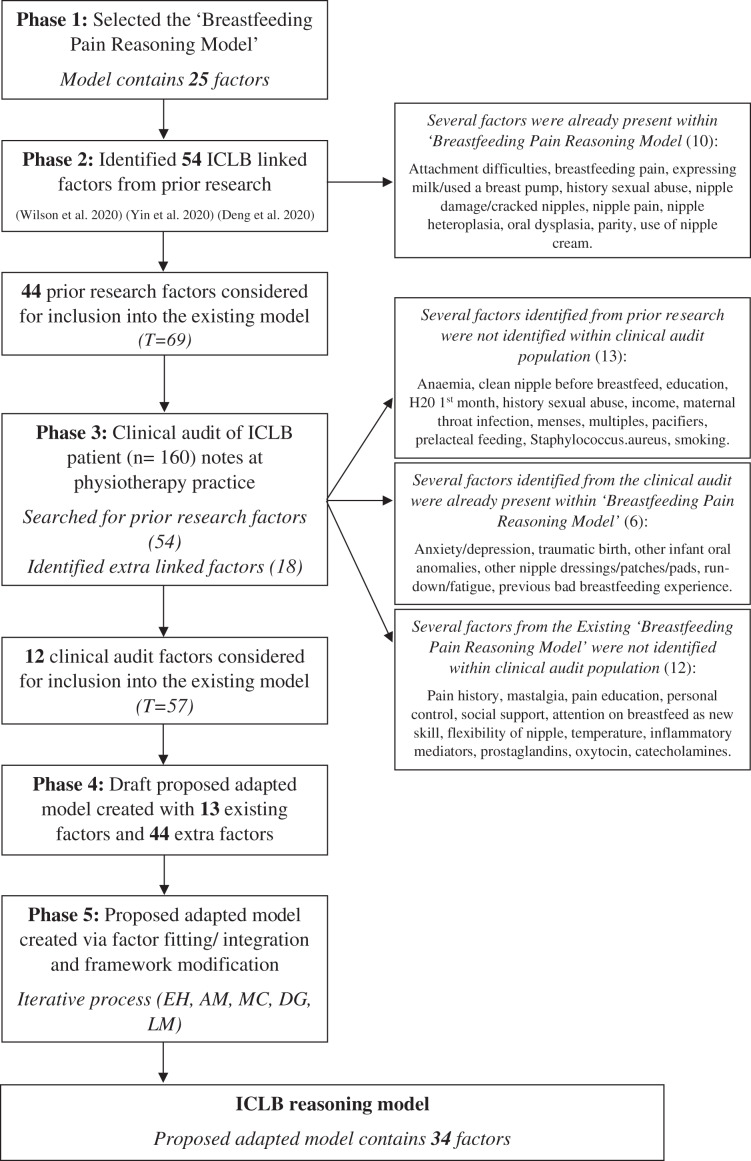
Factors linked with ICLB were identified from prior research and considered for inclusion into the existing model. Clinical data from a retrospective audit of ICLB patient notes at a private physiotherapy practice were also examined. Any factors identified from prior research that could not be identified in the clinical notes were not considered for inclusion into the existing model. Additional factors from the clinical notes that appeared repeatedly were considered for inclusion into the adaptation of the BPRM. A draft adapted model was created comprising all eligible factors, considering their counts and percentages as calculated from the clinical data. The research team iteratively examined all factors for appropriate categorisation and modification within the adapted model.

RESULTS

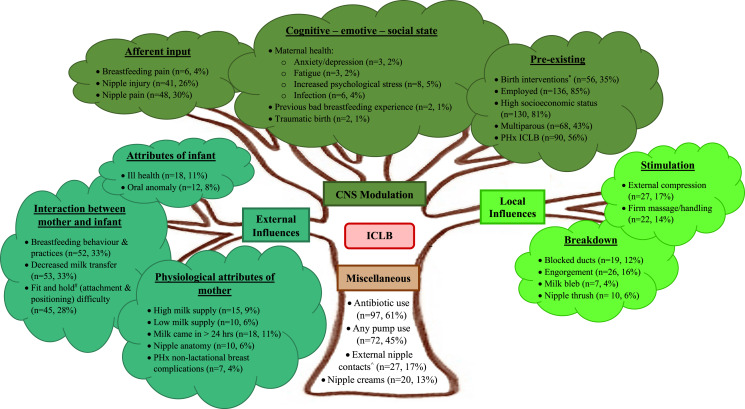
Prior research and data from 160 clinical notes were used to identify factors for inclusion in the adapted model. A total of 57 factors, 13 pre-existing in the BPRM and 44 extra identified from the prior research or clinical audit, comprised the draft adapted model. Factor consolidation and terminology modification resulted in a total of 34 factors in the final proposed adapted ICLB model. The three main categories, CNS modulation, External influences and Local stimulation, from the existing model were maintained, with one minor terminology change to the former Local stimulation category, resulting in 'Local influences' category. Terminology for five subcategories were modified to better reflect the types of factors for ICLB. The most common factors in the adapted model, calculated from the clinical audit population of mothers with ICLB, were employment (85%), high socioeconomic status (81%), antibiotic use during breastfeeding (61%), history of an ICLB (56%), any breast pump use (45%), multiparity (43%), birth interventions (35%), decreased milk transfer (33%), breastfeeding behaviour and practices (33%), nipple pain (30%) and fit and hold (attachment and positioning) difficulty (28%).

CONCLUSION

An ICLB-specific linked factors model is proposed in this paper. Clinicians treating mothers with ICLB can use this model to identify influencing and determining factors of ICLB clinical presentations and provide targeted education and effective treatment plans.
https://cdn.ncbi.nlm.nih.gov/pmc/blobs/0d0a/9332403/0f1a71324fc3/peerj-10-13627-g002.jpg
https://cdn.ncbi.nlm.nih.gov/pmc/blobs/0d0a/9332403/1989ca76d38f/peerj-10-13627-g001.jpg
https://cdn.ncbi.nlm.nih.gov/pmc/blobs/0d0a/9332403/0f1a71324fc3/peerj-10-13627-g002.jpg
https://cdn.ncbi.nlm.nih.gov/pmc/blobs/0d0a/9332403/1989ca76d38f/peerj-10-13627-g001.jpg
https://cdn.ncbi.nlm.nih.gov/pmc/blobs/0d0a/9332403/0f1a71324fc3/peerj-10-13627-g002.jpg
摘要

背景

许多与哺乳期乳腺炎(ICLB)相关的潜在因素已在文献中被哺乳期母亲和临床医生报道。包括全科医生、哺乳顾问和物理治疗师在内的临床医生需要一个临床推理模型来总结相关或关联因素,以帮助评估、治疗和预防 ICLB。因此,我们旨在使用先前的研究和临床审计数据来指导改编,改编现有的母乳喂养疼痛推理模型(BPRM),以用于 ICLB 的管理。现有的 BPRM 对导致母乳喂养乳头疼痛的因素进行了分类,而不是 ICLB。

方法

从先前的研究中确定与 ICLB 相关的因素,并考虑将其纳入现有模型。还检查了私人物理治疗实践中对 ICLB 患者病历进行回顾性审计的临床数据。在临床记录中无法识别的先前研究中确定的任何因素均未被考虑纳入现有模型。从临床记录中反复出现的其他因素被认为是纳入 BPRM 改编的因素。创建了一个包含所有合格因素的草案改编模型,考虑了从临床数据中计算得出的计数和百分比。研究团队迭代地检查了所有因素,以在改编模型中进行适当的分类和修改。

结果

先前的研究和 160 份临床记录的数据用于确定纳入改编模型的因素。共有 57 个因素,其中 13 个是 BPRM 中的现有因素,44 个是从先前的研究或临床审计中确定的额外因素,构成了草案改编模型。通过因素合并和术语修改,最终提出的改编 ICLB 模型中共有 34 个因素。现有的模型中的三个主要类别,即 CNS 调节、外部影响和局部刺激,得到了保留,以前的局部刺激类别更名为“局部影响”类别。五个子类别术语进行了修改,以更好地反映 ICLB 的类型因素。从患有 ICLB 的母亲的临床审计人群中计算出改编模型中最常见的因素为就业(85%)、高社会经济地位(81%)、哺乳期使用抗生素(61%)、有 ICLB 病史(56%)、任何吸奶器使用(45%)、多胎(43%)、分娩干预(35%)、乳汁转移减少(33%)、母乳喂养行为和做法(33%)、乳头疼痛(30%)和贴合和握持(附接和定位)困难(28%)。

结论

本文提出了一种与 ICLB 相关的特定关联因素模型。治疗患有 ICLB 的母亲的临床医生可以使用该模型识别影响 ICLB 临床表现的影响因素和决定因素,并提供有针对性的教育和有效的治疗计划。

相似文献

1
Adaptation of a clinical reasoning model for use in inflammatory conditions of the lactating breast: a retrospective mixed-methods study.用于哺乳期乳腺炎症性疾病的临床推理模型的改编:一项回顾性混合方法研究。
PeerJ. 2022 Jul 25;10:e13627. doi: 10.7717/peerj.13627. eCollection 2022.
2
Exploring physiotherapists' clinical definition and diagnosis of inflammatory conditions of the lactating breast in Australia: a mixed methods study.探索澳大利亚物理治疗师对哺乳期乳房炎症性疾病的临床定义和诊断:混合方法研究。
Int Breastfeed J. 2020 May 24;15(1):48. doi: 10.1186/s13006-020-00294-9.
3
Construct validity and internal consistency of the Breast Inflammatory Symptom Severity Index in lactating mothers with inflammatory breast conditions.患有炎性乳腺疾病的哺乳期母亲的乳腺炎性症状严重程度指数的结构效度和内部一致性。
PeerJ. 2021 Nov 16;9:e12439. doi: 10.7717/peerj.12439. eCollection 2021.
4
Preventing nipple trauma in lactating women in the University Hospital of the University of Sao Paulo: a best practice implementation project.圣保罗大学大学医院预防哺乳期妇女乳头损伤:最佳实践实施项目
JBI Database System Rev Implement Rep. 2015 Mar 12;13(2):212-32. doi: 10.11124/jbisrir-2015-1631.
5
Comparative Effectiveness of Olive Oil and Breast Milk on Nipple Soreness in Breastfeeding Mothers.橄榄油与母乳对母乳喂养母亲乳头疼痛的比较效果
Breastfeed Med. 2023 Oct;18(10):779-784. doi: 10.1089/bfm.2023.0081. Epub 2023 Oct 5.
6
Breast pain in lactating mothers.哺乳期母亲的乳房疼痛。
Hong Kong Med J. 2016 Aug;22(4):341-6. doi: 10.12809/hkmj154762. Epub 2016 Jun 17.
7
Raynaud's phenomenon of the nipple: a treatable cause of painful breastfeeding.乳头雷诺现象:母乳喂养疼痛的一个可治疗病因。
Pediatrics. 2004 Apr;113(4):e360-4. doi: 10.1542/peds.113.4.e360.
8
It's Not Yeast: Retrospective Cohort Study of Lactating Women with Persistent Nipple and Breast Pain.并非酵母感染:哺乳期妇女持续性乳头和乳房疼痛的回顾性队列研究。
Breastfeed Med. 2021 Apr;16(4):318-324. doi: 10.1089/bfm.2020.0160. Epub 2020 Dec 10.
9
In vivo assessment of number of milk duct orifices in lactating women and association with parameters in the mother and the infant.哺乳期女性乳腺导管开口数量的体内评估及其与母婴相关参数的关联。
BMC Pregnancy Childbirth. 2014 Apr 2;14:124. doi: 10.1186/1471-2393-14-124.
10
Implementation of an education package on breast engorgement aimed at lactation consultants and midwives to prevent conflicting information for postnatal mothers.针对哺乳顾问和助产士实施一项关于乳房胀痛的教育计划,以防止产后母亲收到相互矛盾的信息。
Int J Evid Based Healthc. 2017 Mar;15(1):13-21. doi: 10.1097/XEB.0000000000000090.

本文引用的文献

1
Construct validity and internal consistency of the Breast Inflammatory Symptom Severity Index in lactating mothers with inflammatory breast conditions.患有炎性乳腺疾病的哺乳期母亲的乳腺炎性症状严重程度指数的结构效度和内部一致性。
PeerJ. 2021 Nov 16;9:e12439. doi: 10.7717/peerj.12439. eCollection 2021.
2
The suitability and utility of the pain and movement reasoning model for physiotherapy: A qualitative study.疼痛与运动推理模型在物理治疗中的适宜性和实用性:一项定性研究。
Physiother Theory Pract. 2022 Nov;38(13):2757-2770. doi: 10.1080/09593985.2021.1934922. Epub 2021 Jun 10.
3
Maternal Risk Factors for Lactation Mastitis: A Meta-analysis.
哺乳期乳腺炎的母体风险因素:一项荟萃分析。
West J Nurs Res. 2021 Jul;43(7):698-708. doi: 10.1177/0193945920967674. Epub 2020 Oct 22.
4
A conceptual framework for prognostic research.预后研究的概念框架。
BMC Med Res Methodol. 2020 Jun 29;20(1):172. doi: 10.1186/s12874-020-01050-7.
5
Development of a novel patient focussed symptom severity index for use in assessing and treating inflammatory conditions of the lactating breast: a Delphi study.开发一种新的以患者为中心的症状严重程度指数,用于评估和治疗哺乳期乳房炎症性疾病:一项德尔菲研究。
Int J Evid Based Healthc. 2020 Jun;18(2):231-240. doi: 10.1097/XEB.0000000000000225.
6
Exploring physiotherapists' clinical definition and diagnosis of inflammatory conditions of the lactating breast in Australia: a mixed methods study.探索澳大利亚物理治疗师对哺乳期乳房炎症性疾病的临床定义和诊断:混合方法研究。
Int Breastfeed J. 2020 May 24;15(1):48. doi: 10.1186/s13006-020-00294-9.
7
Incidence of and Risk Factors for Lactational Mastitis: A Systematic Review.哺乳期乳腺炎的发病率及危险因素:一项系统综述
J Hum Lact. 2020 Nov;36(4):673-686. doi: 10.1177/0890334420907898. Epub 2020 Apr 14.
8
Comprehensive evaluation of the risk of lactational mastitis in Chinese women: combined logistic regression analysis with receiver operating characteristic curve.中国女性哺乳期乳腺炎风险的综合评估:联合逻辑回归分析与受试者工作特征曲线。
Biosci Rep. 2020 Mar 27;40(3). doi: 10.1042/BSR20190919.
9
The REDCap consortium: Building an international community of software platform partners.REDCap 联盟:构建软件平台合作伙伴的国际社区。
J Biomed Inform. 2019 Jul;95:103208. doi: 10.1016/j.jbi.2019.103208. Epub 2019 May 9.
10
Regional and Facility Differences in Interventions for Mastitis by Australian Physiotherapists.澳大利亚物理治疗师在乳腺炎干预方面的区域和机构差异。
J Hum Lact. 2019 Nov;35(4):695-705. doi: 10.1177/0890334418812041. Epub 2018 Nov 27.