Mutepfe Freedom, Kalejahi Behnam Kiani, Meshgini Saeed, Danishvar Sebelan
Department of Computer Science and Engineering, School of Science and Engineering, Khazar University, Baku, Azerbaijan.
Department of Biomedical Engineering, Faculty of Electrical and Computer Engineering, University of Tabriz, Tabriz, Iran.
J Med Signals Sens. 2021 Oct 20;11(4):237-252. doi: 10.4103/jmss.JMSS_53_20. eCollection 2021 Oct-Dec.
One of the common limitations in the treatment of cancer is in the early detection of this disease. The customary medical practice of cancer examination is a visual examination by the dermatologist followed by an invasive biopsy. Nonetheless, this symptomatic approach is timeconsuming and prone to human errors. An automated machine learning model is essential to capacitate fast diagnoses and early treatment.
The key objective of this study is to establish a fully automatic model that helps Dermatologists in skin cancer handling process in a way that could improve skin lesion classification accuracy.
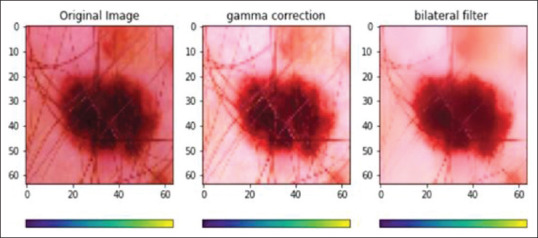
The work is conducted following an implementation of a Deep Convolutional Generative Adversarial Network (DCGAN) using the Python-based deep learning library Keras. We incorporated effective image filtering and enhancement algorithms such as bilateral filter to enhance feature detection and extraction during training. The Deep Convolutional Generative Adversarial Network (DCGAN) needed slightly more fine-tuning to ripe a better return. Hyperparameter optimization was utilized for selecting the best-performed hyperparameter combinations and several network hyperparameters. In this work, we decreased the learning rate from the default 0.001 to 0.0002, and the momentum for Adam optimization algorithm from 0.9 to 0.5, in trying to reduce the instability issues related to GAN models and at each iteration the weights of the discriminative and generative network were updated to balance the loss between them. We endeavour to address a binary classification which predicts two classes present in our dataset, namely benign and malignant. More so, some wellknown metrics such as the receiver operating characteristic -area under the curve and confusion matrix were incorporated for evaluating the results and classification accuracy.
The model generated very conceivable lesions during the early stages of the experiment and we could easily visualise a smooth transition in resolution along the way. Thus, we have achieved an overall test accuracy of 93.5% after fine-tuning most parameters of our network.
This classification model provides spatial intelligence that could be useful in the future for cancer risk prediction. Unfortunately, it is difficult to generate high quality images that are much like the synthetic real samples and to compare different classification methods given the fact that some methods use non-public datasets for training.
癌症治疗中常见的限制之一是疾病的早期检测。癌症检查的常规医疗做法是皮肤科医生进行目视检查,然后进行侵入性活检。然而,这种对症治疗方法既耗时又容易出现人为错误。自动化机器学习模型对于实现快速诊断和早期治疗至关重要。
本研究的主要目标是建立一个全自动模型,以帮助皮肤科医生在皮肤癌处理过程中提高皮肤病变分类的准确性。
该工作是在使用基于Python的深度学习库Keras实现深度卷积生成对抗网络(DCGAN)之后进行的。我们纳入了有效的图像滤波和增强算法,如双边滤波器,以在训练期间增强特征检测和提取。深度卷积生成对抗网络(DCGAN)需要稍微更多的微调才能获得更好的回报。利用超参数优化来选择性能最佳的超参数组合和几个网络超参数。在这项工作中,我们将学习率从默认的0.001降低到0.0002,并将Adam优化算法的动量从0.9降低到0.5,试图减少与GAN模型相关的不稳定性问题,并且在每次迭代时更新判别网络和生成网络的权重以平衡它们之间的损失。我们致力于解决一个二分类问题,该问题预测我们数据集中存在的两类,即良性和恶性。此外,还纳入了一些知名指标,如曲线下面积的接收器操作特征和混淆矩阵,以评估结果和分类准确性。
该模型在实验早期生成了非常逼真的病变,并且我们可以很容易地看到分辨率在此过程中的平滑过渡。因此,在对网络的大多数参数进行微调后,我们实现了93.5%的总体测试准确率。
这种分类模型提供了空间智能,未来可能对癌症风险预测有用。不幸的是,由于一些方法使用非公开数据集进行训练,很难生成非常类似于合成真实样本的高质量图像,也难以比较不同的分类方法。