Palombieri Andrea, Tsachev Ilia, Sarchese Vittorio, Fruci Paola, Di Profio Federica, Pepovich Roman, Baymakova Magdalena, Marsilio Fulvio, Martella Vito, Di Martino Barbara
Faculty of Veterinary Medicine, Università degli Studi di Teramo, 64100 Teramo, Italy.
Department of Microbiology, Infectious and Parasitic Diseases, Faculty of Veterinary Medicine, Trakia University, 6000 Stara Zagora, Bulgaria.
Vet Sci. 2021 Nov 6;8(11):267. doi: 10.3390/vetsci8110267.
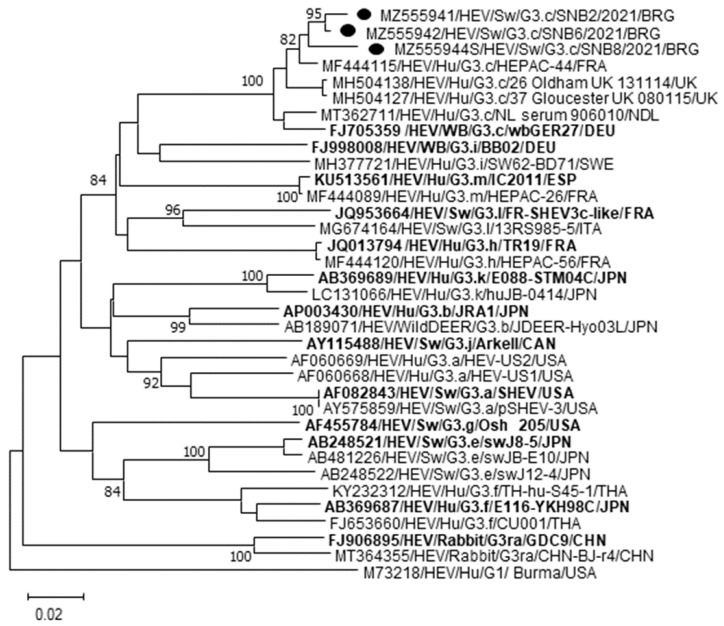
Information on hepatitis E virus (HEV) strains circulating in animal reservoirs in Bulgaria is currently lacking. Herein, by screening HEV seropositive sera obtained from Bulgarian swine and wild boars, viral RNA was detected at high prevalence rate (28.2%) in industrial pigs. Sequence analysis of the partial polymerase (RdRp) region revealed the highest genetic correlation with HEVs of genotype (Gt) 3 identified in French and Dutch patients. For three such strains, a 700-bp fragment of the open reading frame 2 gene was generated. On phylogenetic analysis, the Bulgarian strains clustered tightly (93.8-98.3% nt) with human and animal HEVs classified within the Gt3 subtype c.
目前尚缺乏关于保加利亚动物宿主中流行的戊型肝炎病毒(HEV)毒株的信息。在此,通过筛查从保加利亚猪和野猪获得的HEV血清阳性血清,在工业猪中检测到病毒RNA的流行率很高(28.2%)。对部分聚合酶(RdRp)区域的序列分析显示,与在法国和荷兰患者中鉴定出的基因型(Gt)3的HEV具有最高的遗传相关性。对于其中三个这样的毒株,生成了开放阅读框2基因的700 bp片段。在系统发育分析中,保加利亚毒株与归类于Gt3亚型c的人和动物HEV紧密聚类(核苷酸同源性为93.8 - 98.3%)。