Silva José-Gabriel-Victor-Costa, Martins João-Paulo-Gomes, de Sousa Elizabeth-Barreto-Galvão, Fernandes Nayanna-Lana-Soares, Meira Ingrid-Andrade, Sampaio Fábio-Correia, de Oliveira Andressa-Feitosa-Bezerra, Pereira Ana-Maria-Barros-Chaves
Undergraduate Dentistry Course, Health Sciences Centre, Federal University of Paraíba-UFPB, João Pessoa/Paraíba, Brazil.
Department of Clinical and Social Dentistry, Federal University of Paraíba-UFPB, João Pessoa/Paraíba, Brazil.
J Clin Exp Dent. 2021 Nov 1;13(11):e1076-e1082. doi: 10.4317/jced.57788. eCollection 2021 Nov.
Dental erosion has become a relevant public health problem in recent years and is related to the increase in the consumption of acidic beverages. Objective: The aim of the present study was to evaluate the erosive potential of energy drinks on dental enamel using an in vitro erosion model.
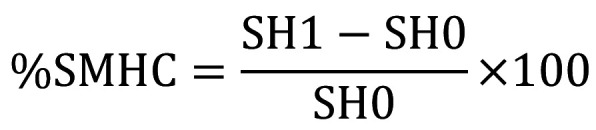
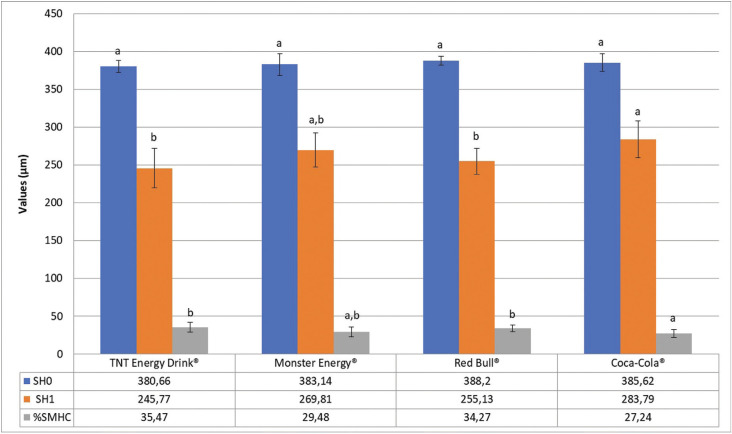
Thirty-eight blocks of human enamel were divided into four groups: G1- TNT Energy Drink®(n=8), G2- Red Bull® (n=10), G3- Monster Energy® (n=10), and G4- Coca-Cola® (n=10) (positive control). For the chemical analysis, the pH values, titratable acidity, and buffering capacity of the beverages were measured in triplicate. For the erosive test, the specimens were immersed in the beverages (5ml/block) for 30 minutes at room temperature with gentle shaking. Initial and final surface microhardness values were measured and the percentage of the loss of surface microhardness was calculated. Profilometry (surface loss and lesion depth) and mineral loss analysis (quantitative light-induced fluorescence) were performed. The data were analysed statistically using ANOVA followed by the Bonferroni correction, Pearson's correlation test, and multiple linear regression (<0.05).
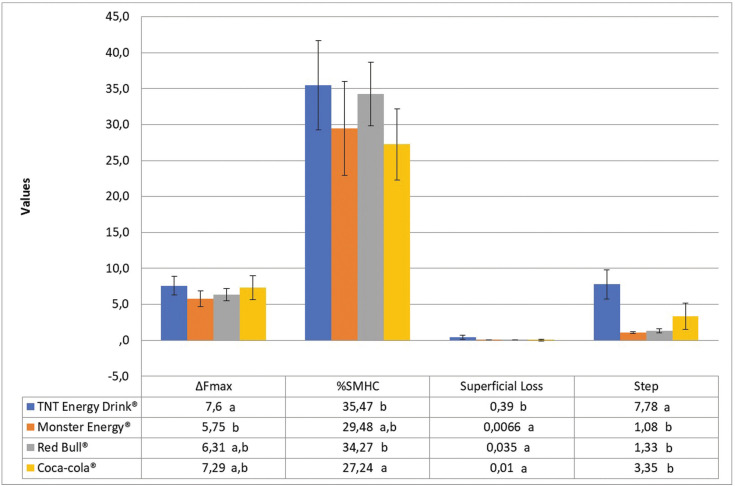
The energy drinks had pH values ranging from 2.36 to 3.41. The lowest titratable acidity value was recorded for Monster Energy® and the highest was recorded for TNT Energy Drink®. All energy drinks had buffering capacity values higher than Coca-Cola®. Analysing the eroded enamel surface, the specimens submitted to TNT Energy Drink® had the greatest percentage loss of surface microhardness, surface loss, depth, and mineral loss, followed by those submitted to Red Bull® and Monster Energy®. Surface loss was the only predictor of mineral loss (<0.001).
Based on the study model employed, all the energy drinks examined were erosive to tooth enamel and TNT Energy Drink® had the worst behaviour. Energy drinks, tooth erosion, tooth demineralisation, hardness tests, quantitative light-induced fluorescence.
近年来,牙齿侵蚀已成为一个重要的公共卫生问题,并且与酸性饮料消费的增加有关。目的:本研究的目的是使用体外侵蚀模型评估能量饮料对牙釉质的侵蚀潜力。
将38块人牙釉质块分为四组:G1 - TNT能量饮料®(n = 8),G2 - 红牛®(n = 10),G3 - 魔爪能量®(n = 10)和G4 - 可口可乐®(n = 10)(阳性对照)。进行化学分析时,对饮料的pH值、可滴定酸度和缓冲能力进行了三次测量。进行侵蚀试验时,将标本在室温下轻轻摇晃的条件下浸泡在饮料中(每块5毫升)30分钟。测量初始和最终表面显微硬度值,并计算表面显微硬度损失的百分比。进行了轮廓测定法(表面损失和病变深度)和矿物质损失分析(定量光诱导荧光)。使用方差分析,随后进行Bonferroni校正、Pearson相关检验和多元线性回归(<0.05)对数据进行统计分析。
能量饮料的pH值范围为2.36至3.41。魔爪能量®的可滴定酸度值最低,TNT能量饮料®的可滴定酸度值最高。所有能量饮料的缓冲能力值均高于可口可乐®。分析侵蚀后的牙釉质表面,接受TNT能量饮料®处理的标本表面显微硬度损失、表面损失、深度和矿物质损失的百分比最大,其次是接受红牛®和魔爪能量®处理的标本。表面损失是矿物质损失的唯一预测指标(<0.001)。
基于所采用的研究模型,所有检测的能量饮料对牙釉质均有侵蚀性,且TNT能量饮料®的侵蚀性最差。能量饮料、牙齿侵蚀、牙齿脱矿、硬度测试、定量光诱导荧光。