Iquebal Mir Asif, Mishra Pallavi, Maurya Ranjeet, Jaiswal Sarika, Rai Anil, Kumar Dinesh
Centre for Agricultural Bioinformatics, ICAR-Indian Agricultural Statistics Research Institute, New Delhi 110012, India.
Biology (Basel). 2021 Nov 9;10(11):1152. doi: 10.3390/biology10111152.
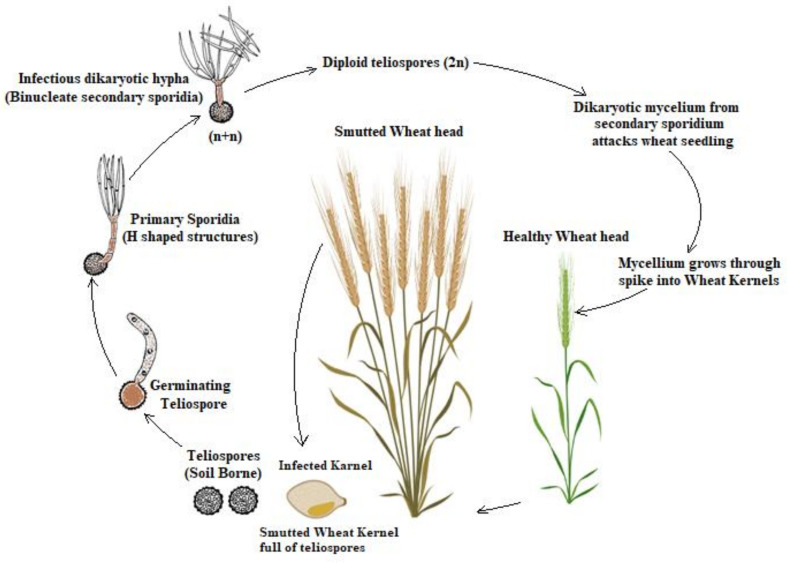
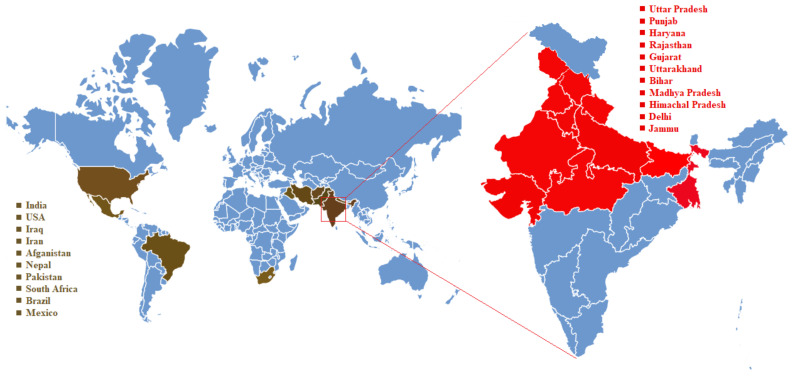
Karnal bunt (KB) of wheat ( L.), known as partial bunt has its origin in Karnal, India and is caused by (Ti). Its incidence had grown drastically since late 1960s from northwestern India to northern India in early 1970s. It is a seed, air and soil borne pathogen mainly affecting common wheat, durum wheat, triticale and other related species. The seeds become inedible, inviable and infertile with the precedence of trimethylamine secreted by teliospores in the infected seeds. Initially the causal pathogen was named but was later renamed . The black powdered smelly spores remain viable for years in soil, wheat straw and farmyard manure as primary sources of inoculum. The losses reported were as high as 40% in India and also the cumulative reduction of national farm income in USA was USD 5.3 billion due to KB. The present review utilizes information from literature of the past 100 years, since 1909, to provide a comprehensive and updated understanding of KB, its causal pathogen, biology, epidemiology, pathogenesis, etc. Next generation sequencing (NGS) is gaining popularity in revolutionizing KB genomics for understanding and improving agronomic traits like yield, disease tolerance and disease resistance. Genetic resistance is the best way to manage KB, which may be achieved through detection of genes/quantitative trait loci (QTLs). The genome-wide association studies can be applied to reveal the association mapping panel for understanding and obtaining the KB resistance locus on the wheat genome, which can be crossed with elite wheat cultivars globally for a diverse wheat breeding program. The review discusses the current NGS-based genomic studies, assembly, annotations, resistant QTLs, GWAS, technology landscape of diagnostics and management of KB. The compiled exhaustive information can be beneficial to the wheat breeders for better understanding of incidence of disease in endeavor of quality production of the crop.
小麦印度腥黑穗病(KB),又称局部腥黑穗病,起源于印度卡纳尔,由小麦印度腥黑粉菌(Ti)引起。自20世纪60年代末起,其发病率从印度西北部急剧上升,到20世纪70年代初蔓延至印度北部。它是一种种传、气传和土传病原体,主要影响普通小麦、硬粒小麦、小黑麦及其他相关物种。受感染种子中的冬孢子分泌三甲胺,导致种子不可食用、无法存活且不育。最初,致病病原体被命名为小麦印度腥黑粉菌,但后来被重新命名为小麦印度腥黑穗病菌。黑色粉末状有臭味的孢子在土壤、麦秸和农家肥中可存活数年,作为主要接种源。据报道,印度的损失高达40%,而且在美国,由于小麦印度腥黑穗病,全国农业收入累计减少53亿美元。本综述利用自1909年以来过去100年的文献信息,全面更新了对小麦印度腥黑穗病、其致病病原体、生物学、流行病学、发病机制等的认识。下一代测序(NGS)在革新小麦印度腥黑穗病基因组学以了解和改善产量、抗病性和抗逆性等农艺性状方面越来越受欢迎。遗传抗性是防治小麦印度腥黑穗病的最佳方法,可通过检测基因/数量性状位点(QTL)来实现。全基因组关联研究可用于揭示关联作图群体,以了解和获得小麦基因组上的小麦印度腥黑穗病抗性位点,该位点可与全球优良小麦品种杂交,用于多样化的小麦育种计划。本综述讨论了当前基于NGS的基因组研究、组装、注释、抗性QTL、GWAS、小麦印度腥黑穗病诊断和管理的技术前景。汇编的详尽信息有助于小麦育种者更好地了解该病的发病情况,从而努力实现作物的优质生产。