Song Hai-Yang, Wang Kai-Sheng, Yang Jian-Fa, Mao Hua-Ming, Pu Li-Hua, Zou Yang, Ma Jun, Zhu Xing-Quan, Zou Feng-Cai, He Jun-Jun
Faculty of Animal Science and Technology, Yunnan Agricultural University, Kunming 650201, China.
College of Biology and Pharmacy, Yulin Normal University, Yulin 537000, China.
Animals (Basel). 2021 Oct 20;11(11):3014. doi: 10.3390/ani11113014.
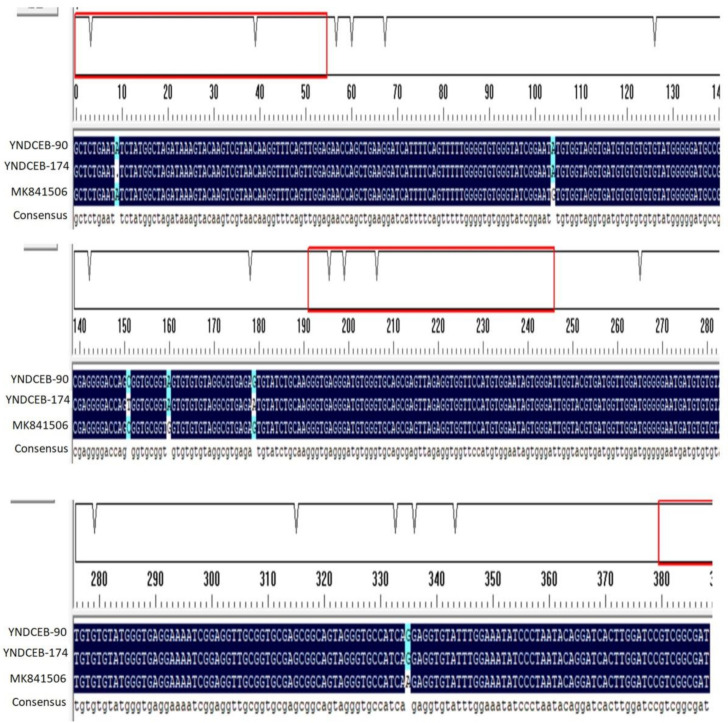
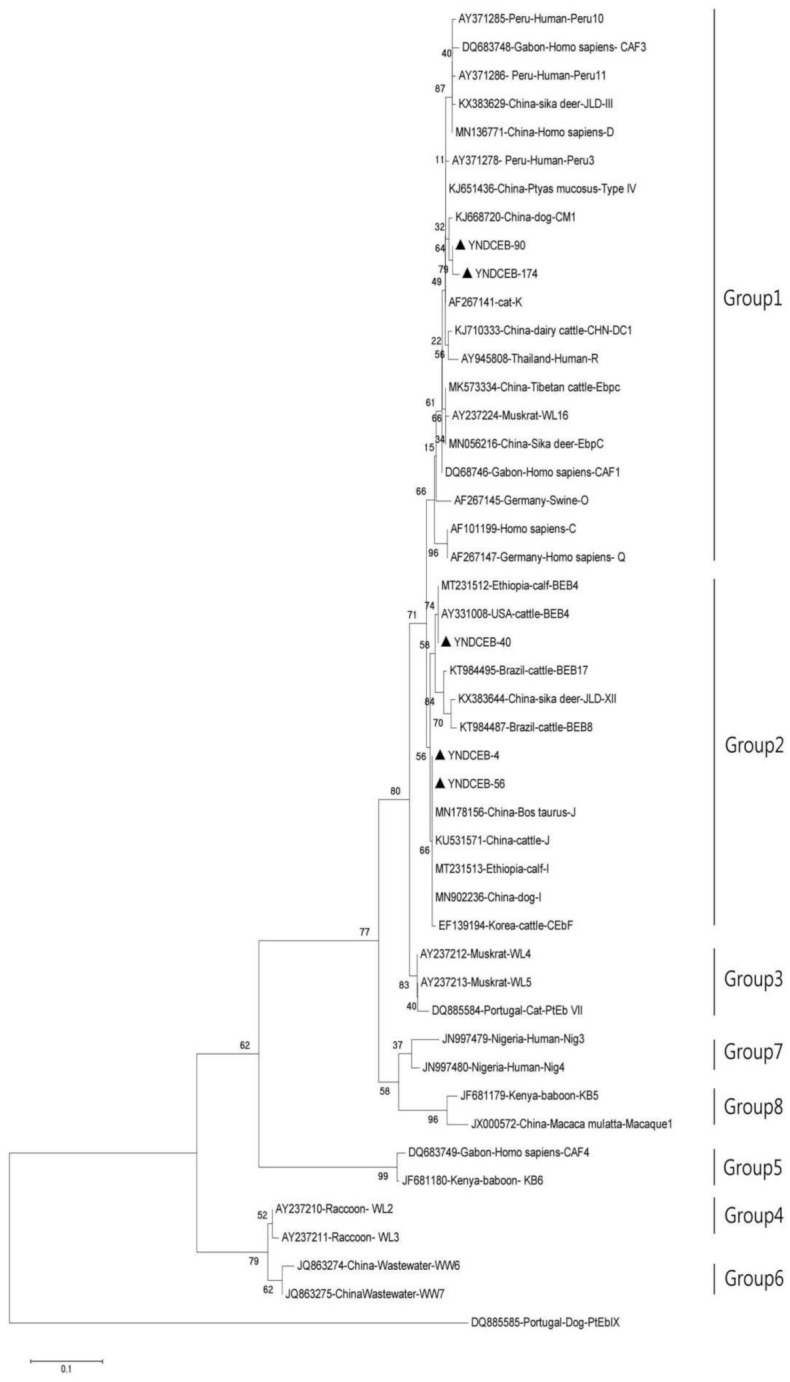
is a fungus-like protist parasite that can cause diarrhea and enteric diseases. The infection of has been reported in many host species, including cattle and humans. However, information on prevalence and genotype distribution of in dairy cattle in Yunnan province in China is still absent. In this study, 490 Holstein Cows and 351 dairy buffalo fecal samples were collected from three regions in Yunnan province, China. By using nest-PCR that targets the internal transcribed spacer (ITS), we found that the prevalence of was 0.59% (5/841). DNA sequence analysis showed that five genotypes were identified in this study, including two novel genotypes, YNDCEB-90 and YNDCEB-174, and three known genotypes (I, J, BEB4). Phylogenetic analysis revealed that two novel genotypes, YNDCEB-90 and YNDCEB-174, were clustered into Group 1, representing the zoonotic potential. The remaining genotypes I, J, and BEB4, which are the most frequent genotypes of infection in cattle and lead to infection in humans, belonged to Group 2. Although the lower prevalence of was detected in dairy cattle in Yunnan province, it indicates that dairy cattle should be considered to be one of the potential hosts for transmitting to humans. These findings are important for the development of effective prevention strategies for microsporidiosis.
是一种类似真菌的原生生物寄生虫,可引起腹泻和肠道疾病。在包括牛和人类在内的许多宿主物种中都有该寄生虫感染的报道。然而,中国云南省奶牛中该寄生虫的流行情况和基因型分布信息仍然缺乏。在本研究中,从中国云南省三个地区采集了490份荷斯坦奶牛和351份奶水牛粪便样本。通过使用针对内部转录间隔区(ITS)的巢式PCR,我们发现该寄生虫的流行率为0.59%(5/841)。DNA序列分析表明,本研究中鉴定出五种该寄生虫基因型,包括两种新基因型YNDCEB - 90和YNDCEB - 174,以及三种已知基因型(I、J、BEB4)。系统发育分析显示,两种新基因型YNDCEB - 90和YNDCEB - 174聚类到第1组,代表有人畜共患病潜力。其余基因型I、J和BEB4是牛感染该寄生虫最常见的基因型,可导致人类感染,属于第2组。虽然在云南省奶牛中检测到该寄生虫的流行率较低,但这表明奶牛应被视为将该寄生虫传播给人类的潜在宿主之一。这些发现对于制定有效的微孢子虫病预防策略很重要。