Fair Cynthia, Thompson Amanda, Barnett Marie, Flowers Stacy, Burke June, Wiener Lori
Department of Public Health Studies, Elon University, Elon, NC 27244, USA.
Inova Schar Cancer Institute, Fairfax, VA 22031, USA.
Children (Basel). 2021 Nov 12;8(11):1045. doi: 10.3390/children8111045.
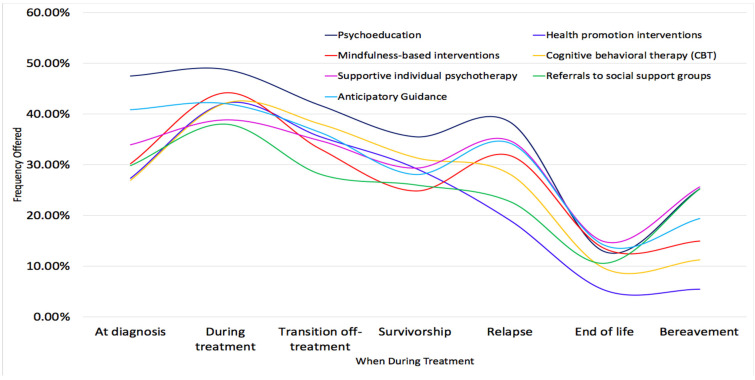
One of the Standards of Psychosocial Care for Children with Cancer and their Families recommends that all youth with cancer and their family members have access to psychotherapeutic interventions and support throughout the cancer trajectory. This study was created to identify the psychosocial interventions and services provided to children with cancer and their family members, to ascertain whether there are differences in interventions provided by age of the patient and stage of treatment, and to learn about barriers to psychosocial service provision. An online survey was disseminated to psychosocial providers through the listservs of national and international professional organizations. The majority of the 242 respondents were either psychologists (39.3%) or social workers (26.9%) and 79.7% worked in the United States. The intervention offered most often to pediatric patients, caregivers, and siblings, at every stage of treatment, was psychoeducation (41.7-48.8%). Evidence-based interventions, including cognitive behavioral therapy (56.6%) and mindfulness-based interventions (57.9%) were reported to be frequently used with patients. Interventions designed specifically for the pediatric oncology population were not commonly endorsed. Psychosocial providers reported quality of care would be improved by additional staff, better communication/collaboration with medical team members and increased community-based resources. Future research should focus on improving accessibility to population-specific evidenced-based interventions and translating science to practice.
《癌症患儿及其家庭心理社会护理标准》之一建议,所有患癌青少年及其家庭成员在整个癌症治疗过程中都能获得心理治疗干预和支持。本研究旨在确定为癌症患儿及其家庭成员提供的心理社会干预措施和服务,确定所提供的干预措施是否因患者年龄和治疗阶段而异,并了解心理社会服务提供的障碍。通过国内和国际专业组织的邮件列表向心理社会服务提供者开展了一项在线调查。242名受访者中,大多数是心理学家(39.3%)或社会工作者(26.9%),79.7%在美国工作。在治疗的每个阶段,最常向儿科患者、照顾者和兄弟姐妹提供的干预措施是心理教育(41.7%-48.8%)。据报告,包括认知行为疗法(56.6%)和正念干预(57.9%)在内的循证干预措施经常用于患者。专门为儿科肿瘤患者设计的干预措施未得到普遍认可。心理社会服务提供者报告称,增加工作人员、改善与医疗团队成员的沟通/协作以及增加社区资源将提高护理质量。未来的研究应侧重于提高针对特定人群的循证干预措施的可及性,并将科学转化为实践。