Ritzel Christian, Mann Stefan
Agroscope, Economic Modelling and Policy Analysis, 8356 Ettenhausen, Switzerland.
Agroscope, Socioeconomics, 8356 Ettenhausen, Switzerland.
Foods. 2021 Nov 15;10(11):2809. doi: 10.3390/foods10112809.
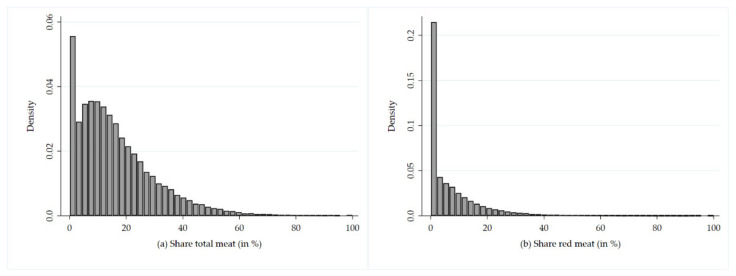
It is not a radically new insight that men eat more meat than women do. However, one piece of the puzzle was previously missing: the development of a gender bias in total and red meat consumption across stages of human life. To identify the gender bias across stages of human life, we apply a multiple-group regression across seven age classes. Data for the empirical analysis stem from the US National Health and Nutrition Examination Survey. Regression results reveal that gender differences in meat consumption start only after the age of four and then move in some parallel with the development of biological differences, reaching a maximum between 51 and 65 years. The effect of both household income and education on meat consumption is negative and per-capita consumption of meat rises with household size.
男性比女性吃更多的肉,这并不是一个全新的见解。然而,之前缺少拼图中的一块:在人类生命的各个阶段,红肉总消费量中存在性别偏见。为了确定人类生命各阶段的性别偏见,我们对七个年龄组进行了多组回归分析。实证分析的数据来自美国国家健康与营养检查调查。回归结果显示,肉类消费的性别差异仅在4岁之后开始,然后在一定程度上与生物差异的发展平行,在51岁至65岁之间达到最大值。家庭收入和教育对肉类消费的影响都是负面的,人均肉类消费量随家庭规模的增加而上升。