Department of Forest Genetics and Plant Physiology, Swedish University of Agricultural Sciences, 90183 Umeå, Sweden.
Department of Clinical and Molecular Medicine, Norwegian University of Science and Technology, 7491 Trondheim, Norway.
Int J Mol Sci. 2021 Nov 17;22(22):12393. doi: 10.3390/ijms222212393.
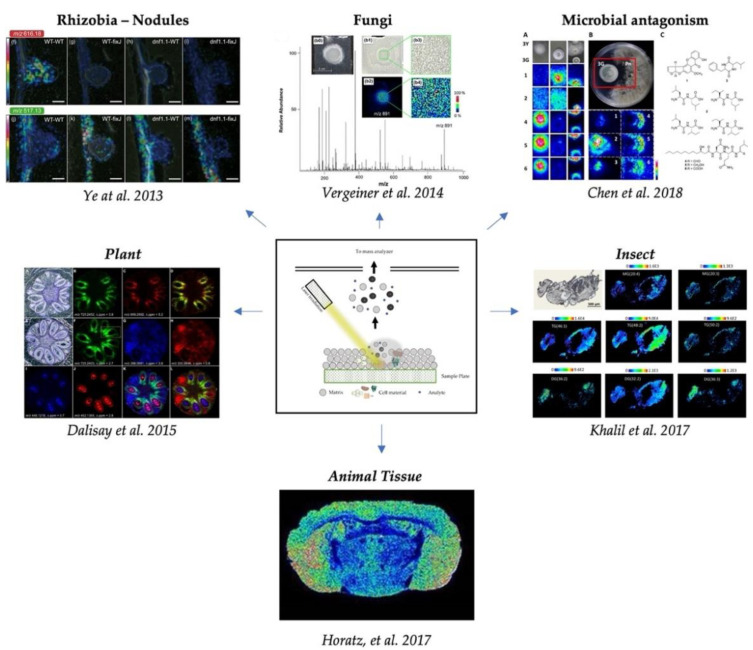
Classic metabolomic methods have proven to be very useful to study functional biology and variation in the chemical composition of different tissues. However, they do not provide any information in terms of spatial localization within fine structures. Matrix-assisted laser desorption ionization mass spectrometry imaging (MALDI MSI) does and reaches at best a spatial resolution of 0.25 μm depending on the laser setup, making it a very powerful tool to analyze the local complexity of biological samples at the cellular level. Here, we intend to give an overview of the diversity of the molecules and localizations analyzed using this method as well as to update on the latest adaptations made to circumvent the complexity of samples. MALDI MSI has been widely used in medical sciences and is now developing in research areas as diverse as entomology, microbiology, plant biology, and plant-microbe interactions, the rhizobia symbiosis being the most exhaustively described so far. Those are the fields of interest on which we will focus to demonstrate MALDI MSI strengths in characterizing the spatial distributions of metabolites, lipids, and peptides in relation to biological questions.
经典代谢组学方法已被证明非常有助于研究功能生物学和不同组织化学成分的变化。然而,它们不能提供任何关于精细结构内空间定位的信息。基质辅助激光解吸电离质谱成像(MALDI MSI)可以做到这一点,并且根据激光设置,其最佳空间分辨率可达 0.25μm,使其成为分析细胞水平生物样品局部复杂性的非常强大的工具。在这里,我们旨在概述使用该方法分析的分子和定位的多样性,并更新为克服样品复杂性而进行的最新适应。MALDI MSI 已广泛应用于医学科学领域,现在正在昆虫学、微生物学、植物生物学和植物-微生物相互作用等多样化的研究领域发展,其中根瘤菌共生是迄今为止描述最详尽的领域。这些是我们将重点关注的感兴趣领域,以证明 MALDI MSI 在描述与生物学问题相关的代谢物、脂质和肽的空间分布方面的优势。