Barańska Agnieszka, Błaszczuk Agata, Kanadys Wiesław, Malm Maria, Drop Katarzyna, Polz-Dacewicz Małgorzata
Department of Medical Informatics and Statistics with E-Learning Lab, Medical University of Lublin, 20-090 Lublin, Poland.
Department of Virology with SARS Laboratory, Medical University of Lublin, 20-059 Lublin, Poland.
Cancers (Basel). 2021 Nov 12;13(22):5654. doi: 10.3390/cancers13225654.
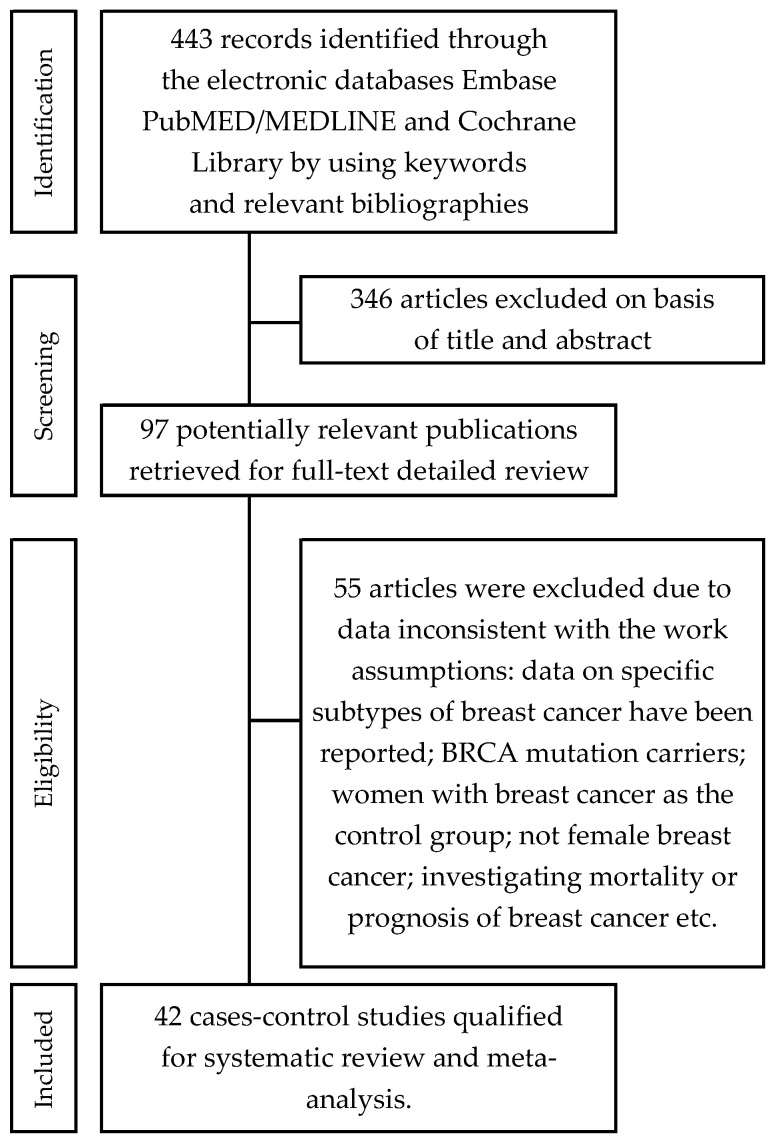
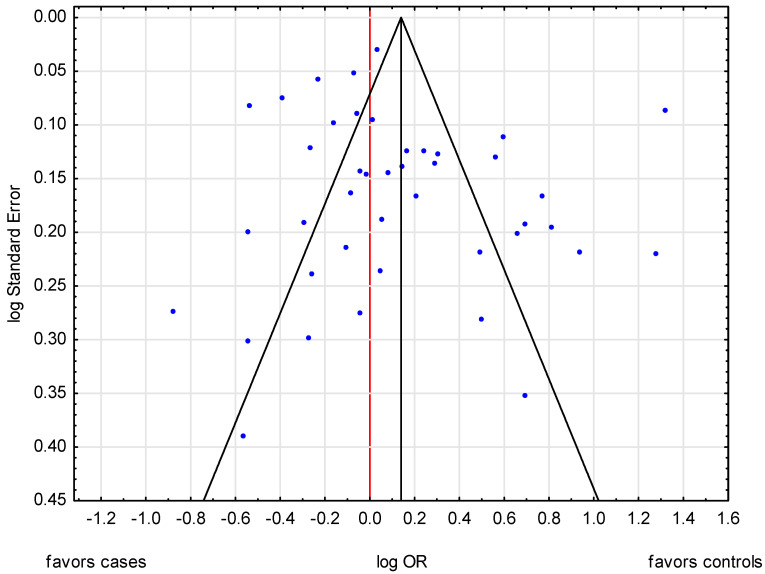
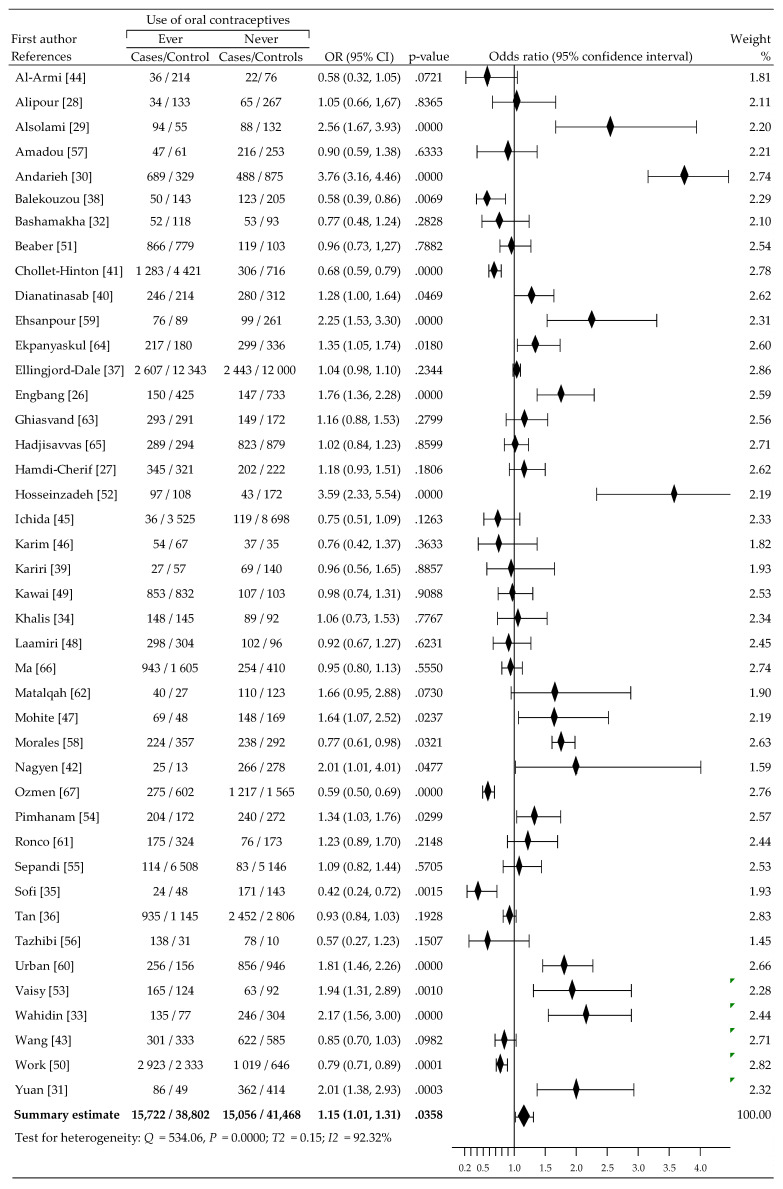
To perform a meta-analysis of case-control studies that addressed the association between oral contraceptive pills (OC) use and breast cancer (BrCa), PubMED (MEDLINE), Embase, and the Cochrane Library were searched to identify case-control studies of OC and BrCa published between 2009 and 2020. We used the DerSimonian-Laird method to compute pooled odds ratios (ORs) and confidence intervals (CIs), and the Mantel-Haenszel test to assess the association between OC use and cancer. Forty-two studies were identified that met the inclusion criteria and we included a total of 110,580 women (30,778 into the BrCa group and 79,802 into the control group, of which 15,722 and 38,334 were using OC, respectively). The conducted meta-analysis showed that the use of OC was associated with a significantly increased risk of BrCa in general, OR = 1.15, 95% CI: 1.01 to 1.31, = 0.0358. Regarding other risk factors for BrCa, we found that increased risk was associated significantly with early menarche, nulliparous, non-breastfeeding, older age at first parity, postmenopause, obesity, smoking, and family history of BrCa. Despite our conclusion that birth control pills increase the cancer risk being supported by extensive previous studies and meta-analyzes, further confirmation is required.
为了对探讨口服避孕药(OC)使用与乳腺癌(BrCa)之间关联的病例对照研究进行荟萃分析,我们检索了PubMed(MEDLINE)、Embase和Cochrane图书馆,以确定2009年至2020年间发表的关于OC与BrCa的病例对照研究。我们使用DerSimonian-Laird方法计算合并比值比(OR)和置信区间(CI),并使用Mantel-Haenszel检验评估OC使用与癌症之间的关联。共识别出42项符合纳入标准的研究,我们总共纳入了110580名女性(30778名进入BrCa组,79802名进入对照组,其中分别有15722名和38334名正在使用OC)。进行的荟萃分析表明,总体而言,使用OC与BrCa风险显著增加相关,OR = 1.15,95% CI:1.01至1.31,P = 0.0358。关于BrCa的其他风险因素,我们发现风险增加与初潮早、未生育、不哺乳、首次生育年龄较大、绝经后、肥胖、吸烟以及BrCa家族史显著相关。尽管我们得出避孕药会增加癌症风险的结论得到了先前大量研究和荟萃分析的支持,但仍需要进一步证实。