State Key Laboratory of Earth Surface Processes and Resource Ecology, Faculty of Geographical Science, Beijing Normal University, Beijing 100875, China.
Institute of Land Surface System and Sustainable Development, Faculty of Geographical Science, Beijing Normal University, Beijing 100875, China.
Int J Environ Res Public Health. 2021 Nov 9;18(22):11753. doi: 10.3390/ijerph182211753.
The outbreak of the COVID-19 epidemic has caused an unprecedented public health crisis and drastically impacted the economy. The relationship between different control measures and economic losses becomes a research hotspot.
In this study, the SEIR infectious disease model was revised and coupled with an economic model to quantify this nonlinear relationship in Wuhan. The control measures were parameterized into two factors: the effective number of daily contacts (people) (); the average waiting time for quarantined patients (day) ().
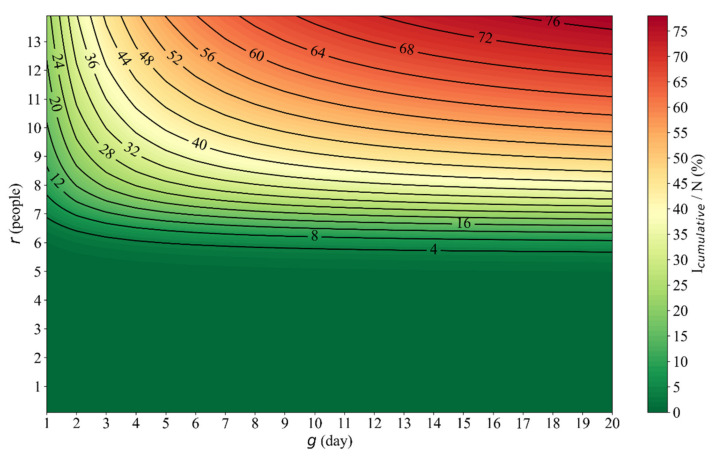
The parameter has a threshold value that if r is less than 5 (people), the number of COVID-19 infected patients is very close to 0. A "central valley" around = 5~6 can be observed, indicating an optimal control measure to reduce economic losses. A lower value of parameter g is beneficial to stop COVID-19 spread with a lower economic cost.
The simulation results demonstrate that implementing strict control measures as early as possible can stop the spread of COVID-19 with a minimal economic impact. The quantitative assessment method in this study can be applied in other COVID-19 pandemic areas or countries.
COVID-19 疫情的爆发引发了前所未有的公共卫生危机,对经济造成了巨大冲击。不同控制措施与经济损失之间的关系成为研究热点。
本研究修正了 SEIR 传染病模型,并将其与经济模型耦合,以量化武汉的这种非线性关系。控制措施被参数化为两个因素:每日有效接触人数();隔离患者的平均等待时间(天)()。
参数 具有一个阈值,如果 r 小于 5(人),则 COVID-19 感染患者的数量非常接近 0。可以观察到一个约等于 5~6 的“中央山谷”,表明存在一种最佳的控制措施,可以在降低经济损失的同时减少 COVID-19 的传播。参数 g 的较低值有利于以较低的经济成本阻止 COVID-19 的传播。
模拟结果表明,尽早实施严格的控制措施可以以最小的经济影响阻止 COVID-19 的传播。本研究中的定量评估方法可应用于其他 COVID-19 大流行地区或国家。