Alshabanah Latifah Abdullah, Omran Nada, Elwakil Bassma H, Hamed Moaaz T, Abdallah Salwa M, Al-Mutabagani Laila A, Wang Dong, Liu Qiongzhen, Shehata Nader, Hassanin Ahmed H, Hagar Mohamed
Chemistry Department, College of Science, Princess Nourah Bint Abdulrahman University, Riyadh 11671, Saudi Arabia.
Science and Technology Institute, Wuhan Textile University, Wuhan 430073, China.
Polymers (Basel). 2021 Nov 18;13(22):3987. doi: 10.3390/polym13223987.
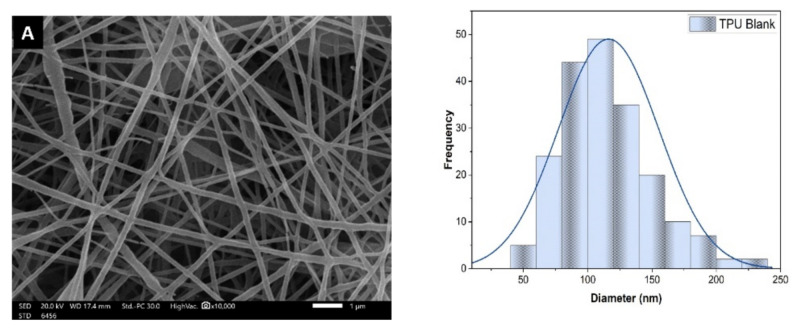
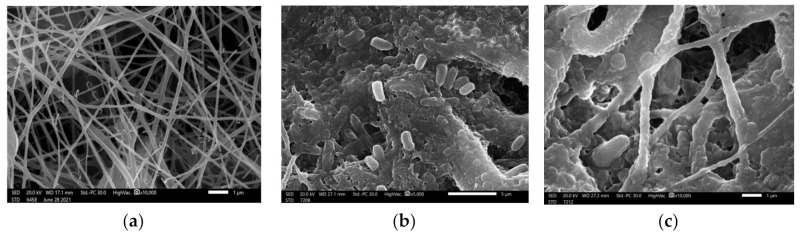
Herein, in the present work two series of thermoplastic polyurethane (TPU) nanofibers were manufactured using the electrospinning techniques with ZnO and CuO nanoparticles for a potential use as an elastic functional layer in antimicrobial applications. Percentages of 0%, 2 wt%, and 4 wt% of the nanoparticles were used. The morphological characterization of the electrospun TPU and TPU/NPs composites nanofibers were observed by using scanning electron microscopy to show the average fiber diameter and it was in the range of 90-150 nm with a significant impact of the nanoparticle type. Mechanical characterization showed that TPU nanofiber membranes exhibit excellent mechanical properties with ultra-high elastic properties. Elongation at break reached up to 92.5%. The assessment of the developed nanofiber membranes for medical and personal protection applications was done against various colistin resistant bacterial strains and the results showed an increment activity by increasing the metal oxide concentration up to 83% reduction rate by using TPU/ZnO 4% nanofibers against strain 10. The bacterial growth was completely eradicated after 8 and 16 h incubation with TPU/ZnO and TPU/CuO nanofibers, respectively. The nanofibers SEM study reveals the adsorption of the bacterial cells on the metal oxides nanofibers surface which led to cell lysis and releasing of their content. Finally, in vitro study against Spike S-protein from SARS-CoV-2 was also evaluated to investigate the potent effectiveness of the proposed nanofibers in the virus deactivation. The results showed that the metal oxide concentration is an effective factor in the antiviral activity due to the observed pattern of increasing the antibacterial and antiviral activity by increasing the metal oxide concentration; however, TPU/ZnO nanofibers showed a potent antiviral activity in relation to TPU/CuO.
在本工作中,使用静电纺丝技术制备了两个系列的热塑性聚氨酯(TPU)纳米纤维,其中含有氧化锌(ZnO)和氧化铜(CuO)纳米颗粒,有望用作抗菌应用中的弹性功能层。纳米颗粒的用量分别为0%、2 wt%和4 wt%。通过扫描电子显微镜观察了静电纺TPU和TPU/纳米颗粒复合材料纳米纤维的形态特征,以显示平均纤维直径,其范围为90-150 nm,纳米颗粒类型对此有显著影响。力学性能表征表明,TPU纳米纤维膜具有优异的力学性能和超高的弹性性能。断裂伸长率高达92.5%。针对各种耐黏菌素细菌菌株对所制备的纳米纤维膜进行了医疗和个人防护应用评估,结果表明,通过增加金属氧化物浓度,活性有所提高,使用4% TPU/ZnO纳米纤维对菌株10的降低率高达83%。分别用TPU/ZnO和TPU/CuO纳米纤维孵育8小时和16小时后,细菌生长被完全根除。纳米纤维的扫描电子显微镜研究揭示了细菌细胞吸附在金属氧化物纳米纤维表面,导致细胞裂解并释放其内容物。最后,还评估了针对严重急性呼吸综合征冠状病毒2(SARS-CoV-2)刺突S蛋白的体外研究,以研究所提出的纳米纤维在病毒灭活方面的潜在有效性。结果表明,由于观察到通过增加金属氧化物浓度来提高抗菌和抗病毒活性的模式,金属氧化物浓度是抗病毒活性的一个有效因素;然而,相对于TPU/CuO,TPU/ZnO纳米纤维显示出更强的抗病毒活性。