Berillo Dmitriy, Yeskendir Adilkhan, Zharkinbekov Zharylkasyn, Raziyeva Kamila, Saparov Arman
Department of Pharmaceutical and Toxicological Chemistry, Pharmacognosy and Botany School of Pharmacy, Asfendiyarov Kazakh National Medical University, Almaty 050000, Kazakhstan.
Department of Medicine, School of Medicine, Nazarbayev University, Nur-Sultan 010000, Kazakhstan.
Medicina (Kaunas). 2021 Nov 5;57(11):1209. doi: 10.3390/medicina57111209.
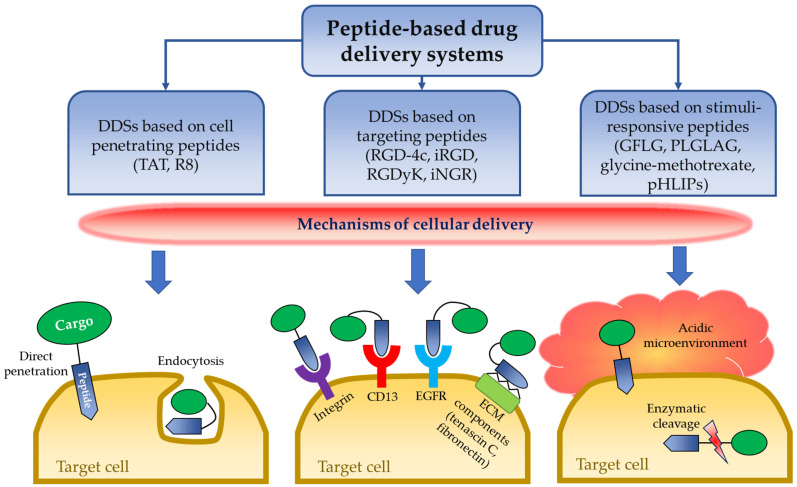
Peptide-based drug delivery systems have many advantages when compared to synthetic systems in that they have better biocompatibility, biochemical and biophysical properties, lack of toxicity, controlled molecular weight via solid phase synthesis and purification. Lysosomes, solid lipid nanoparticles, dendrimers, polymeric micelles can be applied by intravenous administration, however they are of artificial nature and thus may induce side effects and possess lack of ability to penetrate the blood-brain barrier. An analysis of nontoxic drug delivery systems and an establishment of prospective trends in the development of drug delivery systems was needed. This review paper summarizes data, mainly from the past 5 years, devoted to the use of peptide-based carriers for delivery of various toxic drugs, mostly anticancer or drugs with limiting bioavailability. Peptide-based drug delivery platforms are utilized as peptide-drug conjugates, injectable biodegradable particles and depots for delivering small molecule pharmaceutical substances (500 Da) and therapeutic proteins. Controlled drug delivery systems that can effectively deliver anticancer and peptide-based drugs leading to accelerated recovery without significant side effects are discussed. Moreover, cell penetrating peptides and their molecular mechanisms as targeting peptides, as well as stimuli responsive (enzyme-responsive and pH-responsive) peptides and peptide-based self-assembly scaffolds are also reviewed.
与合成系统相比,基于肽的药物递送系统具有许多优势,因为它们具有更好的生物相容性、生化和生物物理性质、无毒性、可通过固相合成和纯化控制分子量。溶酶体、固体脂质纳米粒、树枝状大分子、聚合物胶束可通过静脉给药应用,然而它们具有人工性质,因此可能会引起副作用,并且缺乏穿透血脑屏障的能力。需要对无毒药物递送系统进行分析,并确立药物递送系统发展的前瞻性趋势。这篇综述文章总结了主要来自过去5年的数据,这些数据致力于使用基于肽的载体递送各种有毒药物,主要是抗癌药物或生物利用度有限的药物。基于肽的药物递送平台被用作肽-药物缀合物、可注射的可生物降解颗粒和用于递送小分子药物物质(500道尔顿)和治疗性蛋白质的贮库。讨论了能够有效递送抗癌药物和基于肽的药物从而加速康复且无明显副作用的控释药物递送系统。此外,还综述了细胞穿透肽及其作为靶向肽的分子机制,以及刺激响应性(酶响应性和pH响应性)肽和基于肽的自组装支架。