AlSaeed Aseel Ali, Rabbani Unaib
Family Medicine Academy, Qassim Health Cluster, Buraidah 52385, Saudi Arabia.
Vaccines (Basel). 2021 Nov 9;9(11):1304. doi: 10.3390/vaccines9111304.
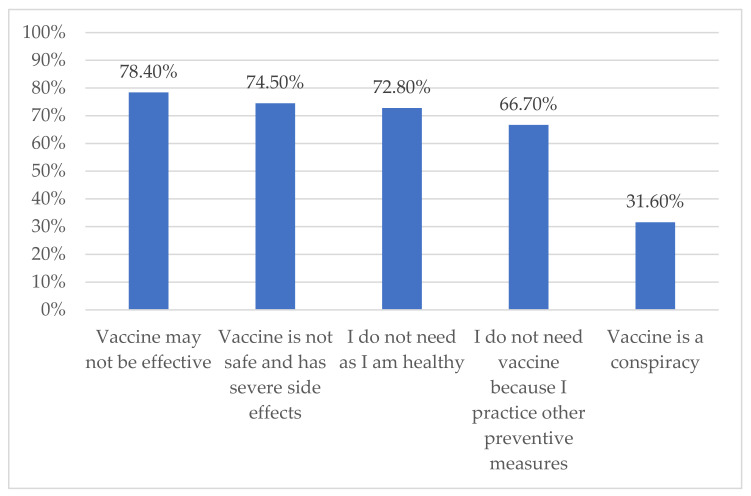
Acceptance of COVID-19 vaccines needs a health promotion approach to address various social, environmental and personal factors leading to vaccine hesitancy. We assessed the vaccine hesitancy rate and applied social cognitive theory (SCT) to understand COVID-19 vaccine rejection in Qassim, Saudi Arabia. A cross-sectional study was conducted among visitors of 10 randomly selected primary health care centers in Buraidah, Saudi Arabia. Data was collected by a self-administrated questionnaire. The variables were grouped into six constructs of SCT. Logistic regression was used to assess the predictors of vaccine rejection. Out of 486 participants included in the study, 30.5% rejected the vaccine. The most common reason for vaccine rejection was uncertainty about the vaccine's effectiveness (78%). Among various constructs of SCT, reciprocal determinism (nationality, income and suffering from COVID-19 infection), behavioral capability (knowledge about vaccine safety), self-efficacy (registered for vaccine), and observational learning (getting the vaccine after friends and family members) were significant predictors. Expectation and reinforcement constructs did not show significant association. There was high vaccine rejection in Qassim, KSA. This calls for further improving the mass education strategies. Social cognitive theory can be used to predict vaccine rejection and to develop strategies to increase the utilization of COVID-19 vaccines in Saudi Arabia.
接受新冠疫苗需要一种健康促进方法,以解决导致疫苗犹豫的各种社会、环境和个人因素。我们评估了疫苗犹豫率,并应用社会认知理论(SCT)来了解沙特阿拉伯卡西姆地区对新冠疫苗的拒绝情况。在沙特阿拉伯布赖代随机选择的10个初级卫生保健中心的访客中进行了一项横断面研究。通过自填问卷收集数据。变量被分组为社会认知理论的六个构成要素。使用逻辑回归来评估疫苗拒绝的预测因素。在纳入研究的486名参与者中,30.5%的人拒绝接种疫苗。拒绝接种疫苗最常见的原因是对疫苗有效性的不确定性(78%)。在社会认知理论的各种构成要素中,相互决定论(国籍、收入和感染新冠病毒)、行为能力(对疫苗安全性的了解)、自我效能感(登记接种疫苗)和观察学习(在朋友和家人接种后接种疫苗)是显著的预测因素。期望和强化构成要素未显示出显著关联。沙特阿拉伯卡西姆地区的疫苗拒绝率很高。这就需要进一步改进大众教育策略。社会认知理论可用于预测疫苗拒绝情况,并制定策略以提高沙特阿拉伯新冠疫苗的接种率。