Costantino Andrea, Invernizzi Federica, Centorrino Erica, Vecchi Maurizio, Lampertico Pietro, Donato Maria Francesca
Division of Gastroenterology and Endoscopy, Fondazione IRCCS Ca' Granda Ospedale Maggiore Policlinico, 20122 Milan, Italy.
Department of Pathophysiology and Transplantation, Università degli Studi di Milano, 20122 Milan, Italy.
Vaccines (Basel). 2021 Nov 11;9(11):1314. doi: 10.3390/vaccines9111314.
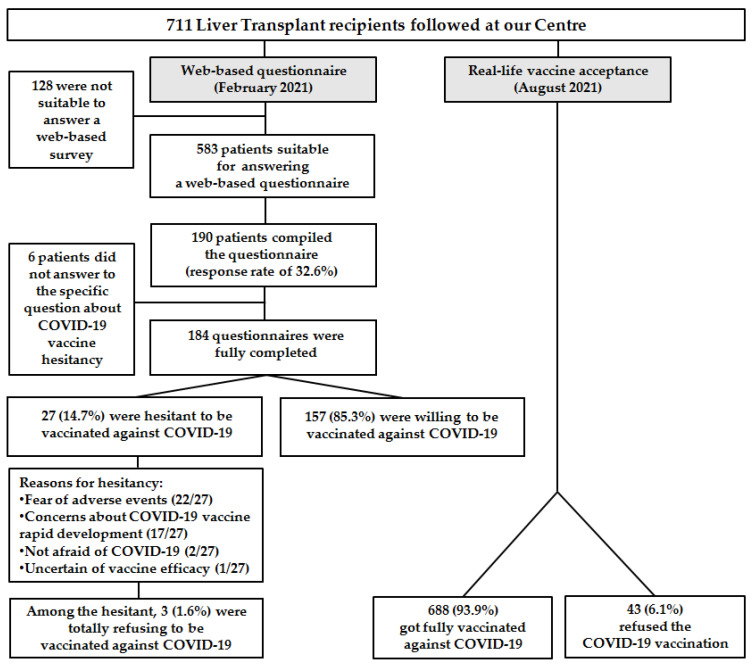
(1) Background: COVID-19 vaccination hesitancy is a threat for fragile patients. We aimed to evaluate COVID-19 vaccination hesitancy and its reasons in a population of liver transplant (LT) recipients. (2) Methods: In February 2021, a questionnaire on COVID-19 vaccines was sent to LT patients followed at our liver transplant outpatient clinic in Milan, Italy. Sociodemographic and clinical characteristics were recorded. Patients were defined as willing, hesitant, or refusing and their reasons were investigated. Associations between baseline characteristics and willingness were evaluated. Since March 2021, when the COVID-19 vaccines became available for LT candidates and recipients in Italy, the entire cohort of LT recipients was contacted by phone and called for vaccination, and the rate of refusals recorded. (3) Results: The web-based survey was sent to 583 patients, of whom 190 responded (response rate of 32.6%). Among the respondents to the specific question about hesitancy (184), 157 (85.3%) were willing to be vaccinated against COVID-19, while 27 (14.7%) were hesitant. Among the hesitant, three were totally refusing, for a refusal rate of 1.6%. Thirteen hesitant patients (48.1%) answered that their COVID-19 vaccination hesitancy was influenced by being a transplant recipient. The fear of adverse effects was the main reason for refusal (81.5%). Of the 711 LT patients followed at our center, 668 got fully vaccinated, while 43 (6.1%) of them refused the scheduled vaccination. (4) Conclusions: Most patients accepted COVID-19 vaccines, although 6.1% refused the vaccine. Since it is crucial to achieve adequate vaccination of LT patients, it is very important to identify the reasons influencing COVID-19 vaccination hesitancy so that appropriate and targeted communication strategies can be established and specific vaccination campaigns further implemented.
(1) 背景:对新冠病毒疾病(COVID - 19)疫苗接种的犹豫态度对脆弱患者构成威胁。我们旨在评估肝移植(LT)受者群体中对COVID - 19疫苗接种的犹豫态度及其原因。(2) 方法:2021年2月,一份关于COVID - 19疫苗的问卷被发送给在意大利米兰我们的肝移植门诊随访的LT患者。记录社会人口统计学和临床特征。将患者定义为愿意、犹豫或拒绝接种,并调查其原因。评估基线特征与意愿之间的关联。自2021年3月意大利的LT候选者和受者可获得COVID - 19疫苗以来,通过电话联系了整个LT受者队列并呼吁其接种疫苗,并记录拒绝率。(3) 结果:基于网络的调查发送给了583名患者,其中190人做出回应(回应率为32.6%)。在针对犹豫态度的特定问题的184名受访者中,157人(85.3%)愿意接种COVID - 19疫苗,而27人(14.7%)表示犹豫。在犹豫者中,3人完全拒绝,拒绝率为1.6%。13名犹豫患者(48.1%)回答他们对COVID - 19疫苗接种的犹豫受到自身作为移植受者这一因素的影响。对不良反应的恐惧是拒绝接种的主要原因(81.5%)。在我们中心随访的711名LT患者中,668人完成了全程接种,而其中43人(6.1%)拒绝了预定的疫苗接种。(4) 结论:大多数患者接受了COVID - 19疫苗,尽管有6.1%的患者拒绝接种。由于实现LT患者的充分接种至关重要,因此识别影响COVID - 19疫苗接种犹豫态度的原因非常重要,以便能够制定适当且有针对性的沟通策略并进一步开展特定的疫苗接种活动。