Motuzienė Violeta, Bielskus Jonas, Lapinskienė Vilūnė, Rynkun Genrika, Bernatavičienė Jolita
Department of Building Energetics at Vilnius Gediminas Technical University, Vilnius 10230, Lithuania.
Institute of Data Science and Digital Technologies, Vilnius University, Vilnius 08663, Lithuania.
Sustain Cities Soc. 2022 Feb;77:103557. doi: 10.1016/j.scs.2021.103557. Epub 2021 Nov 20.
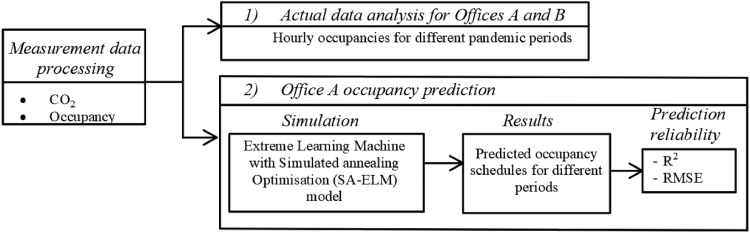
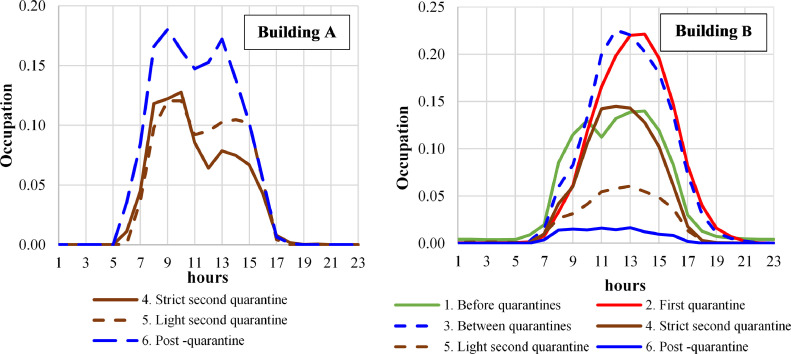
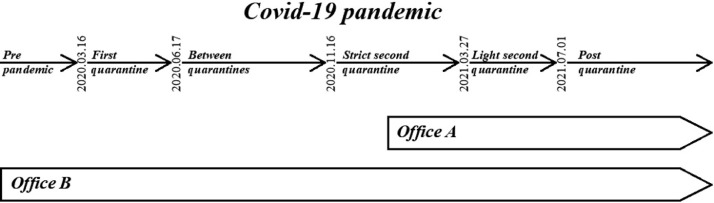
Buildings' occupancy is one of the important factors causing the energy performance and sustainability gap in buildings. Better occupancy prediction decreases this gap both in the design stage and in the use phase of the building. Machine learning-based models proved to be very accurate and fast for occupancy prediction when buildings are exploited under normal conditions. Meanwhile, during the Covid-19 pandemic occupancy of the offices has dramatically changed. The study presents 2 office buildings' long-term monitoring results for different periods of the pandemic. It aims to analyse actual occupancies during the pandemic and its influence on the ELM (Extreme Learning Machine) based occupancy-forecasting models' reliability. The results show much lower actual occupancies in the offices than given in standards and methodologies; it is still low even when quarantines are cancelled. Average peak occupancy within the whole measured period is: for Building A - 12-20% and for Building B - 2-23%. The daily occupancy schedules differ for both offices as they belong to different industries. ELM-SA model has shown low accuracies during pandemic periods as a result of lower occupancies - R = 0.27-0.56.
建筑的使用情况是导致建筑能源性能和可持续性差距的重要因素之一。更准确的使用情况预测能够在建筑设计阶段和使用阶段缩小这一差距。当建筑在正常条件下运行时,基于机器学习的模型在预测使用情况方面已被证明非常准确且快速。与此同时,在新冠疫情期间,办公室的使用情况发生了巨大变化。该研究展示了两座办公楼在疫情不同阶段的长期监测结果。其目的是分析疫情期间的实际使用情况及其对基于极限学习机(ELM)的使用情况预测模型可靠性的影响。结果显示,办公室的实际使用情况远低于标准和方法中给出的数值;即使取消隔离,使用率仍然很低。在整个测量期间,平均峰值使用率为:A楼12% - 20%,B楼2% - 23%。由于两座办公楼属于不同行业,它们的每日使用时间表也有所不同。由于使用率较低,ELM - SA模型在疫情期间的准确率较低 - R = 0.27 - 0.56。