Kwan Bethany M, Ytell Kate, Coors Marilyn, DeCamp Matthew, Morse Brad, Ressalam Julie, Reno Jenna E, Himber Meleah, Maertens Julie, Wearner Robyn, Gordon Kaylee, Wynia Matthew K
The Data Science to Patient Value Initiative, University of Colorado Anschutz Medical Campus, Aurora, CO, USA.
The Adult and Child Consortium for Health Outcomes Research and Delivery Science, University of Colorado Anschutz Medical Campus, Aurora, CO, USA.
J Clin Transl Sci. 2021 Sep 13;5(1):e180. doi: 10.1017/cts.2021.850. eCollection 2021.
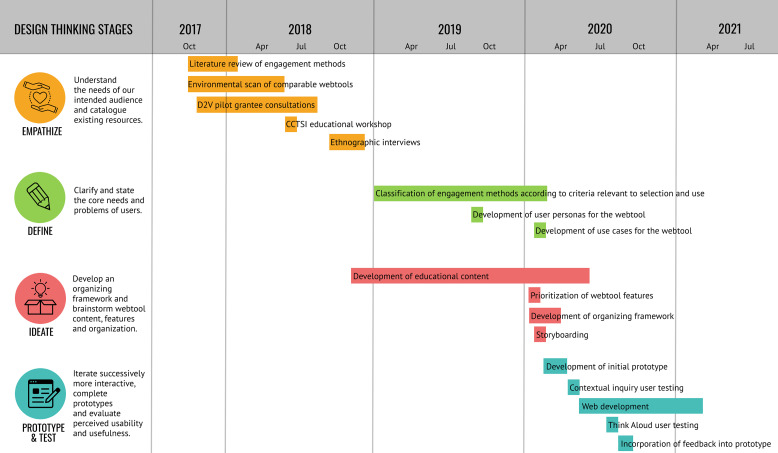
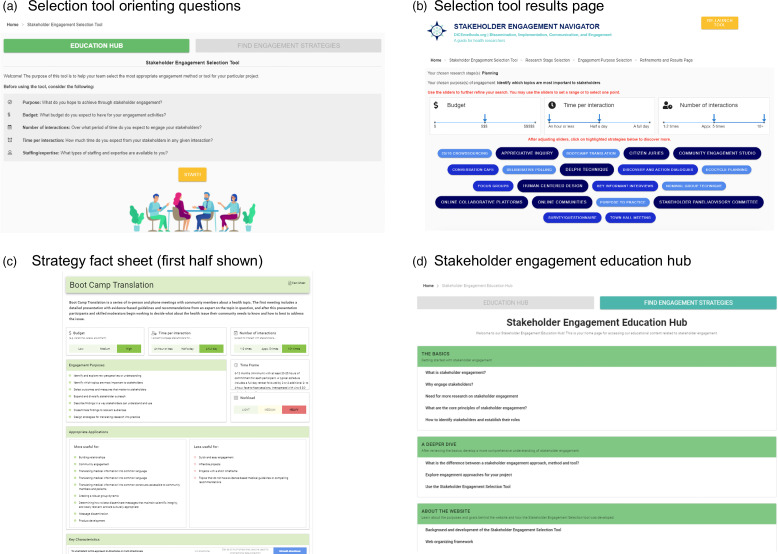
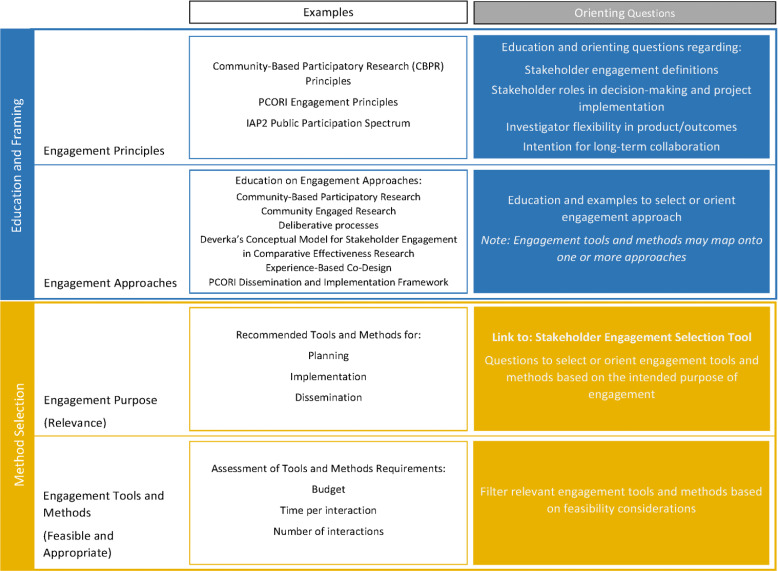
Stakeholder engagement is increasingly expected by funders and valued by researchers in clinical and translational science, yet many researchers lack access to expert consultation or training in selecting appropriate stakeholder engagement methods. We describe the development of a novel Stakeholder Engagement Navigator webtool. We conducted an environmental scan and literature review, along with investigator interviews, surveys, and engagement expert facilitated group discussion. We formally reviewed and cataloged 29 distinct engagement methods. To develop the webtool, we used an iterative design process that followed Design Thinking phases: empathize, define, ideate, prototype, and test. As prioritized during user testing, the Stakeholder Engagement Navigator webtool both educates and guides investigators in selecting an engagement method based on key criteria. The V1.0 Navigator webtool filters methods first by purpose of engagement (noted by 62% of users as the highest priority criteria), then by budget, time per stakeholder interaction, and total interactions. The tool is available at DICEMethods.org. The Stakeholder Engagement Navigator webtool is a user-centered, interactive webtool suitable for use by researchers seeking guidance on appropriate stakeholder engagement methods for clinical and translational research projects.
资助者越来越期望利益相关者参与,临床和转化科学领域的研究人员也重视这种参与,但许多研究人员在选择合适的利益相关者参与方法时,缺乏获得专家咨询或培训的机会。我们描述了一种新型的利益相关者参与导航网络工具的开发过程。我们进行了环境扫描和文献综述,同时开展了研究者访谈、调查以及由参与专家主持的小组讨论。我们正式审查并编目了29种不同的参与方法。为开发该网络工具,我们采用了遵循设计思维阶段的迭代设计过程:共情、定义、构思、原型制作和测试。正如在用户测试中所确定的优先级那样,利益相关者参与导航网络工具既能教育研究者,又能根据关键标准指导他们选择参与方法。V1.0版导航网络工具首先根据参与目的对方法进行筛选(62%的用户将其列为最高优先级标准),然后再根据预算、与每个利益相关者互动的时间以及总互动次数进行筛选。该工具可在DICEMethods.org上获取。利益相关者参与导航网络工具是以用户为中心的交互式网络工具,适合那些在临床和转化研究项目中寻求合适的利益相关者参与方法指导的研究人员使用。