• 文献检索
  • 文档翻译
  • 深度研究
  • 学术资讯
  • Suppr Zotero 插件Zotero 插件
  • 邀请有礼
  • 套餐&价格
  • 历史记录
应用&插件
Suppr Zotero 插件Zotero 插件浏览器插件Mac 客户端Windows 客户端微信小程序
定价
高级版会员购买积分包购买API积分包
服务
文献检索文档翻译深度研究API 文档MCP 服务
关于我们
关于 Suppr公司介绍联系我们用户协议隐私条款
关注我们

Suppr 超能文献

核心技术专利:CN118964589B侵权必究
粤ICP备2023148730 号-1Suppr @ 2026

文献检索

告别复杂PubMed语法,用中文像聊天一样搜索,搜遍4000万医学文献。AI智能推荐,让科研检索更轻松。

立即免费搜索

文件翻译

保留排版,准确专业,支持PDF/Word/PPT等文件格式,支持 12+语言互译。

免费翻译文档

深度研究

AI帮你快速写综述,25分钟生成高质量综述,智能提取关键信息,辅助科研写作。

立即免费体验

全球患者体验数据导航器的共同创建:一项多利益相关方倡议,以确保患者的声音在健康决策中得到体现。

Co-creation of the Global Patient Experience Data Navigator: a multi-stakeholder initiative to ensure the patient voice is represented in health decision-making.

作者信息

Willgoss Tom, Escontrias Omar A, Scrafton Carole, Oehrlein Elisabeth, Livingstone Victoria, Chaplin Fiona C, Benivento Maddalena, Chapman Hayley, Brooke Nicholas

机构信息

Patient Centered Outcomes Research, Roche, Hexagon Place, Falcon Way, Welwyn Garden City, UK.

Escontrías, National Health Council, 1730 M St. NW, Suite 650, Washington, DC, 20036, USA.

出版信息

Res Involv Engagem. 2023 Oct 12;9(1):92. doi: 10.1186/s40900-023-00503-9.

DOI:10.1186/s40900-023-00503-9
PMID:37828617
原文链接:https://pmc.ncbi.nlm.nih.gov/articles/PMC10571339/
Abstract

BACKGROUND

Putting patients' needs and priorities at the forefront of healthcare initiatives and medical product development is critical to achieve outcomes that matter most to patients. This relies on the integration of early, meaningful patient engagement (PE) to learn what is important to patients, and collection of representative patient experience data (PXD). The increased number of PE/PXD efforts across global regulatory, health technology assessment, and healthcare systems is an important step forward to deliver improved health outcomes for patients. However, these initiatives are fragmented and lack integration, which is necessary to maximize efforts and reduce burden on patients. To overcome these challenges, the Global Patient Experience Data Navigator has been co-created by Patient Focused Medicines Development to provide practical resources that can facilitate and optimize PXD generation, collection, analysis, and dissemination for patient benefit and aims to be applicable across all therapeutic areas for all stakeholders.

METHODS

Co-creation of the Navigator took place through an iterative process of validation and formalization driven by a diverse, multi-stakeholder working group with individuals who have varying knowledge/experience in PE/PXD.

RESULTS

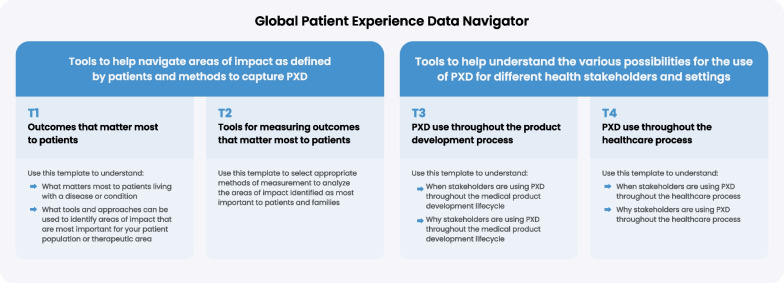
A series of workshops took place to conduct a gap analysis, develop a taxonomy model, and integrate existing frameworks. The collective insights led to the development of the Navigator consisting of four specific tools in the form of downloadable templates, which can be used to: (1) prioritize outcomes that matter most to patients and their caregivers; (2) select appropriate measurement methods for these outcomes; (3) identify when and why PXD is used throughout the product development cycle for each stakeholder; (4) identify when and why PXD is used throughout the healthcare process for each stakeholder. A public consultation was carried out to collect user feedback before the Navigator was made publicly available in December 2022.

CONCLUSION

To our knowledge, the Global Patient Experience Data Navigator is the only publicly available toolkit developed with a multi-stakeholder and disease-agnostic approach providing taxonomically grouped resources to optimize the collection and collation of PXD for patient benefit. Future work will aim to further engage patients by adding a PE dimension to the Navigator.

摘要

背景

将患者需求和优先事项置于医疗保健举措及医疗产品开发的前沿,对于实现对患者最为重要的结果至关重要。这依赖于早期、有意义的患者参与(PE)的整合,以了解对患者重要的事项,并收集具有代表性的患者体验数据(PXD)。全球监管、卫生技术评估和医疗保健系统中患者参与/患者体验数据工作的增加,是朝着为患者提供改善的健康结果迈出的重要一步。然而,这些举措分散且缺乏整合,而整合对于最大限度地发挥作用和减轻患者负担是必要的。为克服这些挑战,患者聚焦药物研发共同创建了全球患者体验数据导航器,以提供实用资源,促进和优化患者体验数据的生成、收集、分析和传播,以造福患者,并旨在适用于所有治疗领域的所有利益相关者。

方法

导航器的共同创建通过一个由多元化、多利益相关者工作组驱动的迭代验证和形式化过程进行,该工作组的成员在患者参与/患者体验数据方面具有不同的知识/经验。

结果

举办了一系列研讨会,进行差距分析、开发分类模型并整合现有框架。这些集体见解促成了导航器的开发,导航器由四个特定工具组成,形式为可下载模板,可用于:(1)确定对患者及其护理人员最重要的结果的优先级;(2)为这些结果选择合适的测量方法;(3)确定每个利益相关者在整个产品开发周期中何时以及为何使用患者体验数据;(4)确定每个利益相关者在整个医疗过程中何时以及为何使用患者体验数据。在2022年12月导航器公开可用之前,进行了一次公众咨询以收集用户反馈。

结论

据我们所知,全球患者体验数据导航器是唯一一个采用多利益相关者和疾病无关方法开发的公开可用工具包,提供分类分组资源以优化患者体验数据的收集和整理,造福患者。未来的工作将旨在通过在导航器中增加患者参与维度来进一步让患者参与进来。
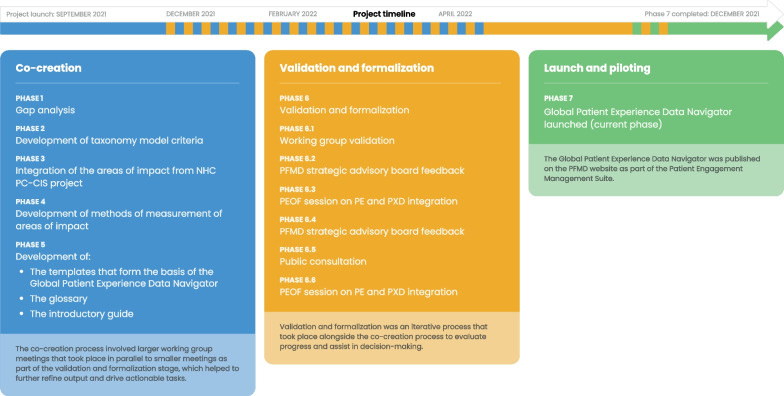
https://cdn.ncbi.nlm.nih.gov/pmc/blobs/a83a/10571339/640d895a6044/40900_2023_503_Fig4a_HTML.jpg
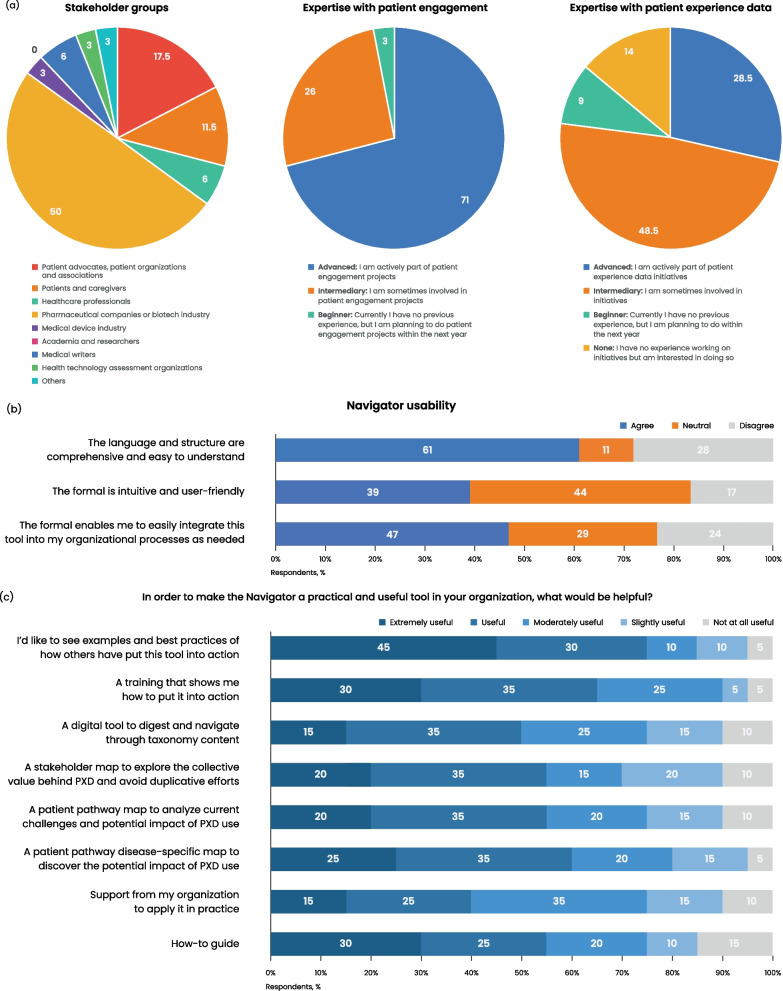
https://cdn.ncbi.nlm.nih.gov/pmc/blobs/a83a/10571339/6e0600aaecab/40900_2023_503_Fig1_HTML.jpg
https://cdn.ncbi.nlm.nih.gov/pmc/blobs/a83a/10571339/3cae2f109915/40900_2023_503_Fig2_HTML.jpg
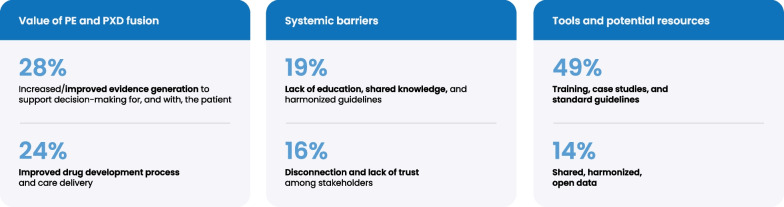
https://cdn.ncbi.nlm.nih.gov/pmc/blobs/a83a/10571339/4cccff2e1eb7/40900_2023_503_Fig3_HTML.jpg
https://cdn.ncbi.nlm.nih.gov/pmc/blobs/a83a/10571339/640d895a6044/40900_2023_503_Fig4a_HTML.jpg
https://cdn.ncbi.nlm.nih.gov/pmc/blobs/a83a/10571339/6e0600aaecab/40900_2023_503_Fig1_HTML.jpg
https://cdn.ncbi.nlm.nih.gov/pmc/blobs/a83a/10571339/3cae2f109915/40900_2023_503_Fig2_HTML.jpg
https://cdn.ncbi.nlm.nih.gov/pmc/blobs/a83a/10571339/4cccff2e1eb7/40900_2023_503_Fig3_HTML.jpg
https://cdn.ncbi.nlm.nih.gov/pmc/blobs/a83a/10571339/640d895a6044/40900_2023_503_Fig4a_HTML.jpg

相似文献

1
Co-creation of the Global Patient Experience Data Navigator: a multi-stakeholder initiative to ensure the patient voice is represented in health decision-making.全球患者体验数据导航器的共同创建:一项多利益相关方倡议,以确保患者的声音在健康决策中得到体现。
Res Involv Engagem. 2023 Oct 12;9(1):92. doi: 10.1186/s40900-023-00503-9.
2
Co-creation of practical "how-to guides" for patient engagement in key phases of medicines development-from theory to implementation.共同创建实用的“操作指南”,以促进患者在药物研发关键阶段的参与——从理论到实践。
Res Involv Engagem. 2021 Aug 23;7(1):57. doi: 10.1186/s40900-021-00294-x.
3
Patient Engagement and Patient Experience Data in Regulatory Review and Health Technology Assessment: A Global Landscape Review.监管审查和卫生技术评估中的患者参与和患者体验数据:全球概况综述。
Ther Innov Regul Sci. 2024 Jan;58(1):63-78. doi: 10.1007/s43441-023-00573-7. Epub 2023 Sep 24.
4
The future of Cochrane Neonatal.考克兰新生儿协作网的未来。
Early Hum Dev. 2020 Nov;150:105191. doi: 10.1016/j.earlhumdev.2020.105191. Epub 2020 Sep 12.
5
Critical Care Network in the State of Qatar.卡塔尔国重症监护网络。
Qatar Med J. 2019 Nov 7;2019(2):2. doi: 10.5339/qmj.2019.qccc.2. eCollection 2019.
6
Folic acid supplementation and malaria susceptibility and severity among people taking antifolate antimalarial drugs in endemic areas.在流行地区,服用抗叶酸抗疟药物的人群中,叶酸补充剂与疟疾易感性和严重程度的关系。
Cochrane Database Syst Rev. 2022 Feb 1;2(2022):CD014217. doi: 10.1002/14651858.CD014217.
7
A qualitative systematic review of internal and external influences on shared decision-making in all health care settings.对所有医疗环境中共同决策的内部和外部影响进行的定性系统评价。
JBI Libr Syst Rev. 2012;10(58):4633-4646. doi: 10.11124/jbisrir-2012-432.
8
The patient experience of patient-centered communication with nurses in the hospital setting: a qualitative systematic review protocol.医院环境中患者与护士以患者为中心的沟通体验:一项定性系统评价方案
JBI Database System Rev Implement Rep. 2015 Jan;13(1):76-87. doi: 10.11124/jbisrir-2015-1072.
9
Using qualitative Health Research methods to improve patient and public involvement and engagement in research.运用定性健康研究方法,改善患者及公众对研究的参与度。
Res Involv Engagem. 2018 Dec 13;4:49. doi: 10.1186/s40900-018-0129-8. eCollection 2018.
10
Co-designing person-centred quality indicator implementation for primary care in Alberta: a consensus study.共同设计艾伯塔省初级保健中以患者为中心的质量指标实施方案:一项共识研究。
Res Involv Engagem. 2022 Nov 8;8(1):59. doi: 10.1186/s40900-022-00397-z.

引用本文的文献

1
Incorporating Patient Needs and Perspectives in Additional Risk Minimization Measures and Other Pharmacovigilance Deliverables - A Framework and Implementation Roadmap.将患者需求和观点纳入额外的风险最小化措施及其他药物警戒工作成果——一个框架和实施路线图
Ther Innov Regul Sci. 2025 Jul 25. doi: 10.1007/s43441-025-00844-5.
2
Leveraging patient experience data to guide medicines development, regulation, access decisions and clinical care in the EU.利用患者体验数据指导欧盟的药物研发、监管、准入决策和临床护理。
Front Med (Lausanne). 2024 May 23;11:1408636. doi: 10.3389/fmed.2024.1408636. eCollection 2024.

本文引用的文献

1
Building from Patient Experiences to Deliver Patient-Focused Healthcare Systems in Collaboration with Patients: A Call to Action.从患者体验出发,与患者合作构建以患者为中心的医疗保健系统:行动呼吁。
Ther Innov Regul Sci. 2022 Sep;56(5):848-858. doi: 10.1007/s43441-022-00432-x. Epub 2022 Jul 19.
2
Patient-Centered Core Impact Sets: What They are and Why We Need Them.以患者为中心的核心影响指标集:它们是什么以及我们为什么需要它们。
Patient. 2022 Nov;15(6):619-627. doi: 10.1007/s40271-022-00583-x. Epub 2022 Jun 2.
3
FDA Reported Use of Patient Experience Data in 2018 Drug Approvals.
FDA 报告称在 2018 年药物批准中使用了患者体验数据。
Ther Innov Regul Sci. 2020 May;54(3):709-716. doi: 10.1007/s43441-019-00106-1. Epub 2020 Jan 6.
4
Improving Access and Quality of Health Care in the United States: Shared Goals Among Patient Advocates.改善美国医疗保健的可及性与质量:患者权益倡导者的共同目标
Patient. 2021 Sep;14(5):687-690. doi: 10.1007/s40271-020-00453-4.
5
Amplifying the Voice of the Patient in Clinical Research: Development of Toolkits for Use in Designing and Conducting Patient-Centered Clinical Studies.在临床研究中放大患者的声音:用于设计和开展以患者为中心的临床研究的工具包的开发。
Ther Innov Regul Sci. 2020 Nov;54(6):1489-1500. doi: 10.1007/s43441-020-00176-6. Epub 2020 Jul 2.
6
Co-creation of patient engagement quality guidance for medicines development: an international multistakeholder initiative.共同制定药物研发患者参与质量指南:一项国际多利益相关方倡议。
BMJ Innov. 2019 Jan;5(1):43-55. doi: 10.1136/bmjinnov-2018-000317. Epub 2019 Mar 2.
7
Improving Patient Involvement in Medicines Research and Development:: A Practical Roadmap.提高患者在药物研发中的参与度:一份实用路线图。
Ther Innov Regul Sci. 2017 Sep;51(5):612-619. doi: 10.1177/2168479017706405. Epub 2017 May 8.
8
A taxonomy has been developed for outcomes in medical research to help improve knowledge discovery.已经为医学研究中的结果开发了一种分类法,以帮助提高知识发现。
J Clin Epidemiol. 2018 Apr;96:84-92. doi: 10.1016/j.jclinepi.2017.12.020. Epub 2017 Dec 28.
9
Culture and Process Change as a Priority for Patient Engagement in Medicines Development.将文化与流程变革作为患者参与药物研发的优先事项。
Ther Innov Regul Sci. 2017 Jan;51(1):29-38. doi: 10.1177/2168479016659104. Epub 2016 Aug 20.
10
Patient-Focused Drug Development: A New Direction for Collaboration.以患者为中心的药物研发:合作的新方向。
Med Care. 2015 Jan;53(1):9-17. doi: 10.1097/MLR.0000000000000273.