den Boer Duncan, den Hartogh Mariska D, Kotte Alexis N T J, van der Voort van Zyp Jochem R N, Noteboom Juus L, Bol Gijsbert H, Willigenburg Thomas, Werensteijn-Honingh Anita M, Jürgenliemk-Schulz Ina M, van Lier Astrid L H M W, Kroon Petra S
Department of Radiotherapy, University Medical Center Utrecht, Heidelberglaan 100, 3584 CX Utrecht, the Netherlands.
Phys Imaging Radiat Oncol. 2021 Nov 20;20:82-87. doi: 10.1016/j.phro.2021.11.002. eCollection 2021 Oct.
Whole bladder radiotherapy is challenging due to inter- and intrafraction size and shape changes. To account for these changes, currently a Library of Plans (LoP) technique is often applied, but daily adaptive radiotherapy is also increasingly becoming available. The aim of this study was to compare LoP with two magnetic resonance imaging guided radiotherapy (MRgRT) strategies by comparing target coverage and volume of healthy tissue inside the planning target volume (PTV) for whole bladder treatments.
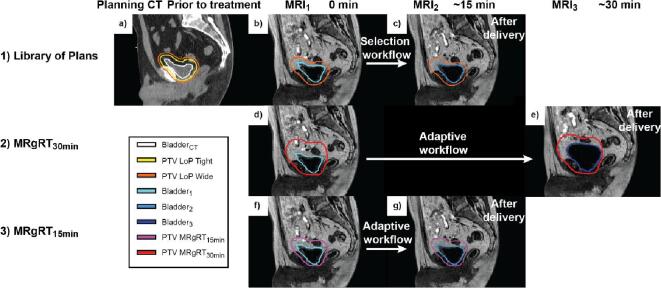
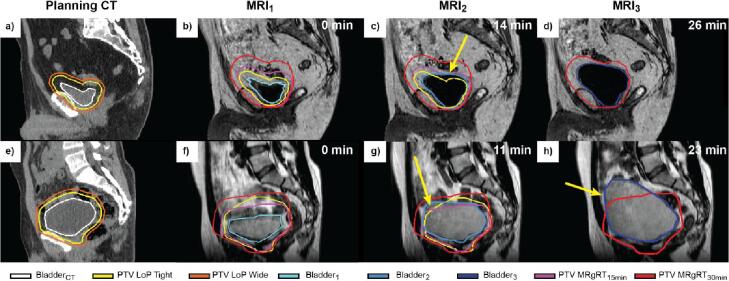
Data from 25 MRgRT lymph node oligometastases treatments (125 fractions) were used, with three MRI scans acquired at each fraction at 0, 15 and 30 min. Bladders were delineated and used to evaluate three strategies: 1) LoP with two plans for a 15 min fraction, 2) MRgRT for a 15 min fraction and 3) MRgRT for a 30 min fraction. The volumes of healthy tissue inside and bladder outside the PTV were analyzed on the simulated post-treatment images.
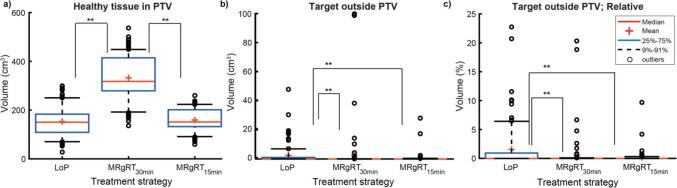
MRgRT had 120% and 121% more healthy tissue inside the PTV than LoP and MRgRT. For LoP slightly more target outside the PTV was found than for MRgRT and MRgRT, with median 0% (range 0-23%) compared to 0% (0-20%) and 0% (0-10%), respectively.
Taking into account both target coverage and volume of healthy tissue inside the PTV, MRgRT performed better than LoP and MRgRT for whole bladder treatments. A 15 min daily adaptive radiotherapy workflow is needed to potentially benefit from replanning compared to LoP.
由于分次间和分次内膀胱大小及形状的变化,全膀胱放疗具有挑战性。为了应对这些变化,目前常采用计划库(LoP)技术,但每日自适应放疗也越来越普及。本研究的目的是通过比较全膀胱治疗中计划靶体积(PTV)内的靶区覆盖情况和健康组织体积,将LoP与两种磁共振成像引导放疗(MRgRT)策略进行比较。
使用了25例MRgRT淋巴结寡转移治疗(125个分次)的数据,每个分次在0、15和30分钟时进行三次MRI扫描。勾画膀胱并用于评估三种策略:1)针对15分钟分次的两个计划的LoP;2)针对15分钟分次的MRgRT;3)针对30分钟分次的MRgRT。在模拟的治疗后图像上分析PTV内和PTV外膀胱的健康组织体积。
MRgRT在PTV内的健康组织比LoP和MRgRT分别多120%和121%。与MRgRT和MRgRT相比,LoP在PTV外发现的靶区略多,中位数分别为0%(范围0 - 23%)、0%(0 - 20%)和0%(0 - 10%)。
综合考虑靶区覆盖情况和PTV内的健康组织体积,在全膀胱治疗中MRgRT比LoP和MRgRT表现更好。与LoP相比,需要每日15分钟的自适应放疗工作流程才能从重新计划中潜在获益。