Centre for Medical Image Computing, Department of Computer Science, University College London, 90 High Holborn, Floor 1, London WC1V6LJ, United Kingdom.
The Dementia Research Centre, Department of Neurodegenerative Disease, UCL Queen Square Institute of Neurology, UCL, London, United Kingdom; UK Dementia Research Institute at UCL, UCL, London, United Kingdom.
Neuroimage. 2021 Dec 15;245:118749. doi: 10.1016/j.neuroimage.2021.118749. Epub 2021 Nov 28.
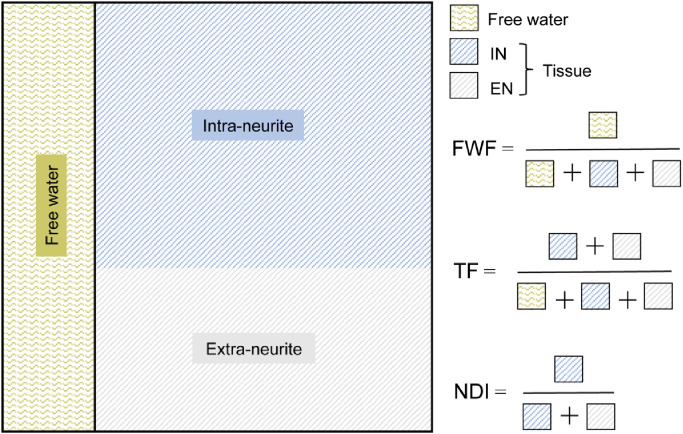
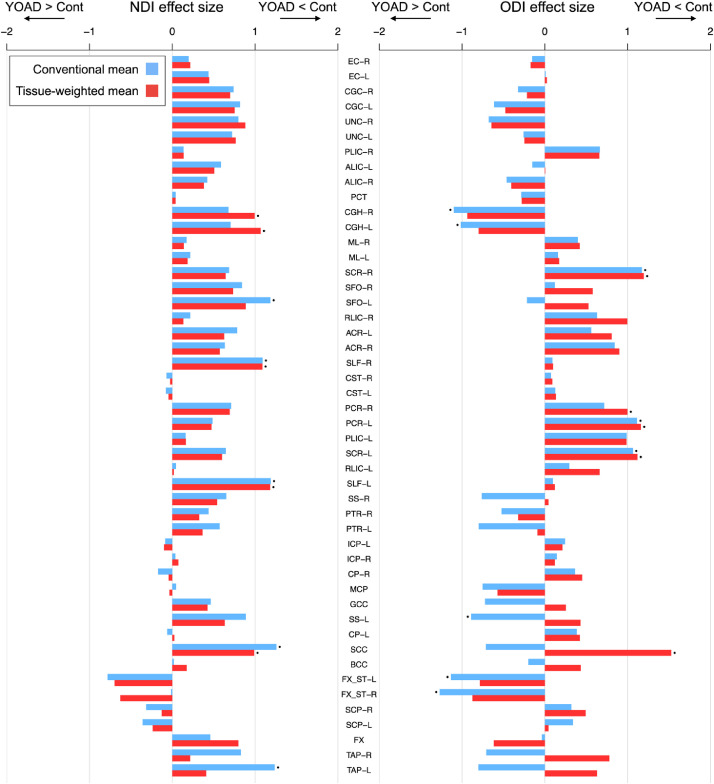
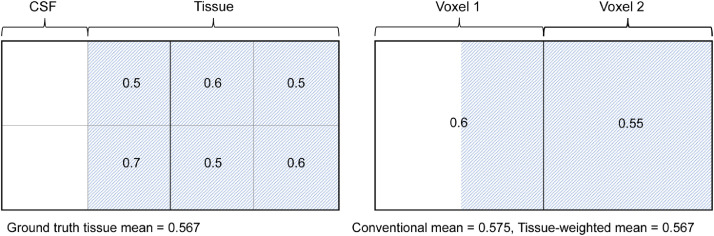
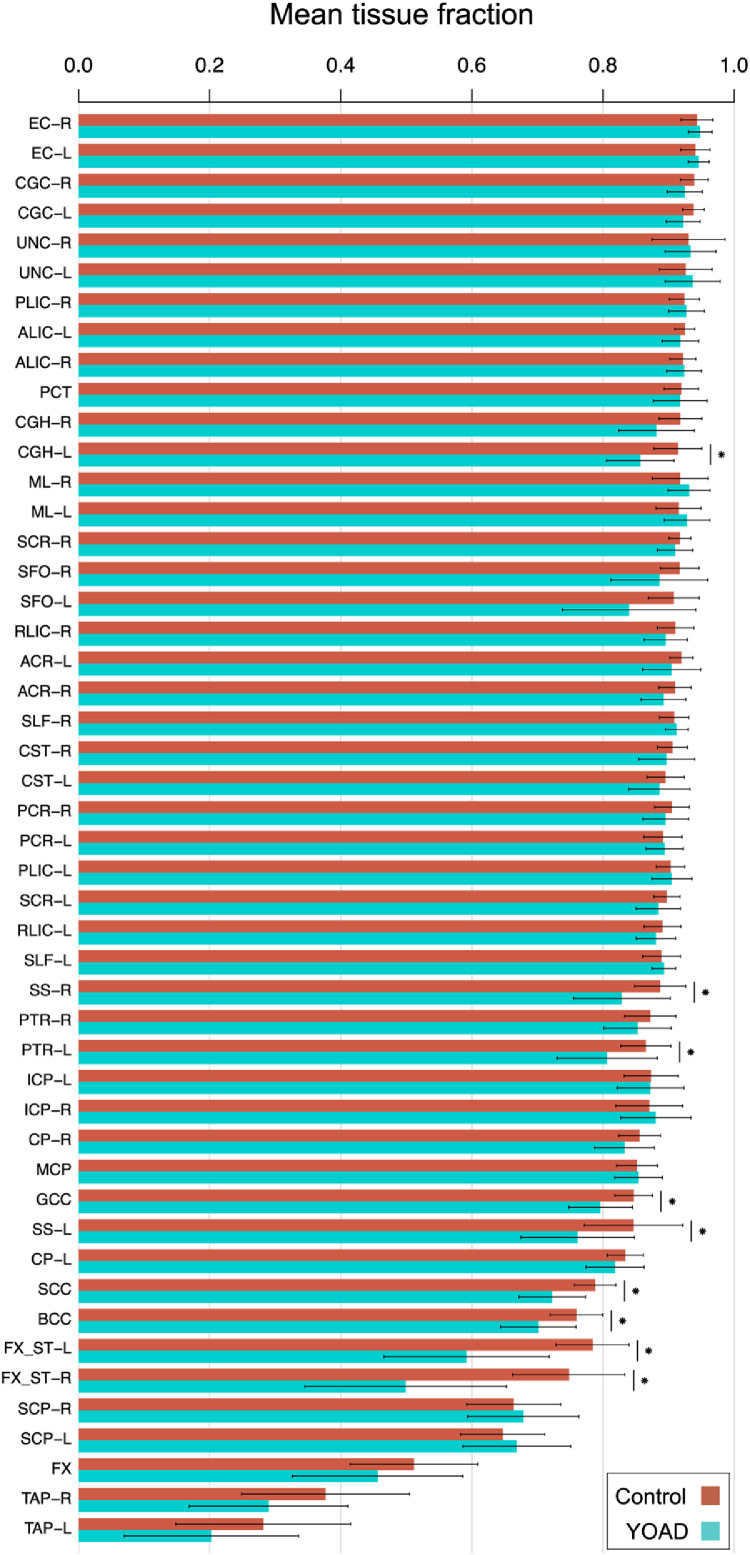
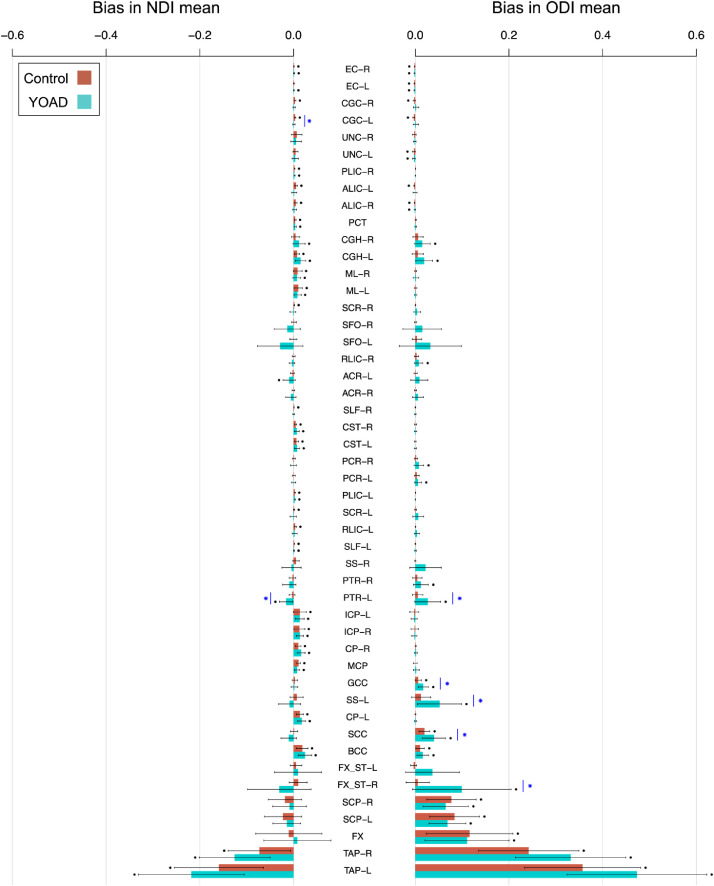
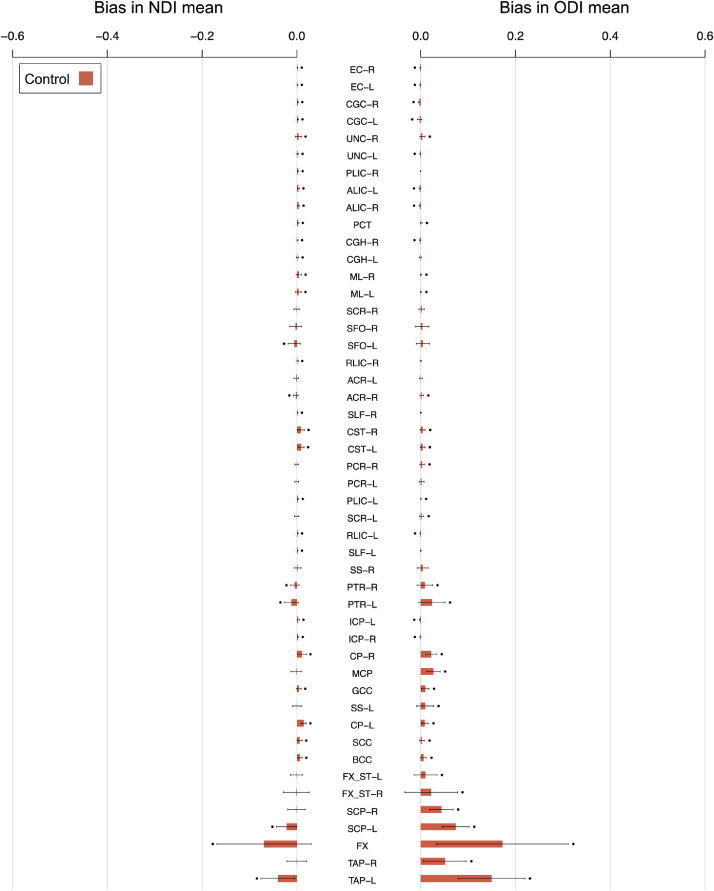
Neurite orientation dispersion and density imaging (NODDI) estimates microstructural properties of brain tissue relating to the organisation and processing capacity of neurites, which are essential elements for neuronal communication. Descriptive statistics of NODDI tissue metrics are commonly analyzed in regions-of-interest (ROI) to identify brain-phenotype associations. Here, the conventional method to calculate the ROI mean weights all voxels equally. However, this produces biased estimates in the presence of CSF partial volume. This study introduces the tissue-weighted mean, which calculates the mean NODDI metric across the tissue within an ROI, utilising the tissue fraction estimate from NODDI to reduce estimation bias. We demonstrate the proposed mean in a study of white matter abnormalities in young onset Alzheimer's disease (YOAD). Results show the conventional mean induces significant bias that correlates with CSF partial volume, primarily affecting periventricular regions and more so in YOAD subjects than in healthy controls. Due to the differential extent of bias between healthy controls and YOAD subjects, the conventional mean under- or over-estimated the effect size for group differences in many ROIs. This demonstrates the importance of using the correct estimation procedure when inferring group differences in studies where the extent of CSF partial volume differs between groups. These findings are robust across different acquisition and processing conditions. Bias persists in ROIs at higher image resolution, as demonstrated using data obtained from the third phase of the Alzheimer's disease neuroimaging initiative (ADNI); and when performing ROI analysis in template space. This suggests that conventional ROI means of NODDI metrics are biased estimates under most contemporary experimental conditions, the correction of which requires the proposed tissue-weighted mean. The tissue-weighted mean produces accurate estimates of ROI means and group differences when ROIs contain voxels with CSF partial volume. In addition to NODDI, the technique can be applied to other multi-compartment models that account for CSF partial volume, such as the free water elimination method. We expect the technique to help generate new insights into normal and abnormal variation in tissue microstructure of regions typically confounded by CSF partial volume, such as those in individuals with larger ventricles due to atrophy associated with neurodegenerative disease.
神经突方向分散和密度成像(NODDI)估计与神经突的组织和处理能力有关的脑组织的微观结构特性,而神经突是神经元通讯的基本要素。通常在感兴趣区域(ROI)中分析 NODDI 组织指标的描述性统计信息,以识别脑表型关联。在这里,计算 ROI 均值的常规方法是平等地对所有体素进行加权。然而,在存在 CSF 部分体积的情况下,这会产生有偏差的估计。本研究引入了组织加权均值,它利用 NODDI 中的组织分数估计值,在 ROI 内计算组织内的平均 NODDI 指标,以减少估计偏差。我们在青年发病阿尔茨海默病(YOAD)的白质异常研究中展示了所提出的均值。结果表明,常规均值会产生与 CSF 部分体积相关的显著偏差,主要影响脑室周围区域,在 YOAD 患者中比在健康对照组中更为明显。由于健康对照组和 YOAD 患者之间的偏差程度不同,因此在许多 ROI 中,常规均值低估或高估了组间差异的效应大小。这表明,在 CSF 部分体积在组间存在差异的研究中,当推断组间差异时,使用正确的估计程序非常重要。这些发现是稳健的,适用于不同的采集和处理条件。在更高的图像分辨率的 ROI 中仍然存在偏差,正如使用阿尔茨海默病神经影像学倡议(ADNI)第三阶段获得的数据所证明的那样;并且当在模板空间中进行 ROI 分析时也是如此。这表明,在大多数当代实验条件下,NODDI 指标的常规 ROI 均值是有偏差的估计,需要使用所提出的组织加权均值进行校正。当 ROI 包含 CSF 部分体积的体素时,组织加权均值可以产生准确的 ROI 均值和组间差异的估计。除了 NODDI 之外,该技术还可以应用于其他考虑 CSF 部分体积的多腔室模型,例如自由水消除法。我们希望该技术有助于深入了解通常受 CSF 部分体积混淆的区域的组织微观结构的正常和异常变化,例如由于与神经退行性疾病相关的萎缩导致脑室较大的个体的区域。