Yang Kai, Tang Yulong, Ma Yanyun, Liu Qingmei, Huang Yan, Zhang Yuting, Shi Xiangguang, Zhang Li, Zhang Yue, Wang Ji'an, Zhu Yifei, Liu Wei, Tan Yimei, Lin Jinran, Wu Wenyu
Department of Dermatology, Jing'an District Central Hospital, Shanghai, China.
State Key Laboratory of Genetic Engineering, Collaborative Innovation Center for Genetics and Development, School of Life Sciences, Fudan University, Shanghai, China.
Ann Dermatol. 2021 Dec;33(6):553-561. doi: 10.5021/ad.2021.33.6.553. Epub 2021 Nov 4.
Androgenetic alopecia (AGA) leads to thinning of scalp hair and affects 60%~70% of the adult population worldwide. Developing more effective treatments and studying its mechanism are of great significance. Previous clinical studies have revealed that hair growth is stimulated by 650-nm red light.
This study aimed to explore the effect and mechanism of 650-nm red light on the treatment of AGA by using hair follicle culture.
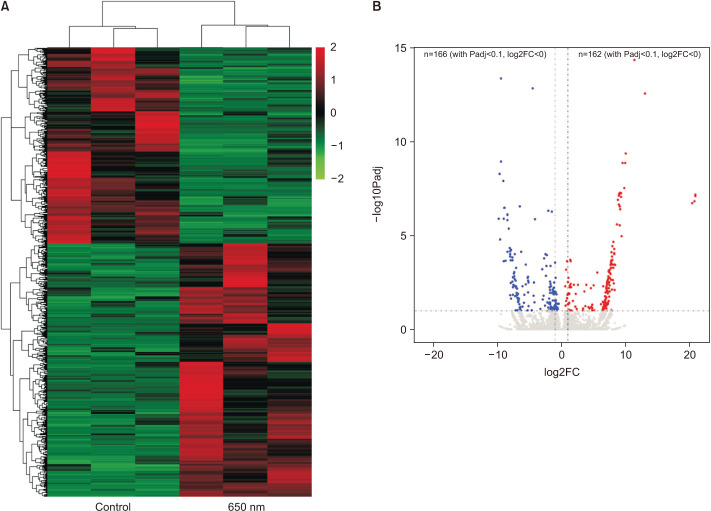
Human hair follicles were obtained from hair transplant patients with AGA. Hair follicles were cultured in Williams E medium and treated with or without 650-nm red light. Real-time RT-PCR and immunofluorescence staining were used to detect the expression level of genes and proteins in hair follicles, respectively. RNA-sequencing analysis was carried out to reveal the distinct gene signatures upon 650 nm treatment.
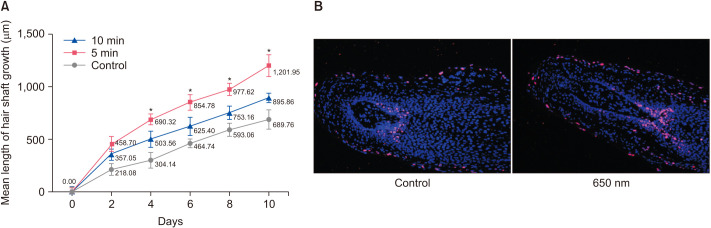
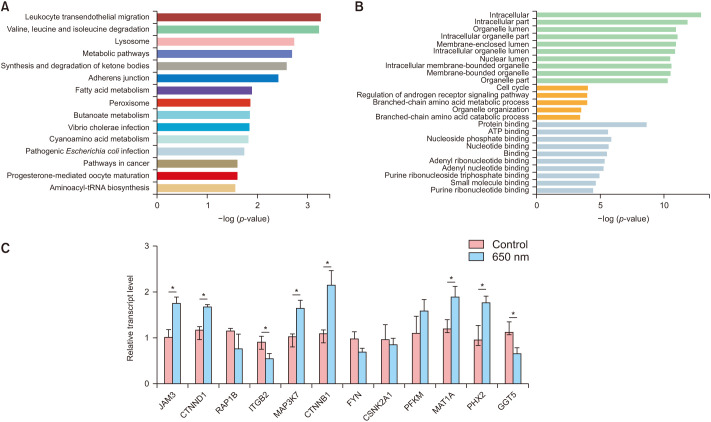
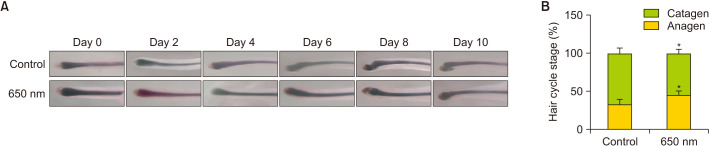
Low-level 650 nm red light promoted the proliferation of human hair follicles in the experimental cultured-tissue model. Consistently, 650 nm red light significantly delayed the transition of hair cycle from anagen to catagen . RNA-seq analysis and gene clustering for the differentially expressed genes suggests that leukocyte transendothelial migration, metabolism, adherens junction and other biological process maybe involved in stimulation of hair follicles by 650-nm red light treatment.
The effect of 650-nm red light on hair follicles and the transcriptome set which implicates the role of red light in promoting hair growth and reversing of miniaturization process of AGA were identified.
雄激素性脱发(AGA)会导致头皮毛发稀疏,影响全球60%至70%的成年人口。开发更有效的治疗方法并研究其机制具有重要意义。先前的临床研究表明,650纳米红光可刺激头发生长。
本研究旨在通过毛囊培养探索650纳米红光治疗AGA的效果及机制。
从AGA植发患者中获取人毛囊。将毛囊在Williams E培养基中培养,分别用或不用650纳米红光处理。实时逆转录聚合酶链反应(RT-PCR)和免疫荧光染色分别用于检测毛囊中基因和蛋白质的表达水平。进行RNA测序分析以揭示650纳米处理后的独特基因特征。
低强度650纳米红光在实验性培养组织模型中促进了人毛囊的增殖。同样,650纳米红光显著延迟了毛发周期从生长期到退行期的转变。对差异表达基因的RNA测序分析和基因聚类表明,白细胞跨内皮迁移、代谢、黏附连接等生物学过程可能参与了650纳米红光对毛囊的刺激作用。
确定了650纳米红光对毛囊的作用以及涉及红光在促进毛发生长和逆转AGA毛囊小型化过程中作用的转录组。