Department of Pharmaceutical Science and Engineering, Seowon University, Cheongju 28674, Korea.
Int J Mol Sci. 2018 Sep 11;19(9):2703. doi: 10.3390/ijms19092703.
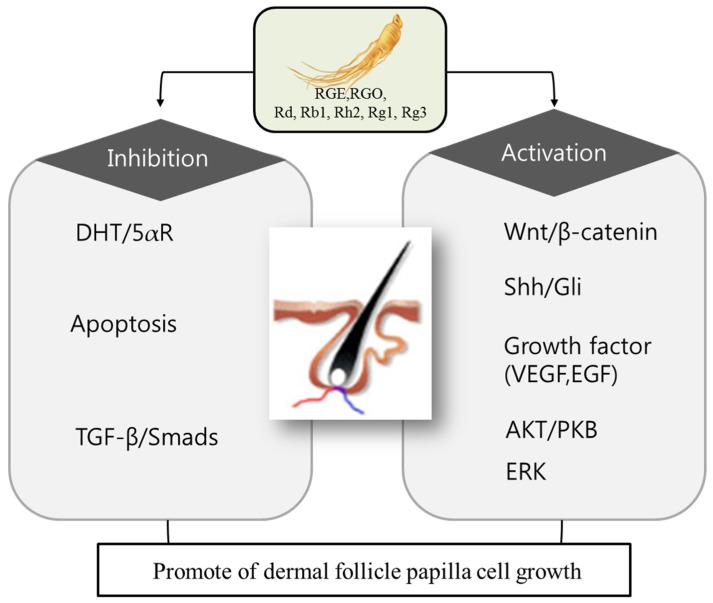
The functional aspect of scalp hair is not only to protect from solar radiation and heat/cold exposure but also to contribute to one's appearance and personality. Progressive hair loss has a cosmetic and social impact. Hair undergoes three stages of hair cycle: the anagen, catagen, and telogen phases. Through cyclical loss and new-hair growth, the number of hairs remains relatively constant. A variety of factors, such as hormones, nutritional status, and exposure to radiations, environmental toxicants, and medications, may affect hair growth. Androgens are the most important of these factors that cause androgenic alopecia. Other forms of hair loss include immunogenic hair loss, that is, alopecia areata. Although a number of therapies, such as finasteride and minoxidil, are approved medications, and a few others (e.g., tofacitinib) are in progress, a wide variety of structurally diverse classes of phytochemicals, including those present in ginseng, have demonstrated hair growth-promoting effects in a large number of preclinical studies. The purpose of this review is to focus on the potential of ginseng and its metabolites on the prevention of hair loss and its underlying mechanisms.
头皮头发的功能不仅在于保护免受太阳辐射和热/冷暴露,还在于影响一个人的外貌和个性。进行性脱发具有美容和社会影响。头发经历三个阶段的头发生长周期:生长期、退行期和休止期。通过周期性的脱发和新发生长,头发数量保持相对恒定。许多因素,如激素、营养状况以及暴露于辐射、环境毒物和药物等,可能会影响头发生长。雄激素是导致雄激素性脱发的最重要因素。其他形式的脱发包括免疫性脱发,即斑秃。尽管有许多疗法,如非那雄胺和米诺地尔,已被批准为药物,还有一些其他药物(如托法替尼)正在研究中,但大量结构多样的植物化学物质,包括人参中的物质,在大量临床前研究中已显示出促进头发生长的作用。本文综述的目的是重点关注人参及其代谢物在预防脱发及其潜在机制中的作用。