Department of Obstetrics and Gynecology, Xi'an Daxing Hospital, Xi'an 710000, Shaanxi, China.
Department of Obstetrics and Gynecology, Affiliated Hospital of Yan'an University, Yan'an 716000, Shaanxi, China.
Contrast Media Mol Imaging. 2021 Nov 8;2021:1673490. doi: 10.1155/2021/1673490. eCollection 2021.
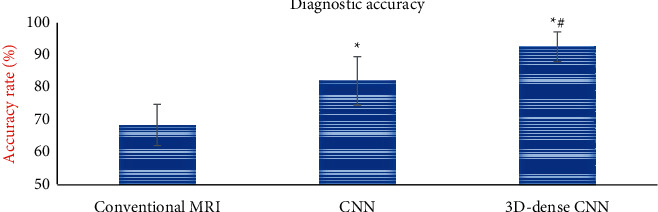
The purpose of this study is to explore the application value of artificial intelligence algorithm in multimodal MRI image diagnosis of cervical cancer. Based on the traditional convolutional neural network (CNN), an artificial intelligence 3D-CNN algorithm is designed according to the characteristics of cervical cancer. 70 patients with cervical cancer were selected as the experimental group, and 10 healthy people were selected as the reference group. The 3D-CNN algorithm was applied to the diagnosis of clinical cervical cancer multimodal MRI images. The value of the algorithm was comprehensively evaluated by the image quality and diagnostic accuracy. The results showed that compared with the traditional CNN algorithm, the convergence rate of the loss curve of the artificial intelligence 3D-CNN algorithm was accelerated, and the segmentation accuracy of whole-area tumors (WT), core tumor areas (CT), and enhanced tumor areas (ET) was significantly improved. In addition, the clarity of the multimodal MRI image and the recognition performance of the lesion were significantly improved. Under the artificial intelligence 3D-CNN algorithm, the Dice values of WT, ET, and CT regions were 0.78, 0.71, and 0.64, respectively. The sensitivity values were 0.92, 0.91, and 0.88, respectively. The specificity values were 0.93, 0.92, and 0.9 l, respectively. The Hausdorff (Haus) distances were 0.93, 0.92, and 0.90, respectively. The data of various indicators were significantly better than those of the traditional CNN algorithm ( 0.05). In addition, the diagnostic accuracy of the artificial intelligence 3D-CNN algorithm was 93.11 ± 4.65%, which was also significantly higher than that of the traditional CNN algorithm (82.45 ± 7.54%) ( 0.05). In summary, the recognition and segmentation ability of multimodal MRI images based on artificial intelligence 3D-CNN algorithm for cervical cancer lesions were significantly improved, which can significantly enhance the clinical diagnosis rate of cervical cancer.
本研究旨在探讨人工智能算法在宫颈癌多模态 MRI 图像诊断中的应用价值。基于传统卷积神经网络(CNN),根据宫颈癌的特点设计了一种人工智能 3D-CNN 算法。选取 70 例宫颈癌患者作为实验组,选取 10 例健康人作为参考组。将 3D-CNN 算法应用于临床宫颈癌多模态 MRI 图像的诊断中,综合评价算法的图像质量和诊断准确率。结果表明,与传统 CNN 算法相比,人工智能 3D-CNN 算法的损失曲线收敛速度加快,全肿瘤区(WT)、核心肿瘤区(CT)和增强肿瘤区(ET)的分割准确率显著提高。此外,多模态 MRI 图像的清晰度和病变的识别性能也显著提高。在人工智能 3D-CNN 算法下,WT、ET 和 CT 区域的 Dice 值分别为 0.78、0.71 和 0.64,灵敏度值分别为 0.92、0.91 和 0.88,特异度值分别为 0.93、0.92 和 0.91,Hausdorff(Haus)距离分别为 0.93、0.92 和 0.90,各指标数据均明显优于传统 CNN 算法( 0.05)。此外,人工智能 3D-CNN 算法的诊断准确率为 93.11 ± 4.65%,也明显高于传统 CNN 算法(82.45 ± 7.54%)( 0.05)。综上所述,基于人工智能 3D-CNN 算法的宫颈癌病变多模态 MRI 图像的识别和分割能力显著提高,可显著提高宫颈癌的临床诊断率。