Seker Fatma Burcu, Fan Ziyu, Gesierich Benno, Gaubert Malo, Sienel Rebecca Isabella, Plesnila Nikolaus
Institute for Stroke and Dementia Research, Munich University Hospital and University of Munich, Munich, Germany.
Munich Cluster for Systems Neurology (SyNergy), Munich, Germany.
Front Neurol. 2021 Nov 11;12:745770. doi: 10.3389/fneur.2021.745770. eCollection 2021.
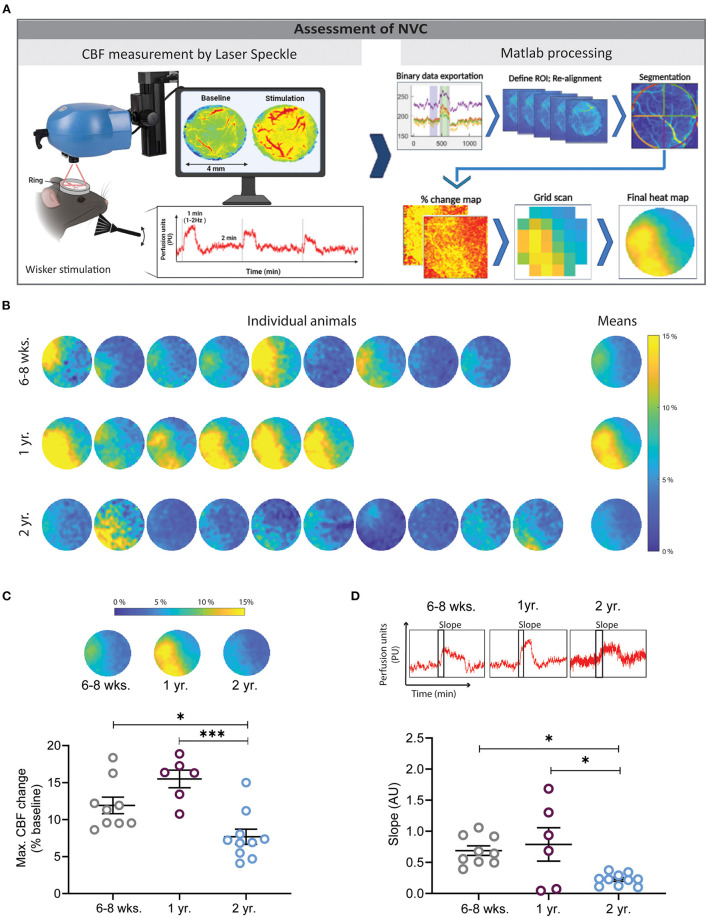
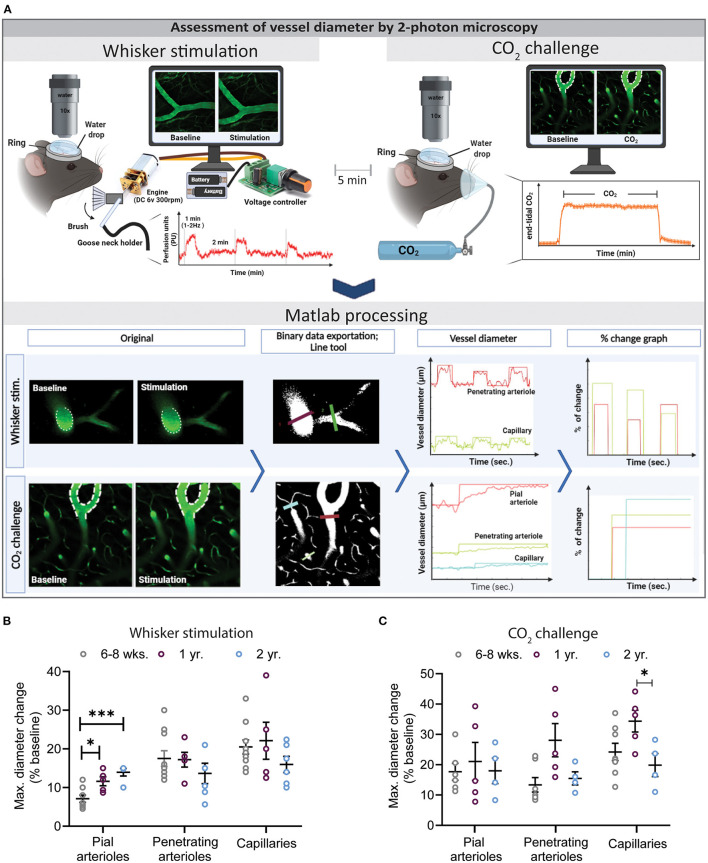
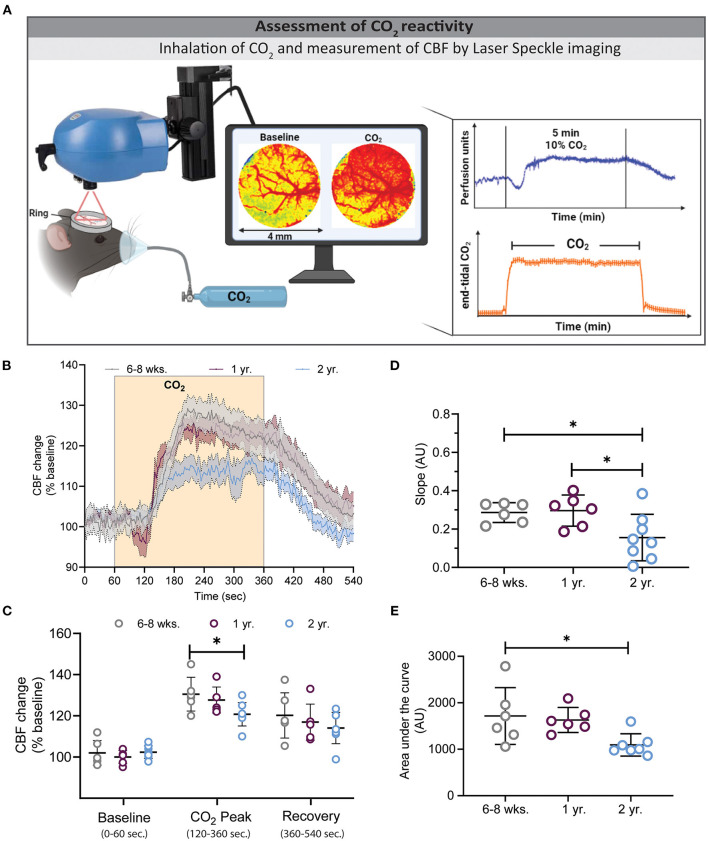
The brain has a high energy demand but little to no energy stores. Therefore, proper brain function relies on the delivery of glucose and oxygen by the cerebral vasculature. The regulation of cerebral blood flow (CBF) occurs at the level of the cerebral capillaries and is driven by a fast and efficient crosstalk between neurons and vessels, a process termed neurovascular coupling (NVC). Experimentally NVC is mainly triggered by sensory stimulation and assessed by measuring either CBF by laser Doppler fluxmetry, laser speckle contrast imaging (LSCI), intrinsic optical imaging, BOLD fMRI, near infrared spectroscopy (NIRS) or functional ultrasound imaging (fUS). Since these techniques have relatively low spatial resolution, diameters of cerebral vessels are mainly assessed by 2-photon microscopy (2-PM). Results of studies on NVC rely on stable animal physiology, high-quality data acquisition, and unbiased data analysis, criteria, which are not easy to achieve. In the current study, we assessed NVC using two different imaging modalities, i.e., LSCI and 2-PM, and analyzed our data using an investigator-independent Matlab-based analysis tool, after manually defining the area of analysis in LSCI and vessels to measure in 2-PM. By investigating NVC in 6-8 weeks, 1-, and 2-year-old mice, we found that NVC was maximal in 1-year old mice and was significantly reduced in aged mice. These findings suggest that NVC is differently affected during the aging process. Most interestingly, specifically pial arterioles, seem to be distinctly affected by the aging. The main finding of our study is that the automated analysis tool works very efficiently in terms of time and accuracy. In fact, the tool reduces the analysis time of one animal from approximately 23 h to about 2 s while basically making no mistakes. In summary, we developed an experimental workflow, which allows us to reliably measure NVC with high spatial and temporal resolution in young and aged mice and to analyze these data in an investigator-independent manner.
大脑对能量的需求很高,但能量储备很少甚至没有。因此,大脑的正常功能依赖于脑循环系统输送葡萄糖和氧气。脑血流量(CBF)的调节发生在脑毛细血管水平,由神经元和血管之间快速有效的相互作用驱动,这一过程称为神经血管耦合(NVC)。在实验中,NVC主要由感觉刺激触发,并通过激光多普勒血流仪、激光散斑对比成像(LSCI)、内在光学成像、血氧水平依赖性功能磁共振成像(BOLD fMRI)、近红外光谱(NIRS)或功能超声成像(fUS)测量CBF来评估。由于这些技术的空间分辨率相对较低,脑血管直径主要通过双光子显微镜(2-PM)评估。关于NVC的研究结果依赖于稳定的动物生理状态、高质量的数据采集和无偏倚的数据分析,而这些标准并不容易实现。在本研究中,我们使用两种不同的成像方式,即LSCI和2-PM评估NVC,并在手动定义LSCI中的分析区域和2-PM中要测量的血管后,使用基于Matlab的独立于研究者的分析工具分析我们的数据。通过研究6-8周龄、1岁和2岁小鼠的NVC,我们发现NVC在1岁小鼠中最大,而在老年小鼠中显著降低。这些发现表明NVC在衰老过程中受到不同的影响。最有趣的是,特别是软脑膜小动脉,似乎受到衰老的明显影响。我们研究的主要发现是,自动分析工具在时间和准确性方面工作非常高效。事实上,该工具将一只动物的分析时间从大约23小时减少到约2秒,同时基本不产生错误。总之,我们开发了一种实验工作流程,使我们能够在年轻和老年小鼠中以高空间和时间分辨率可靠地测量NVC,并以独立于研究者的方式分析这些数据。