Department of Neuroscience, University of Copenhagen, Blegdamsvej 3B, 2200, Copenhagen, Denmark.
Department of Neurosurgery, Rigshospitalet, Copenhagen, Denmark.
Fluids Barriers CNS. 2021 Dec 4;18(1):54. doi: 10.1186/s12987-021-00289-6.
Idiopathic normal pressure hydrocephalus (iNPH) is a potentially reversible neurological condition of unresolved etiology characterized by a clinical triad of symptoms; gait disturbances, urinary incontinence, and cognitive deterioration. In the present study, we aimed to elucidate the molecular coupling between inflammatory markers and development of iNPH and determine whether inflammation-induced hyperactivity of the choroidal Na/K/2Cl cotransporter (NKCC1) that is involved in cerebrospinal fluid (CSF) secretion could contribute to the iNPH pathogenesis.
Lumbar CSF samples from 20 iNPH patients (10 with clinical improvement upon CSF shunting, 10 without clinical improvement) and 20 elderly control subjects were analyzed with the novel proximity extension assay technique for presence of 92 different inflammatory markers. RNA-sequencing was employed to delineate choroidal abundance of the receptors for the inflammatory markers found elevated in the CSF from iNPH patients. The ability of the elevated inflammatory markers to modulate choroidal NKCC1 activity was determined by addition of combinations of rat version of these in ex vivo experiments on rat choroid plexus.
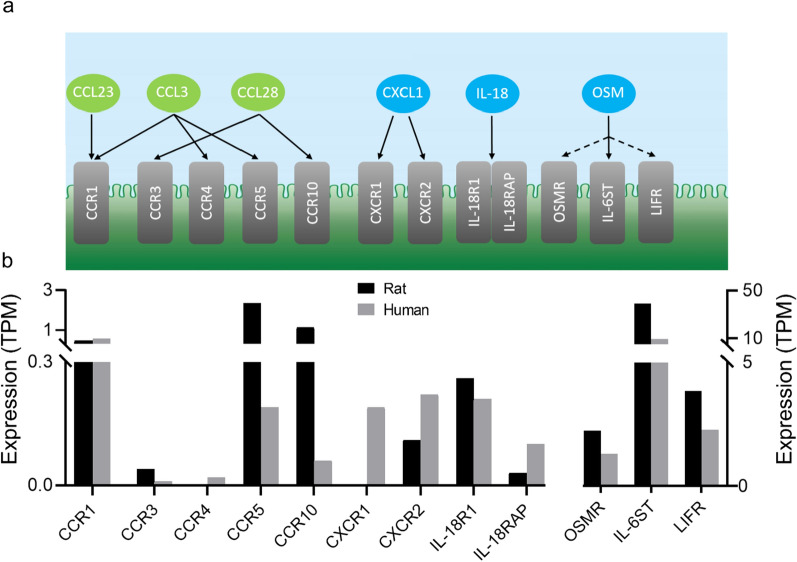
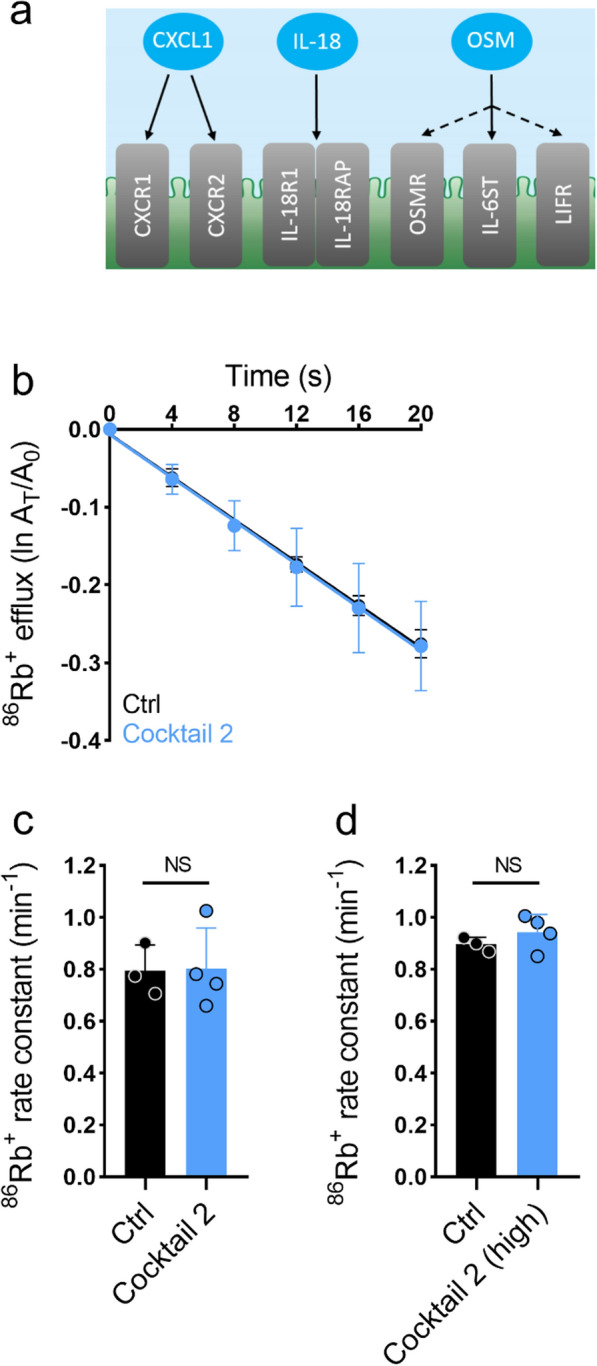
11 inflammatory markers were significantly elevated in the CSF from iNPH patients compared to elderly control subjects: CCL28, CCL23, CCL3, OPG, CXCL1, IL-18, IL-8, OSM, 4E-BP1, CXCL6, and Flt3L. One inflammatory marker, CDCP1, was significantly decreased in iNPH patients compared to control subjects. None of the inflammatory markers differed significantly when comparing iNPH patients with and without clinical improvement upon CSF shunting. All receptors for the elevated inflammatory markers were expressed in the rat and human choroid plexus, except CCR4 and CXCR1, which were absent from the rat choroid plexus. None of the elevated inflammatory markers found in the CSF from iNPH patients modulated the choroidal NKCC1 activity in ex vivo experiments on rat choroid plexus.
The CSF from iNPH patients contains elevated levels of a subset of inflammatory markers. Although the corresponding inflammatory receptors are, in general, expressed in the choroid plexus of rats and humans, their activation did not modulate the NKCC1-mediated fraction of choroidal CSF secretion ex vivo. The molecular mechanisms underlying ventriculomegaly in iNPH, and the possible connection to inflammation, therefore remains to be elucidated.
特发性正常压力脑积水(iNPH)是一种潜在可逆转的、病因不明的神经学疾病,其特征为三联征,即步态障碍、尿失禁和认知功能恶化。在本研究中,我们旨在阐明炎症标志物与 iNPH 发展之间的分子偶联,并确定是否炎症诱导的脉络丛 Na+/K+/2Cl-共转运蛋白(NKCC1)活性亢进,这与脑脊液(CSF)分泌有关,可能导致 iNPH 的发病机制。
对 20 例 iNPH 患者(10 例经 CSF 分流术治疗后临床改善,10 例无临床改善)和 20 例老年对照组的腰椎 CSF 样本进行了新型邻近延伸分析技术检测,以分析 92 种不同的炎症标志物。采用 RNA 测序技术对在 iNPH 患者 CSF 中升高的炎症标志物的受体在脉络丛中的丰度进行了描述。通过在大鼠脉络丛上进行离体实验,加入这些炎症标志物的组合,确定了升高的炎症标志物对脉络丛 NKCC1 活性的调节作用。
与老年对照组相比,iNPH 患者的 CSF 中 11 种炎症标志物显著升高:CCL28、CCL23、CCL3、OPG、CXCL1、IL-18、IL-8、OSM、4E-BP1、CXCL6 和 Flt3L。iNPH 患者的 CSF 中 CDCP1 标志物显著低于对照组。在比较 CSF 分流术治疗后 iNPH 患者的临床改善与无临床改善的患者时,没有一种炎症标志物存在显著差异。在大鼠和人脉络丛中均表达了所有升高的炎症标志物的受体,除 CCR4 和 CXCR1 外,它们不存在于大鼠脉络丛中。在大鼠脉络丛的离体实验中,未发现 iNPH 患者 CSF 中升高的任何炎症标志物调节脉络丛 NKCC1 活性。
iNPH 患者的 CSF 中存在升高的炎症标志物。虽然一般来说,这些炎症标志物的相应受体在大鼠和人类脉络丛中表达,但它们的激活并不能调节体外 NKCC1 介导的脉络丛 CSF 分泌。因此,iNPH 患者脑室扩大的分子机制,以及与炎症的可能联系,仍有待阐明。