Wu Jun, Xie Mei, Lai Yao, Mao Yanhui, Harmat Laszlo
School of Foreign Languages, Southwest Jiaotong University, Chengdu, China.
School of Economics and Management, Southwest Jiaotong University, Chengdu, China.
Front Psychol. 2021 Nov 16;12:743906. doi: 10.3389/fpsyg.2021.743906. eCollection 2021.
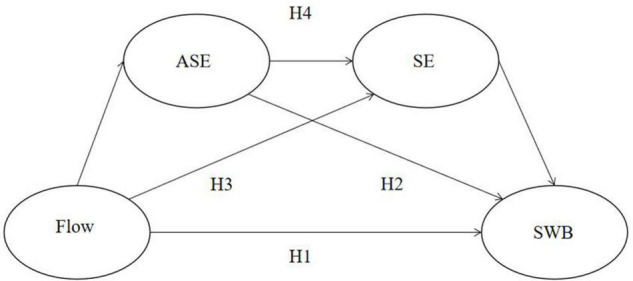
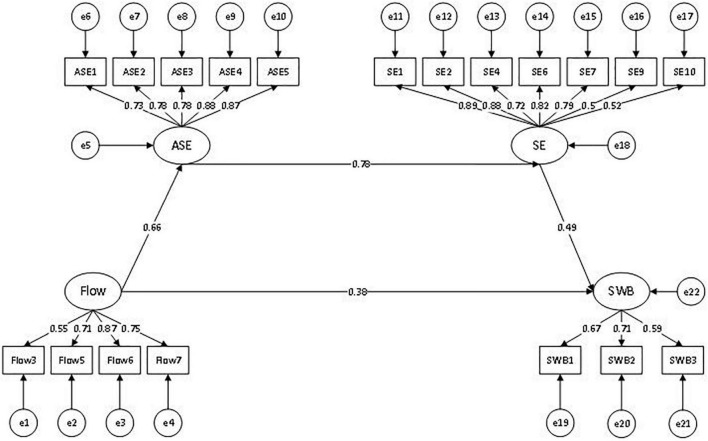
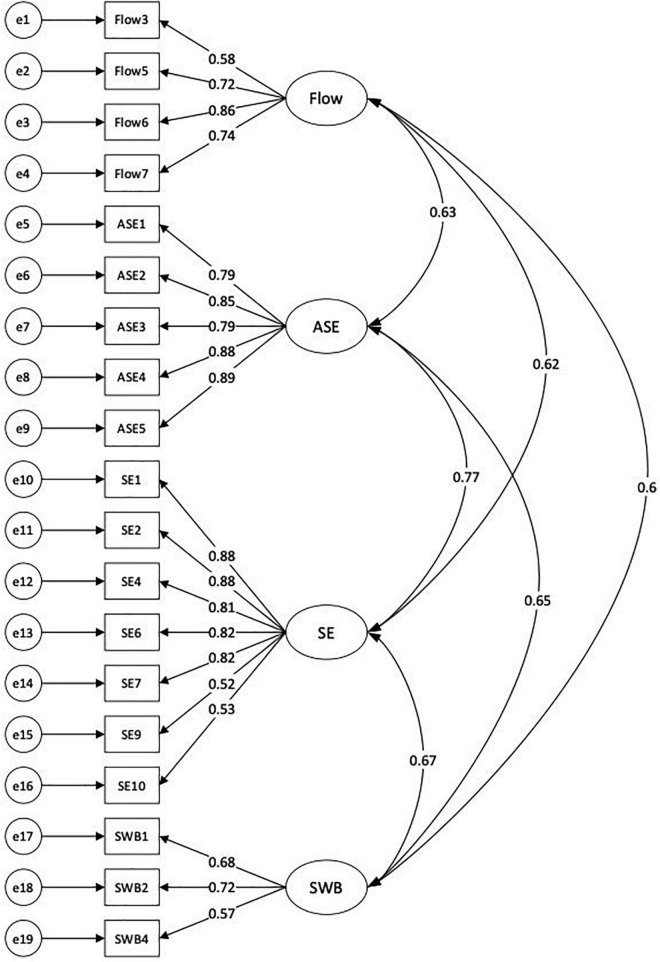
The present study investigated a conceptual model by testing flow experience and subjective well-being of university students during Coronavirus Diseas-19 (COVID-19) considering their underlying mechanisms of academic self-efficacy and self-esteem. A total of 1,109 Chinese university students completed a questionnaire containing scales of subjective well-being, flow, academic self-efficacy, and self-esteem. Results yielded from the structural equation modeling analysis indicated a significant and positive association between flow experience and subjective well-being, and such an association was sequentially mediated by academic self-efficacy and self-esteem. Findings also provided empirical evidence for the proposed model highlighting the significant role of flow experience at the higher educational context in predicting subjective well-being of Chinese university students, and how such a relation can be supported by suggested mediating roles academic self-efficacy and self-esteem played.
本研究通过考察大学生在新型冠状病毒肺炎(COVID-19)疫情期间的沉浸体验和主观幸福感,并考虑其学业自我效能感和自尊的潜在机制,对一个概念模型进行了检验。共有1109名中国大学生完成了一份包含主观幸福感、沉浸体验、学业自我效能感和自尊量表的问卷。结构方程模型分析结果表明,沉浸体验与主观幸福感之间存在显著的正相关,且这种关联依次由学业自我效能感和自尊介导。研究结果还为所提出的模型提供了实证证据,突出了沉浸体验在高等教育背景下对预测中国大学生主观幸福感的重要作用,以及学业自我效能感和自尊所起的中介作用如何支持这种关系。